Synopsis: Schooling reforms raise qualification requirements to degree level while international partners fund new pedagogical institutes and foundational literacy schemes across provinces.
Cambodia must expand investment in teacher quality, modern instructional methods and STEM education to prepare students for modern challenges, Education, Youth and Sport Minister Hang Chuon Naron said Monday.
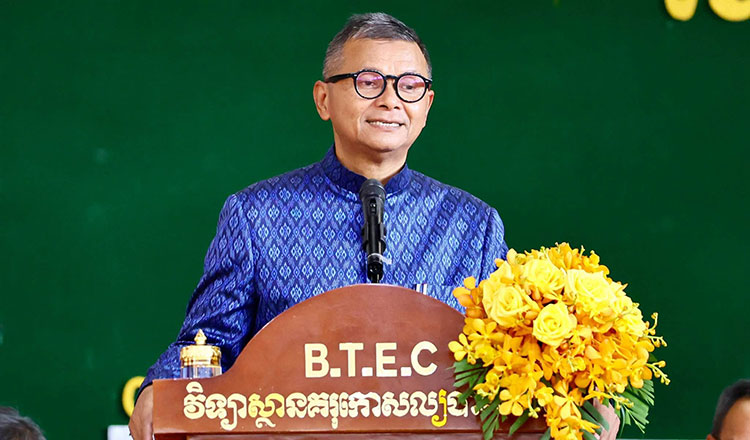
Speaking at the closing ceremony of the First International Forum on 21st Century Teacher Education at Battambang Pedagogical Institute, Naron said 13 years of school and teaching reforms have produced positive results.
Assessments from the 2024 Southeast Asia Primary Learning Metrics and 2025 Programme for International Student Assessment (PISA) showed improvements across reading, mathematics and science. Cambodia recorded a 52-point jump in science during the PISA 2025 assessment, marking the highest point gain globally.
To boost instructor capacity, the ministry upgraded qualification requirements from the 12+2 system to a 12+4 system, elevating standard credentials to a bachelor’s degree level. It established foundational reading and mathematics programmes alongside teacher scholarships worth 70% of basic salary to recruit candidates holding grades A, B and C.
Naron said the Japan International Cooperation Agency and the Japanese government have supported teacher training courses in Japan and funded Cambodian pedagogical institutes, including a new facility in Kampong Cham and centres in Phnom Penh and Battambang.
He said it is necessary to strengthening physical infrastructure, classroom equipment and teaching methodologies is necessary to train educators capable of delivering modern instruction.
The two-day forum was conducted under the theme “Teacher Education on a New Education Pathway: From Foundational Literacy and Numeracy to Inclusive and Resilient STEM Innovation”.
Naron attributed the nation’s learning improvements to school reforms, student meal programmes, disadvantaged student aid and expanded early childhood education access, which rose from 57% to 75%.