The Extraordinary Chambers in the Courts of Cambodia (ECCC) has highlighted Cambodia’s experience in delivering justice for crimes committed under the Khmer Rouge regime, with legal experts and victims discussing how the country’s transitional justice model could offer lessons for the future of international justice.
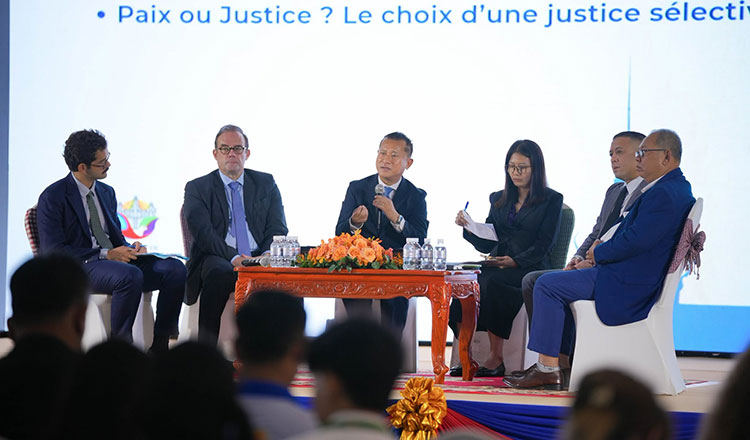
The discussion was held on Sunday at the Francophonie Village in Wat Botum Park, Phnom Penh, under the theme, “Cambodia as an Innovative Model for Transitional Justice: How Can Cambodia’s Experience Inspire the Future of International Justice?”, as part of the 20th Francophonie Summit hosted by Cambodia.
Hem Kranh Tony, Secretary of State at the Office of the Council of Ministers and Acting Director of Administration of the ECCC, said the establishment of the tribunal and prosecution of former Khmer Rouge leaders had helped Cambodians find closure and address victims’ suffering.
“Without the presence of the Khmer Rouge tribunal in Cambodia and the prosecution of Khmer Rouge leaders, our pain would have continued indefinitely.
However, through the ECCC, with the participation of the international community, we have been able to find closure and take great pride in the pursuit of justice,” he said.
He said the mass killings and forced evacuation of people from Phnom Penh were part of deliberate policies pursued by the Khmer Rouge leadership, urging younger generations to learn about the country’s history, including the killings, starvation and torture endured by victims.
He also thanked the United Nations for its support to Cambodia since 1993 and the French Government for its contribution to the tribunal’s work.
Ti Sreynna, Civil Party Lead Co-Lawyer, said the ECCC’s judicial decisions, particularly those concerning sentencing and reparations for victims, were important for Cambodian society.
She said the tribunal’s significance extended beyond its verdicts to establishing the truth for victims through judicial proceedings, creating a legal legacy for future generations and gaining international recognition.
Sreynna also highlighted the tribunal’s decision on forced marriage as a significant achievement, noting that the case originated from requests and advocacy by victims themselves.
She said the judicial recognition of forced marriage demonstrated the importance of victims’ participation in the justice process and helped establish a lasting legal legacy.
The roundtable also featured Judge Olivier Beauvallet, International Judge of the ECCC Pre-Trial Chamber; Hicham Moussar, Dean of the Faculty of Law at the American University of Phnom Penh; and Yin Romduol, a Civil Party in Case 002/01 before the ECCC.
The speakers discussed the ECCC’s judicial model, victims’ participation and the tribunal’s legacy, highlighting the importance of hybrid courts, accountability, historical memory and education in promoting sustainable peace.