The Ministry of Culture and Fine Arts stated on Sunday, strongly rejected Thai Minister of Culture, Sabeeda Thaised remarks.
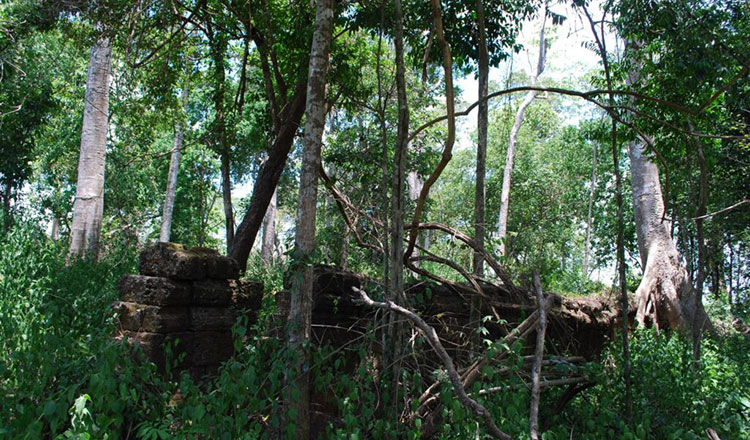
The ministry refutes the minister’s remarks, as published in the Khaosod newspaper, claiming that K’nar temple and Ta Krabey temple are located within Thai territory and registered these temples on its national heritage list under its domestic laws, taking administrative measures to manage and conserve them accordingly.
It also refused to return the artefacts unilaterally removed from the temples, under the pretext that taking them was intended for study, maintenance, and conservation.
The ministry categorically dismisses the above claims as lacking any basis in international law, and wishes to clarify and emphasise the following points:
Firstly, K’nar and Ta Krabey temples, and several other temples along the Cambodia-Thailand border, under unlawful control by the Thai military, were constructed by Khmer ancestors and are located within Cambodia.
This is fully compliant with the 1:200,000 scale map resulting from the demarcation works of the Commissions of Delimitation of the Boundary between Indo-China and Siam, produced in the spirit of the 1907 Franco-Siamese Convention. The Thai side has consistently recognised and adhered to this map, as evidenced in the 2003 Terms of Reference (TOR 2003) and various agreed-upon technical records. The International Court of Justice (ICJ) affirmed and recognised the map’s validity in 1962 and 2013, and Thailand’s challenges were rejected. Following the border conflict initiated by Thailand last year, they declared non-recognition of the map’s validity.
Secondly, the examination of the Series L7017 map, unilaterally drawn by the Thai military, devoid of legal value under international law, contrary to the spirit of the two ICJ judgments, and consistently objected to by Cambodia, shows that these temples are depicted as lying within Cambodian territory, providing undeniable evidence.
Thirdly, administrative measures taken by Thailand, such as listing these temples on its national heritage roster and claiming management and conservation rights without Cambodia’s consent, constitute deliberate attempts to create a fait accompli on the ground. Under international law, such actions do not constitute lawful administration, do not create
inviolable ownership rights, and cannot prevail over Cambodia’s lawful sovereignty and Territorial Title, which is grounded in the principle of border stability (uti possidetis juris), historical boundary maps, treaties, and prior agreements.
Fourthly, the unilateral collection and removal of artefacts from these temple areas, unlawfully occupied by the Thai military and without Cambodia’s consent, violates existing international legal norms. These include state obligations, prohibiting the seizure or removal of cultural property from a sovereign territory of another state or from unlawfully occupied zones under the 1954 Hague Convention, the 1972 World Heritage Convention, and various UNESCO instruments concerning the conservation of cultural property and monument sites.
Furthermore, these illegal actions are viewed as intentional attempts to alter the border environment, destroy technical evidence, and modify the original topography of the border zone. This directly contradicts Article 5 of the 2000 Memorandum of Understanding (MOU 2000), which mandates that only the Joint Boundary Commission (JBC) framework possesses the authority to conduct activities related to boundary survey and demarcation on the ground.
Lastly, these actions provoke unnecessary tension along the border, undermining prior agreements and commitments made by both nations to rebuild and restore mutual trust, most notably the Joint Statement on 27 December last year and subsequent agreements. In this regard, the ministry deeply regrets that the Thailand Ministry of Culture continues to engage in actions that damage trust, good-neighbourly relations, and respect for sovereignty, which are vital for restoring normalised relations between both nations for the ultimate benefit of our peoples.
The ministry firmly calls upon Thailand to immediately cease all unauthorised activities at Cambodian cultural heritage sites, to return of archaeological objects removed from the temples, and to fully respect Cambodia’s sovereignty, territorial integrity, and cultural heritage.
Cambodia urges Thailand to resume the work of the Joint Boundary Commission (JBC) without delay and to resolve all outstanding boundary issues peacefully, through dialogue and in accordance with international law and applicable bilateral agreements. Cambodia remains committed to peaceful resolutions of disputes and protection of cultural heritage for future generations.