Synopsis: Phnom Penh intercepts millions in a collaborative effort with Singapore, even as a rights group reports links between scam compounds and the Kingdom’s security forces.
Cambodia’s effort to restore its reputation from online scam hub allegations gained momentum last week with the freezing of over $12 million from a scam operation, which analysts praised as a significant achievement in combating modern fraud.
However, organisations such as Amnesty International and Nikkei Asia continued to express scepticism, suggesting that the Kingdom is still not doing enough to eradicate online scams.
On Thursday, the General Commissariat of National Police said it had intercepted funds resulting from a business email scheme, totalling $12.8 million. The enforcement resulted from close cooperation between Cambodian authorities and the Singapore Police Force.
According to the statement, the Singapore Police Force was informed last Monday that a petrochemical company in Singapore had been defrauded into transferring $12.8 million to a suspicious bank account based in Cambodia.
A preliminary investigation revealed that suspects used a counterfeit email address to deceive the company into executing the fund transfer. Immediately following this, the Singapore Police Force requested cooperation from the General Commissariat of National Police, assisted by the hotline scam working group, to conduct an investigation.
“Through this collaborative effort, the General Commissariat of National Police coordinated with the National Bank of Cambodia and other relevant institutions to successfully intercept the aforementioned funds and transfer the money back to the victim,” the statement said.
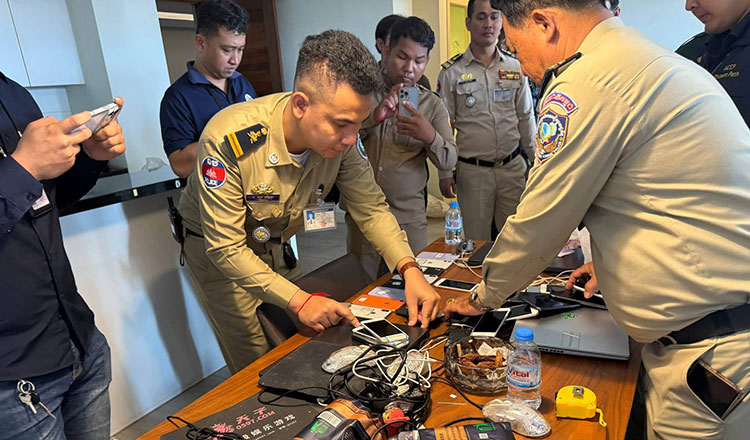
Police raid a building suspected of housing online scam operations. Police
It said the successful cooperation reflected the capacity, efficiency and strong commitment of the General Commissariat of National Police to engage in international cooperation to prevent and suppress transnational crimes and online scams.
“The General Commissariat of National Police highly appreciates the Singapore Police Force, the National Bank of Cambodia, and relevant institutions for providing excellent collaboration in effectively combating online scams,” it added.
Singaporean police advised businesses in a statement to remain careful about falling for business email compromise scams. They recommended verifying any new or sudden changes in payment instructions by directly contacting suppliers and business partners through trusted numbers, rather than relying solely on email.
Economist Ky Sereyvath said Cambodia had taken a significant step in combating cybercrime by detecting a scam and returning the money to Singapore. He added that the action demonstrated political will and supported initiatives such as the Phnom Penh Declaration ratified by over 20 countries at the international anti-scam conference hosted by the Kingdom last month.
“Returning the money demonstrates Cambodia’s commitment, and this news will spread globally,” he said.
“This will further highlight our efforts to combat online scams, and Cambodia will move towards becoming one of the countries with the lowest prevalence of scams in the world, with the aim of attracting tourists back to the country.”
Despite this progress, human rights watchdog Amnesty International released a report titled “Official Business: Security Companies and Authorities at Scamming Compounds in Cambodia”, which identifies five private security companies that provided services at scamming compounds and details their links to members of Cambodia’s military, police and business elites.
The group also accused multiple members of the military and police of working as security guards, trained or supervised guards, at more than 20 compounds.
“For years, survivors of these nightmarish compounds described encountering members of the Cambodian military or police inside. These accounts could not be independently verified – until now,” said Amnesty International secretary-general Agnes Callamard.
“This report demonstrates Cambodian corporate actors’ direct involvement in scamming compounds. Our findings also begin to expose the long-suspected links between Cambodia’s billion-dollar criminal scamming networks and politically connected figures who have remained largely beyond scrutiny.”
The Amnesty report also connects various prominent business and political figures to these security companies – including a former bank CEO, a property developer and the son of a former deputy prime minister.
According to the paper, survivors consistently described guards as responsible for preventing escape, while many reported guards beating people who attempted to flee. Survivors also described guards administering electric shocks and beatings, detaining people in dark rooms and standing guard while compound managers raped women.
At the compound Park 8, also known as PV01, “Maia,” a woman from Cameroon, said guards restrained her on arrival and later took her to a dark room where managers raped her while guards stood outside. “Gabe,” a Ugandan survivor at the same compound, described being chained above basins of water, beaten for hours and shocked with an electric baton.
The group said it has videos to back its findings.
“The evidence suggests military and police involvement in a number of scamming compounds that helps explain how abuses at sites persisted despite years of public reporting and repeated law enforcement operations,” Callamard said.
The report was later picked up by Japan-based outlet Nikkei Asia, which prompted a response from the Cambodian Embassy in Tokyo.
In a statement released on Saturday, the embassy said that under the leadership of Prime Minister Hun Manet, the government has undertaken comprehensive nationwide measures – including strengthening legal and institutional mechanisms, establishing the Commission for Combating Online Scams, intensifying law enforcement operations, investigating criminal networks, and enhancing cooperation with international partners.
According to official figures released by Cambodian authorities, from July 2025 to August 31, 2026, 832 suspected locations were inspected, with crackdown operations conducted at 663 locations, including 86 major scam compounds brought under authorities’ control. Among those, four cases involving 15 public officials and law enforcement personnel were subject to legal action in connection with online scam activities.
During the same period, 446 criminal cases involving 3,927 suspects were referred to courts for legal proceedings, while bank accounts containing more than $300 million in funds suspected of being linked to online scam activities were frozen. Furthermore, 27 casinos faced regulatory enforcement measures, including licence revocations and suspensions.
In addition, the Ministry of Interior reported in September that disciplinary measures had been taken against 77 police officers in connection with online scam cases.
“Allegations of criminal misconduct are subject to investigation and appropriate legal procedures, with responsibility to be determined on the basis of evidence and in accordance with the law,” the embassy said.
“Beyond these enforcement achievements, the government remains steadfast in its commitment to combating online scams through a comprehensive and sustained approach.”
The embassy added that these efforts include dismantling criminal networks, pursuing organisers, disrupting illicit financial flows, strengthening institutional capacity and accountability, enhancing coordination among competent authorities, protecting victims of human trafficking, and expanding cooperation with regional and international partners.
Through these measures, the embassy said, Cambodia aims not only to suppress criminal activities and prevent their recurrence but also to safeguard public security and maintain a safe, transparent and favourable environment for legitimate business and investment.
It also stressed that online scams constitute a complex transnational challenge requiring sustained vigilance and cooperation, as law enforcement authorities carry on investigations and crackdowns, particularly against smaller and more concealed criminal networks.
“The embassy reaffirms Cambodia’s determination to combat these crimes, uphold the rule of law, protect victims and strengthen cooperation with Japan and other international partners,” the embassy said.
“The embassy encourages objective, balanced and fact-based reporting that recognises both the seriousness of transnational online scam activities and the concrete measures and sustained efforts undertaken by the government to combat these crimes.”