Synopsis: As the nation prepares to graduate from least developed country category in 2029, the government calls on international partners for sustainable support, as IMF research indicates success will depend on domestic adaptability rather than graduation itself.
Cambodia has called for predictable and long-term development financing while urging the international community to provide targeted support as the country prepares to graduate from Least Developed Country (LDC) status in 2029.
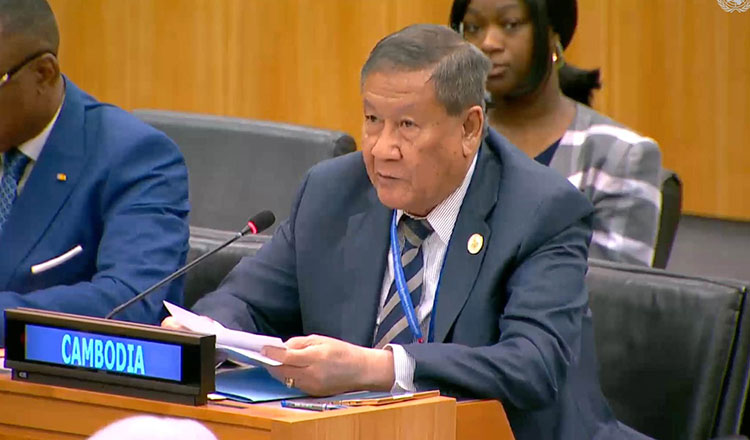
Speaking during the General Debate of the Second Committee of the 81st session of the United Nations General Assembly in New York on Monday, Cambodian Ambassador and Permanent Representative to the United Nations Keo Chhea said international cooperation is needed to accelerate progress towards the Sustainable Development Goals (SDGs).
The debate took place under the theme “Financing development in a globally changing economy to accelerate SDG implementation”.
“With 2030 fast approaching, achieving our shared Sustainable Development Goals remains a distant reality,” Chhea said, stressing the need for collective efforts to meet the global development agenda.
He said predictable and long-term financing must be ensured and distributed equitably, calling for the timely implementation of the Compromiso de Sevilla and welcoming efforts by multilateral development banks and development partners to improve financing conditions for developing countries.
Chhea highlighted the importance of South-South, North-South and triangular cooperation in supporting sustainable growth.
“By pooling technical expertise, sharing innovative practices, and facilitating technology transfers, we can address shared global challenges more efficiently,” he said.
Cambodia is scheduled to graduate from the LDC category in 2029, a transition that Chhea said creates structural challenges linked to concessional financing, trade preferences and official development assistance.
“Therefore, Cambodia calls for targeted support for the smooth LDC transitions and strengthened partnerships and appropriate post-graduation assistance to ensure continued sustainability,” he said.
Cambodia’s appeal comes as developing countries face the challenge of mobilising resources to meet the SDGs while navigating changes in the global economic and development financing landscape.
Chhea said Cambodia remains committed to contributing to sustainable development and working with UN member states and international partners to advance shared development objectives.
“Cambodia is committed to doing its part to finance sustainable development and stand ready to work closely with all Member States and partners toward these shared objectives,” he said.
Only eight economies have graduated from the United Nations status of least developed country since 1994: Botswana (1994), Cabo Verde (2007), the Maldives (2011), Samoa (2014), Equatorial Guinea (2017), Vanuatu (2020), Bhutan (2023) and São Tomé and Príncipe (2024).
Cambodia’s graduation from LDC status in 2029 is unlikely to determine the country’s future growth on its own, but the transition could create pressure on trade-dependent sectors unless firms and institutions adapt, according to the International Monetary Fund (IMF).
In a report on Cambodia, IMF economists Sylwia Nowak and Zhu Liangliang examined the experience of the eight economies that have graduated from LDC status since 1994.
The economists found that the experiences of these countries do not indicate that LDC graduation results in either faster or slower economic growth.
Excluding Equatorial Guinea, whose growth relies heavily on its oil and gas sector, the eight graduates recorded average real GDP growth of around 2.9% in both the five years before and after graduation.
“These patterns do not support treating graduation itself as the main driver of future growth,” the IMF said. “But they also caution against assuming that past growth drivers will continue to deliver at the same pace.”
The IMF noted that outcomes among previous graduates were shaped by factors including commodity cycles, tourism dependence, natural disasters and the COVID-19 pandemic.
The IMF stated that graduation would not be cost-free for Cambodia, but its economic impact depends largely on the country’s exposure to the loss of preferences and its capacity to adjust.
- Tags: Cambodia, Development