Synopsis: Delegations led by Foreign Ministers Prak Sokhonn and Sihasak Phuangketkeow meet behind closed doors next week under the UNCLOS conciliation framework to advance technical delimitation and resource-sharing discussions.
Cambodia and Thailand will resume negotiations over their disputed maritime boundary in Kuala Lumpur next week, with Phnom Penh seeking a peaceful, law-based settlement through compulsory conciliation under the United Nations Convention on the Law of the Sea (UNCLOS), as Prime Minister Hun Manet restated Cambodia’s resolve for a boundary that promotes cooperation and protects both nations.
The four-day meeting from November 24 to 27 will bring together the five-member Conciliation Commission and representatives of both countries for a third round of discussions on the maritime boundary, particularly its technical aspects, and identify areas of common understanding and agreement, according to announcements issued by the Cambodian and Thai foreign ministries and the Permanent Court of Arbitration (PCA) on Wednesday.
The Cambodian delegation will be led by its agent, Foreign Affairs and International Cooperation Minister Prak Sokhonn, accompanied by chief negotiator Justice Minister Koeut Rith, and deputy agent Lam Chea, minister in charge of the State Secretariat of Border Affairs, alongside other officials and the legal team.
Thailand’s delegation will be led by Foreign Minister Sihasak Phuangketkeow as agent, together with Deputy Prime Minister Pakorn Nilprapunt serving as an adviser.
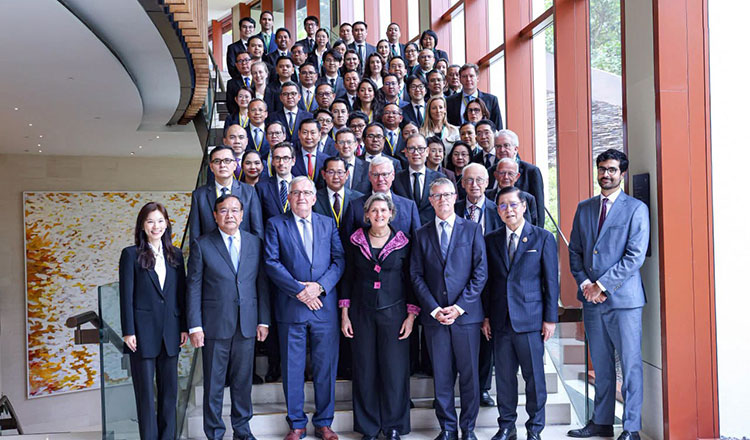
Foreign Affairs and International Cooperation Minister Prak Sokhonn (C) at the second meeting of the United Nations Convention on the Law of the Sea Conciliation Commission in Kuala Lumpur in September. AKP
The Thai side will also include Songchai Chaipatiyut, director-general of the Department of Treaties and Legal Affairs, as deputy agent, as well as Foreign Ministry representatives and technical experts from the Royal Thai Navy’s Hydrographic Department and Naval Operations Department, and the Ministry of Energy’s Department of Mineral Fuels.
The upcoming session marks another step in the peaceful process initiated by Cambodia to resolve the maritime differences between the two neighbours, following previous meetings in Singapore in September and The Hague in October.
In a press statement, Cambodia’s Foreign Ministry described the upcoming meeting as “another positive step in the peaceful process initiated by Cambodia to resolve the two countries’ maritime differences”.
“Building on the momentum from previous meetings, the Commission and the Parties will advance discussions on the delimitation of the maritime boundary, with a particular focus on its technical aspects,” the ministry said, adding that the session would provide an opportunity to identify areas of common understanding and agreement.
The PCA, which serves as the registry for the proceedings with the agreement of both countries, echoed that outlook.
“Drawing on the productive exchanges held at previous meetings, the Commission and the Parties will advance discussions on the delimitation of the maritime boundary between the two States, with a particular focus on its technical aspects,” the PCA said. “The session will also provide an opportunity to identify further areas of common understanding and agreement.”
The Kuala Lumpur meeting will be held in camera, meaning behind closed doors, the PCA said.
Cambodia’s stated objective in the proceedings is to conclude a treaty with Thailand delimiting a single, all-purpose maritime boundary between the two states, or reach an agreement on the joint development and equitable sharing of resources pending a final boundary treaty.
“If neither of these options are achieved, Cambodia would then request the Commission to prepare recommendations that could serve as the basis for future negotiations, in accordance with both countries’ obligations under UNCLOS,” the Cambodian Foreign Ministry said.
Cambodia also stood by the confidence-building measures agreed during the previous meeting in The Hague in October.
“Cambodia once again expresses its appreciation to the chairperson and to the distinguished members of the Commission for their considered approach and reiterates its firm commitment to the confidence-building measures agreed at the last meeting in The Hague in October 2026,” the ministry said, adding that it would participate “in a spirit of good faith, cooperation and mutual respect” towards a fair outcome.
Thailand, meanwhile, said it was ready to continue cooperating with the Commission and supporting its work.
“The third meeting will build on discussions from the second meeting, in particular on technical aspects of maritime delimitation,” Thailand’s Foreign Ministry said. “As a State Party to UNCLOS, Thailand stands ready to continue its cooperation with and support to the work of the Commission.”
Cambodia initiated the compulsory conciliation proceedings on June 2 through a notification under Article 11 of Annex V of UNCLOS, addressed to Thailand pursuant to Article 298 of the convention, following Bangkok’s unilateral termination of their 2001 bilateral maritime agreement. Thailand submitted its response on June 19.
The five-member Conciliation Commission is chaired by Australian diplomat Katrina Cooper, alongside Ambassador Peter Taksoe-Jensen of Denmark, Professor Jean-Marc Thouvenin of France, Judge Albert Hoffmann of South Africa and Judge Rudiger Wolfrum of Germany.
The Commission held its first meeting with the parties in Singapore from September 14 to 16, followed by the second session in The Hague from October 14 to 18, where both countries finalised a set of confidence-building measures.
Mr Hun Manet has reiterated Cambodia’s resolve to settle its maritime differences with Thailand through international law, noting that the country seeks a cooperative boundary rather than confrontation.
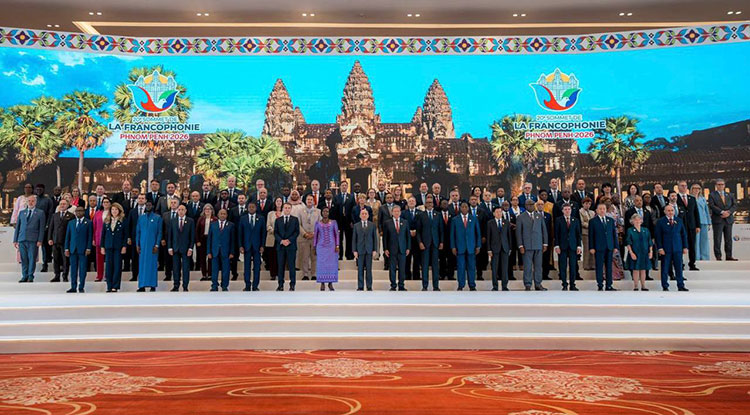
Speaking at the opening of the 20th Francophonie Summit on November 15, Mr Hun Manet said Cambodia had chosen compulsory conciliation under UNCLOS to address the maritime issue, describing Thailand’s participation in the process as “a sign of hope”.
“Our intention is clear. We want a border of peace and cooperation with Thailand. A border that protects both our countries and brings our peoples closer together,” he said.
He said that “no border should be changed by force or through a fait accompli”, adding that respect for international law guarantees the security of all states, regardless of their size.
Drawing a parallel to regional diplomatic history, Sokhonn has noted that a similar framework resolved a seemingly intractable maritime deadlock between Timor-Leste and Australia.
In April 2016, Timor-Leste initiated the first-ever UNCLOS compulsory conciliation under Annex V of the convention to resolve its maritime boundary dispute with Australia. The process concluded on March 6, 2018, when both nations signed the historic Maritime Boundary Treaty at the UN headquarters in New York.