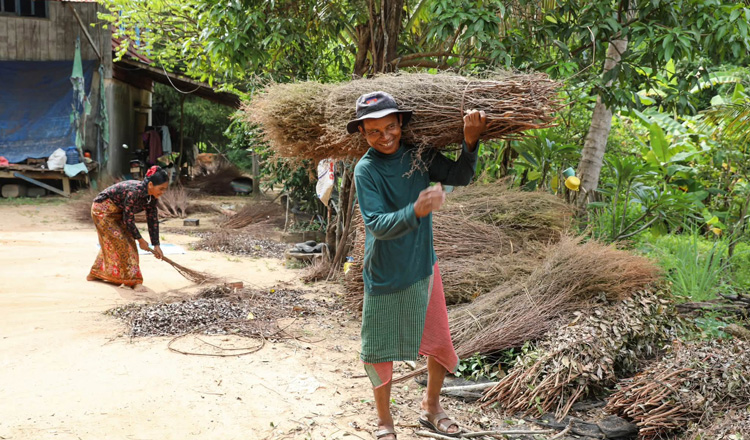
Brooms are essential everyday household items for sweeping and cleaning houses, courtyards, roads, and other areas. Although brooms can be made from various plants, residents of Samrong village, Liang Dai commune, Angkor Thom district, traditionally make them from two particular plants known locally as Puoch and Mrech Tonsay.
Roeum Saroe is from one of the several families in the village who earn a living by making and selling brooms. To obtain the raw materials, he travels to different forest areas to collect and cut the plants. Nowadays, he has to travel to Stoung district, Kampong Thom province, as the forest resources around his village have become increasingly scarce.
He explained that each trip takes at least 10 days to collect enough Puoch and Mrech Tonsay plants to fill a motorised cart. During this time, he and other villagers have to set up tents and stay overnight in the forest.
His wife, Reum Hav, explained that each trip can yield 500 to 600 bundles of plant materials for broom-making, and sometimes as many as 1,000 when the plants are plentiful. Middlemen purchase each finished broom for between 500 and 600 riels.
Although the income from this occupation is relatively modest, Hav emphasised that broom-making provides substantial support for her family’s livelihood, supplementing their income from rice farming and other daily-wage jobs. Moreover, broom-making is a traditional family occupation passed down through generations. She noted that she has been making brooms for sale since she was 20 years old.
Within the Angkor Archaeological Park, this type of broom is commonly used to clean various areas, particularly places with abundant fallen leaves. It is considered more effective at sweeping and cleaning than many other types of brooms. ANA