- Seagrass is known for its blue carbon potential, but meadows also play an important role in coastal protection by helping reduce wave intensity and stabilizing sediments, both of which are key to reducing coastal erosion.
- Experts point out that seagrass brings multiple other benefits, such as improving water quality that helps the marine environment, including coral reefs.
- Yet seagrass meadows across the globe face declines due to multiple stressors, including climate change.
- Conservationists and researchers are working to restore meadows and help them become resilient to increasing ocean temperatures and potentially devastating marine heat waves.
See All Key Ideas
Seagrass meadows might not catch the eye like coral reefs, but they play an important and often unsung role in coastal protection, particularly as climate change increasingly eats away at shorelines. Protecting and restoring seagrass meadows, experts say, is a key “nature-based solution” that can also soak up and store carbon.
Seagrasses reduce erosion and bind sediments with their roots, similar to how a forest stabilizes soil, says Oscar Serrano Gras, a research fellow at the Blanes Center for Advanced Studies (CEAB) in Spain and Edith Cowan University in Australia. “They naturally have this capacity to protect the shoreline from erosion,” he adds. That also means they are incredibly efficient at storing carbon dioxide.
Across the globe, the increasing strength and duration of storms, as well as their frequency, is chipping away at coastlines due to climate change. That’s linked to flooding, damage to infrastructure, and potentially hazardous cliff falls. “The fact that we are losing this protection belt of seagrass along the shorelines also contributes to coastal erosion,” Gras says.
Cymodocea nodosa seagrass in Spain, also known as Little Neptune grass. Restoring and protecting seagrass can have climate and coastal protection benefits. Image courtesy of Liam McGuire/Ocean Image Bank.
Reducing waves, binding sediment
When seagrass meadows are healthy and abundant, they can form a belt along the coastline that helps slow down waves and reduce their height.
“Seagrass creates additional resistance to fluid motion, which reduces wave energy,” says Heidi Nepf, professor of civil and environmental engineering at the Massachusetts Institute of Technology in the U.S. “With lower wave energy reaching the shoreline, flooding and erosion can be reduced.”
What’s important is that seagrass are present in large, dense meadows. But size also matters, says Maike Paul, a senior scientist at Leibniz University Hannover in Germany. “Coastal protection really depends on the physical interaction of seagrass leaves with the water movement,” she says. Larger, sturdier species reduce wave energy to a greater extent.
A species like the broad-leaved Neptune grass (Posidonia oceanica), for example, will slow waves more than, as the name suggests, dwarf eelgrass (Zostera noltii), which is rather “small and flimsy” by comparison, Paul adds.
Perhaps more important is their ability to stabilize sediments. By building up sediments, meadows can also counteract and lessen flooding to a degree. A paper in the journal Nature published in 2024 found that widespread loss of Neptune grass in the Mediterranean would lead to an extreme water level increase in some locations.
Though seagrass certainly plays some role in coastal protection, its extent has yet to be fully quantified by research for all species, Paul says. That means that engineered solutions are still required for coastal and storm protection. Simply relying on seagrass alone wouldn’t be sufficient.
“We observe some sort of stabilization,” Paul says, but adds that further studies are required. “We don’t have the measurements to back that up in a way that coastal protection agencies can actually work with that.”
But seagrass provides so many other benefits and ecosystem services, she says, that ultimately makes it worth protecting and restoring. “It’s not a superhero in a single one of them, but the combination of them all makes it a really valuable ecosystem,” she says.
Marine heat waves in Shark Bay, Australia, devastated seagrass meadows. Scientists are working to restore it. Image courtesy of Tidal Moon.
Using a direct injection device, a technique known as hydro marine seeding, allows seed planting directly into sediment. Seed-based restoration efforts have resulted in germination success rates of 10-25% for U.K.-based Ocean Conservation Trust. Image courtesy of Ocean Conservation Trust.
Nourishing and cleansing
On top of wave reduction and soil stabilization, seagrasses harbor organisms that nourish and replenish beaches.
“Meadows are home to a plethora of organisms and heaps of them form calcareous shells,” Gras says. “When they die, essentially, they leave sand behind.”
He points to research that shows a single hectare of seagrass can produce several tons of calcareous sands per year, thanks to the life cycle of the marine organisms that it hosts. “This is food for the beach and the coastline,” Gras says.
Having seagrass present can also benefit other ecosystems and habitats, experts say. Meadows act as filters and improve water quality by trapping sediment, reducing turbidity, and cleansing the water column of some pollutants.
Studies show that by trapping and accumulating pollutants (including microplastics, nutrients and heavy metals) seagrasses improve water quality. That can ultimately benefit coral reefs, which themselves play a large role in coastal protection. That’s the case on the Great Barrier Reef off Australia, which continues to see large-scale losses of corals, says Will Hamill.
“Seagrasses play a really important role in supporting good water quality heading into the Great Barrier Reef,” says Hamill, blue carbon director at the Great Barrier Reef Foundation in Queensland state. “That’s the primary link between the two.”
Restoring seagrass meadows on the Great Barrier Reef will support biodiversity and coral reefs as meadows can help improve water quality. Image courtesy of Great Barrier Reef Foundation.
Turning up the heat
Across the globe, seagrass meadows are threatened and in decline. Since the 19th century, we have destroyed around 30% of seagrass meadows. That’s largely due to pollution from runoff and wastewater, coastal development and dredging. Today, climate change increasingly threatens seagrasses.
Though seagrass is often resilient, it’s the combination of stressors that can lead to declines.
Shark Bay in Australia is a prominent example. Boasting one of the world’s largest and most diverse seagrass ecosystems, it was struck by a devastatingly long marine heat wave during the Southern Hemisphere summer of 2010-2011 that hammered the meadows. That coincided with flooding that released nutrients into the bay, triggering an algal bloom that smothered the meadows.
“Anoxia [lack of oxygen] combined with the heat waves and stress caused a massive die-off of Posidonia in Shark Bay,” Gras says.
More recently, another extensive heat wave off the state of Western Australia devasted meadows in Exmouth Gulf. That has had ripple effects that underline the importance of maintaining healthy seagrass meadows, experts say.
In Exmouth Gulf, two seagrass species favored for foraging by dugongs were nearly wiped out, says Nicole Said, a research associate at Edith Cowan University. “How that’s going to impact dugong going forward, we’re not sure. I think we just have to wait and see,” she says.
Meanwhile, in Shark Bay the loss of around 1,000 square kilometers (390 square miles) of meadows released an estimated 9 million metric tons of carbon dioxide.
One study suggested that Neptune grass could die off in the coming decades due to climate change. But some seagrass species are proving tough. “The reality is that seagrass is resilient and has the capacity to adapt to change,” Gras says.
Research shows that seagrass has different heat tolerances between and within species. That has possible implications for restoration, as identifying heat-tolerant populations could bolster meadows elsewhere. Image courtesy of Giacomo d’Orlando.
Restoring what’s lost
Efforts are underway to restore seagrass meadows around the world in an attempt to bring back their benefits to coastal areas. But returning meadows to their original state, or close to it, is a costly and long-term effort that is, unfortunately, beset with challenges.
“Sometimes you try exactly the same thing at the same location, and it works one time, but not the other time,” says Fee Smulders, a marine ecologist at Wageningen Marine Research in the Netherlands. “Seagrass is really difficult to get back.”
But experts say that doing so — and, even more so, protecting seagrass before it’s lost — is important not only for its coastal protection role, but the numerous other “ecosystem services” it provides. Ultimately, whether the motivation is stabilizing coastlines, providing habitat for marine biodiversity, or for its climate benefits, there are multiple reasons to both conserve and restore seagrass, Gras says.
But at the moment, seagrass restoration is a costly, labor-intensive job, Hamill says.
“The largest meadow we’re working on is in Pelican banks [in Australia]. It’s over 400 hectares [ 1,000 acres],” he adds, and that’s largely dependent on volunteers and researchers planting roughly 200 seeds per square meter, or about 19 seeds per square foot. “The trials are now at the scale of 1 hectare [2.5 acres] of active restoration within that meadow.”
Restoration projects are using multiple methods, from planting seed mats with adult plants to directly deploying seeds.
“Restoration with adult plants has higher rates of success, but it’s so much harder to do that on a really massive scale,” says Tadhg O Corcora, senior seagrass aquaculture technician at U.K.-based Ocean Conservation Trust. “There’s a lot of learning curves … We have very varying numbers in terms of germination rates once you plant them.”
To that end, conservationists are exploring new tools and methods to aid restoration and build resilience of meadows.
Seagrass seed bags planted at Spurn Point, U.K., by the Wilder Humber project. Image courtesy of Wilder Humber.
That ranges from using hydro marine seeding — directly planting seagrass into sediment using a caulk gun-like device — to building out automated robots to do that same job, which is undergoing trials on the Great Barrier Reef.
There’s also hope that meadows can be futureproofed against increasing temperatures. Research by Said’s team found that even within species, there are different heat tolerances.
“We’re trying to figure out how the thermal tolerance changes across species, how it changes across populations, across different locations,” Said says. “We can start to predict impacts before they actually occur, and where we should be focusing our conservation and management efforts.”
These findings suggest restoring seagrasses with those taken from a location with high heat tolerance could prove beneficial. “The idea is if we’re going to restore anyway, let’s choose those meadows that are more thermally resistant and use those for restoration efforts,” Said says.
Though that research has focused on temperate species, Said’s team is carrying out similar studies on tropical seagrass and believe it could prove to be a valuable tool in the restoration toolkit around the world.
“The framework can be deployed globally,” she says. “We are still seeing a lot of loss in seagrass and large-scale mortality worldwide from climate impacts. I think there’s definitely a need for these proactive interventions.”
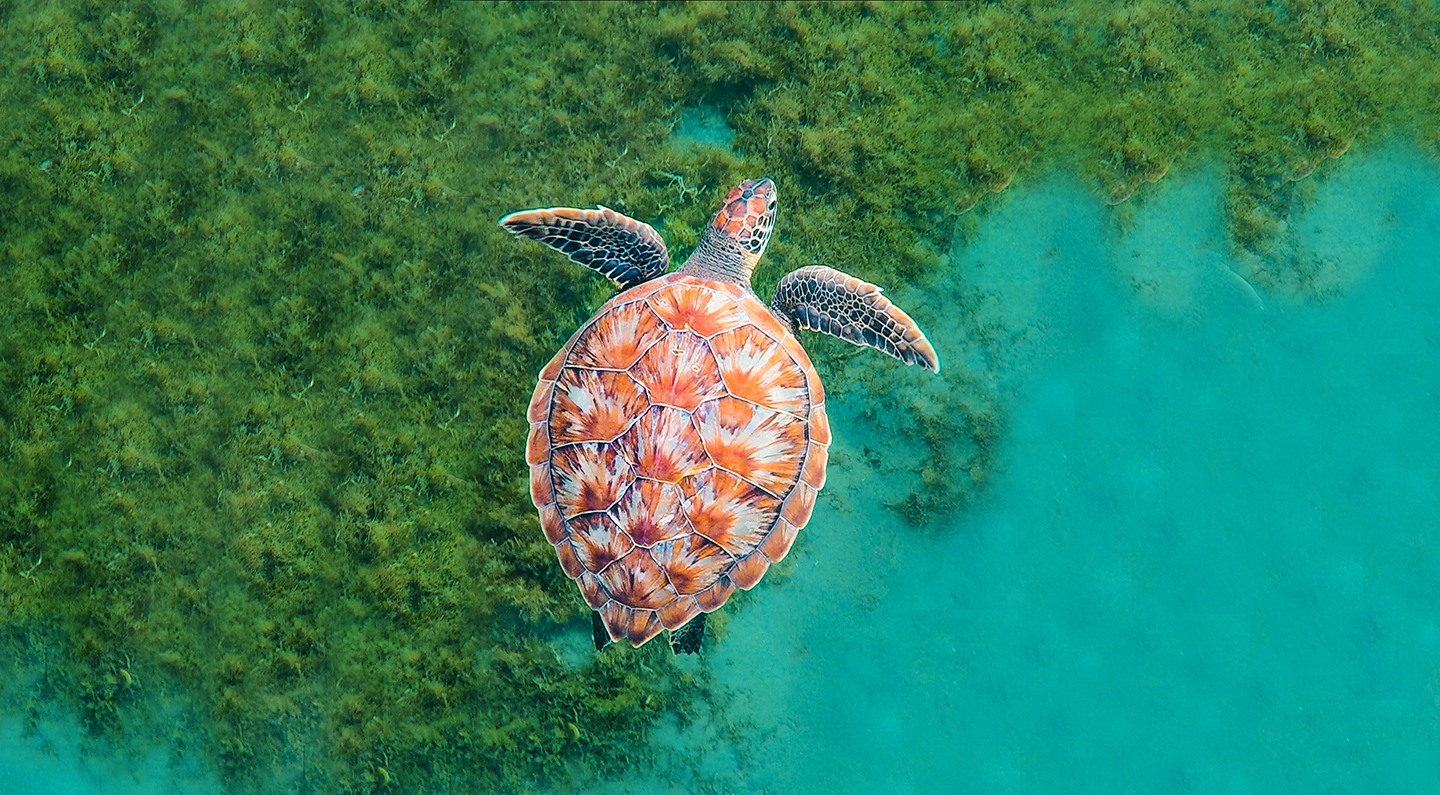
Banner image:Seagrass meadows are also important foraging grounds for many marine species, including green turtles (Chelonia mydas). Image by Michele Roux/Ocean Image Bank.
Scientists call for stronger action to save Indonesia’s vanishing seagrass meadows
Citations:
Serrano, O., Gómez-López, D. I., Sánchez-Valencia, L., Acosta-Chaparro, A., Navas-Camacho, R., González-Corredor, J., … Marbà, N. (2021). Seagrass blue carbon stocks and sequestration rates in the Colombian Caribbean. Scientific Reports, 11(1). doi:10.1038/s41598-021-90544-5
Vousdoukas, M. I., Ranasinghe, R., Mentaschi, L., Plomaritis, T. A., Athanasiou, P., Luijendijk, A., & Feyen, L. (2020). Sandy coastlines under threat of erosion. Nature Climate Change, 10(3), 260-263. doi:10.1038/s41558-020-0697-0
Forrester, J., Leonardi, N., Cooper, J. R., & Kumar, P. (2024). Seagrass as a nature-based solution for coastal protection. Ecological Engineering, 206, 107316. doi:10.1016/j.ecoleng.2024.107316
Potouroglou, M., Bull, J. C., Krauss, K. W., Kennedy, H. A., Fusi, M., Daffonchio, D., … Huxham, M. (2017). Measuring the role of seagrasses in regulating sediment surface elevation. Scientific Reports, 7(1). doi:10.1038/s41598-017-12354-y
Agulles, M., Marbà, N., Duarte, C. M., & Jordà, G. (2024). Mediterranean seagrasses provide essential coastal protection under climate change. Scientific Reports, 14(1). doi:10.1038/s41598-024-81026-5
Duarte, C. M., Losada, I. J., Hendriks, I. E., Mazarrasa, I., & Marbà, N. (2013). The role of coastal plant communities for climate change mitigation and adaptation. Nature Climate Change, 3(11), 961-968. doi:10.1038/nclimate1970
Mazarrasa, I., Marbà, N., Krause-Jensen, D., Kennedy, H., Santos, R., Lovelock, C. E., & Duarte, C. M. (2019). Decreasing carbonate load of seagrass leaves with increasing latitude. Aquatic Botany, 159, 103147. doi:10.1016/j.aquabot.2019.103147
Dunic, J. C., Brown, C. J., Connolly, R. M., Turschwell, M. P., & Côté, I. M. (2021). Long‐term declines and recovery of meadow area across the world’s seagrass bioregions. Global Change Biology, 27(17), 4096-4109. doi:10.1111/gcb.15684
Taylor, M. D., Strydom, S., Fraser, M. W., Sequeira, A. M., & Kendrick, G. A. (2025). Breaking down seagrass fragmentation in a marine heatwave impacted world heritage area. Remote Sensing in Ecology and Conservation. doi:10.1002/rse2.70032
Said, N. E., Cleguer, C., Lavery, P., Hodgson, A. J., Gorham, C., Tyne, J. A., … McMahon, K. (2024). Sparse seagrass meadows are critical dugong habitat: A novel rapid assessment of habitat-wildlife associations using paired drone and in-water surveys. Ecological Indicators, 171, 113135. doi:10.1016/j.ecolind.2025.113135
Arias-Ortiz, A., Serrano, O., Masqué, P., Lavery, P. S., Mueller, U., Kendrick, G. A., … Duarte, C. M. (2018). A marine heatwave drives massive losses from the world’s largest seagrass carbon stocks. Nature Climate Change, 8(4), 338-344. doi:10.1038/s41558-018-0096-y
Chefaoui, R. M., Duarte, C. M., & Serrão, E. A. (2018). Dramatic loss of seagrass habitat under projected climate change in the Mediterranean Sea. Global Change Biology, 24(10), 4919-4928. doi:10.1111/gcb.14401