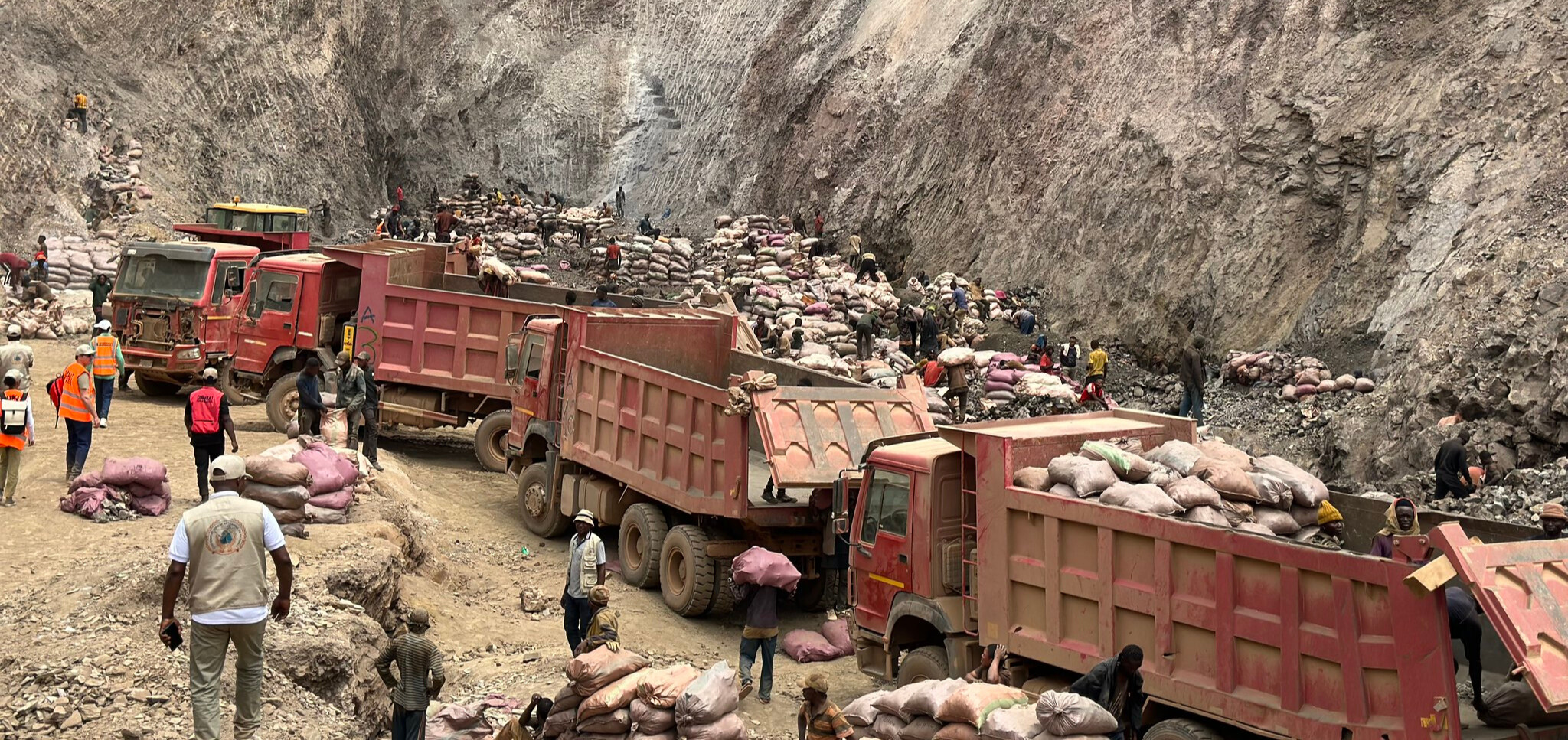
- Recent research shows that mining for minerals needed in the green energy transition takes an extensive toll on forests, soils, water, wildlife habitat and communities.
- Projections indicate that demand for energy transition minerals is expected to increase sixfold between 2020 and 2040; the rush to approve mining licenses in response to the growing demand only heightens the potential risks of conflict and social injustice.
- An analysis finds that the production of construction materials, such as concrete, has a significantly higher impact than the direct extraction of transition minerals themselves.
See All Key Ideas
A study published in Nature Reviews Biodiversity in September describes the extensive environmental toll of mining for minerals needed for a transition to green energy. The direct, site-level impacts are well known — deforestation, soil degradation, contamination of water bodies — with impacts on nearby settlements and wildlife habitat.
“A truly just energy transition must align climate action with conservation and social equity,” Aurora Torres, an ecologist at the University of Alicante in Spain and co-author of the study, told Mongabay.
Projections indicate that demand for energy transition minerals is expected to increase sixfold between 2020 and 2040. However, a 2023 analysis suggests that expanded mining to meet this demand would still require less mining overall than the current fossil fuel-based system.
Analysis by the study’s lead author, Bora Aska, a researcher at The University of Queensland’s Sustainable Minerals Institute, found that production of construction materials has a significantly higher impact than the direct extraction of transition minerals themselves. As an illustration, concrete requires the mining of large quantities of raw materials such as sand, gravel and limestone.
Still, the extraction of resources for low-carbon development without causing harm presents a challenge. “If the transition is not managed properly, there could be significant consequences for biodiversity and local communities,” Andy Symington, a specialist in business and human rights for accounting giant KPMG Australia, told Mongabay. “A lot of mineral stores have already been depleted, so the ones we have left are often in remote areas, often on Indigenous territories or in hard-to-reach areas like the seabed,” he said.
Mining for an energy transition poses some new difficulties. Rare earth minerals, for instance, are only found in small quantities underground. Their extraction can require excavating between 10 and 1,000 metric tons of rock for a single kilogram (2.2 pounds) of refined product — after which there is still the use of toxic chemicals to extract the sought-after minerals from their host rock to account for.
The International Union for Conservation of Nature (IUCN) estimates that 13,581 species are currently threatened by mining. A striking example is the Rio Tinto QMM ilmenite mining site in southeastern Madagascar, which is encroaching on one of the last remaining fragments of the region’s coastal forest, a unique ecosystem home to 64 endemic flora species.
A view of the Nyamurhale mining site in the DRC. Image by USAID Land via Flickr (CC BY-NC-SA 2.0).
Local communities worse off
The destruction of soils, forests and drinking water sources as well as the health risks linked to heavy metal or radioactive pollution exposure inevitably take their toll on local communities. Pollution often leaves people with little choice but to abandon their homes as their land is poisoned.
The destruction of culturally significant or sacred sites is an often-overlooked aspect of biodiversity loss. This aspect is one of the driving forces behind the intense protest movement mobilized in response to the Base Toliara mine. The site encroaches on important biodiversity and cultural areas, as well as the forest of the Mikea, one of the last Indigenous communities on the island.
Analyzing cases in the Global Atlas of Environmental Justice, the researchers note that such protests have been met with violent repression, with local communities almost always ending up disadvantaged. “History shows us that while projects are sometimes suspended, complete cancellations, company withdrawals and effective ecological restorations are much less common,” Aska says.
The rush to approve mining licenses in response to the growing demand only heightens the potential risks of conflict and social injustice. “In my opinion, the main problem is that, as things stand, the major negative impacts will be felt by communities and local environments in the Global South, while the benefits of the transition and technologies will be felt primarily in the Global North,” Symington says.
Trucks at the Shabara mine site in the Katanga region, Democratic Republic of Congo. Image by Electronics Watch via Flickr (CC BY-NC 2.0).
Mitigation strategies aim to manage supply and demand
Reducing the environmental footprint of transition mineral mining will require an approach that goes beyond site-level mitigation measures, Torres says. “While environmental protection measures, improved restoration practices and stronger regulations at mining sites are important, they are not enough on their own, especially given the scale and urgency of the challenges we face.”
For a greener future, both supply and demand measures must be implemented. On the supply side, strengthening scientifically sound environmental and social protection measures (for example, combining metal extraction techniques with agriculture) and including local communities is essential.
The International Energy Agency believes protecting the environment and meeting the demand for transition minerals is possible. “The IEA considers security of supply and environmental and social safeguards as complementary, not competing, objectives. Security of supply depends on local support and environmental respect,” officials explained to Mongabay.
“[T]here is a dire need to drastically improve the management of environmental and social issues related to these minerals. The best way to do this is to meaningfully involve communities in environmental assessments and mine planning,” Symington says, adding that he is encouraged to note that while many governments have relaxed regulations to attract foreign investment, this trend is slowly reversing. Large mining companies are increasingly reluctant to invest in countries that do not offer sufficient social and environmental protections, he says, due to risks to project completion and company reputation.
On the demand side, establishing a circular economy by increasing recycling and reducing demand, Syminton says. Effective technologies for recycling solar panels and electric vehicle batteries, for example, and methods to improve the efficiency of solar panel cells exist. “But we don’t do it because it’s not profitable,” he says. “[G]overnments need to incentivize circular economy measures.”
Banner image: Trucks at the Shabara mine site in the Katanga region, Democratic Republic of Congo. Image by Electronics Watch via Flickr (CC BY-NC 2.0).
Citations:
Aska, B., Sonter, L.J., zu Ermgassen, S.O.S.E. et al. Mining, biodiversity and social conflict in the renewable energy transition. Nat. Rev. Biodivers. 1, 597–614 (2025). https://doi.org/10.1038/s44358-025-00076-3
This article was first published in French here on Oct. 16, 2025.