- The new documentary “A Life Illuminated” traces the career arc of U.S. marine biologist Edie Widder, an expert on bioluminescence who’s made headlines for decades.
- The film documents her team’s attempt to capture a remarkable deep-water phenomenon called “flashback” on camera. (Spoiler alert.)
- Bioluminescence serves a variety of functions for deep-sea creatures, and flashback may originate from bioluminescent bacteria on drifting organic matter, Widder said.
- “A Life Illuminated” will make its Washington, D.C., premiere on Mar. 19, the first night of the D.C. Environmental Film Festival, where Mongabay is a media partner.
See All Key Ideas
The documentary A Life Illuminated will make its Washington, D.C., premiere on March 19, the first night of the D.C. Environmental Film Festival, where Mongabay is a media partner. The film traces the career arc of U.S. marine biologist Edie Widder, an expert on bioluminescence who’s made headlines for decades, and documents her team’s attempt to capture a remarkable deep-water phenomenon called “flashback” on camera.
The film, directed by U.S. documentary filmmaker Tasha Van Zandt, has been on the film festival circuit since September, when it made its world premiere at the Toronto International Film Festival. In the film, Widder meditates on the importance of the deep sea, which usually refers to waters below 200 meters (660 feet) in depth, a zone many experts call the world’s largest habitat. In the deep sea, most creatures can emit light, a trait few land-dwelling animals possess. (Fireflies are a notable exception.)
The film’s plot toggles between previous Widder expeditions and a recent one to the waters off the Azores, a Portuguese-administered archipelago in the Atlantic Ocean, to document flashback. The term refers to the way a wide variety of organisms, from the macro to the micro, will simultaneously light up in response to a flash of light from, say, a submersible. Those who’ve witnessed the phenomenon speak about it with awe: Before the flashback, the sea is pitch-black to the human eye, a seeming void. The flashback then envelops the submersible in an ephemeral snowstorm.
Edie Widder, a marine biologist and bioluminescence expert, in a submersible. Image courtesy of Tasha Van Zandt.
Widder, who’s made hundreds of deep-sea dives over a career spanning half a century, hadn’t yet been able to capture high-quality footage of flashback. Spoiler alert: She does in the Azores.“To me it’s a very big deal,” Widder, who’s the founder of the Ocean Research and Conservation Association, an NGO based in the U.S. state of Florida, told Mongabay in an email. “First of all it’s a testament to the profusion of life in the ocean. With the lights on it looks empty. But life is packed into every cubic meter even in the remote sunless depths that on first look appear lifeless.”
The footage was shot in the Azores in 2023 as part of an expedition by OceanX, a U.S.-based nonprofit founded by billionaire investor Ray Dalio and his son Mark.
“It wasn’t the first video documentation of the flashback but it was definitely the best,” Widder said. “I’ve tried on multiple occasions to record it but with generally disappointing results. This time I had the perfect combination of low light sensitive cameras to record the response and ultra-high output torchlights to stimulate it.”
The “flashback” footage is impressive, and yet Widder’s body of work, as depicted in the film, is even more so.
Edie Widder and a collaborator in a submersible in the waters off the Azores, a Portuguese-administered archipelago in the Atlantic Ocean, in 2023. Image courtesy of Tasha Van Zandt.
As an undergraduate, Widder went blind temporarily following a botched surgery. She wrote in a 2021 memoir that the experience helped create her “obsession” with light and bioluminescence in particular.
Before Widder’s time, most scientific research on the deep sea was done by studying organisms that came up in trawl nets, which revealed little about how they behaved in their own habitats.
Yet Widder ended up exploring the deep sea both in person and with cleverly designed tools placed in situ.
Widder undertook her first submersible dive, in the 1980s, in a one-person machine adapted from one used in offshore oil and gas work. She lifted weights for a year to be able to wear the suit, she says in the film. (“Submersibles were designed by men, for men,” she explains.) She later faced a life-threatening situation in a different submersible that started flooding, the water coming up to her ankles. She managed to return safely to the surface. The submersible was quickly repaired, and she took it back down into the depths — just an hour or so after surfacing.
Edie Widder in 1984, as she trains in a WASP atmospheric diving suit in a tank at Port Hueneme, California. WASP suits were initially used for offshore oil and gas work. Image courtesy of Edie Widder.
Widder first found a way to capture bioluminescence not with a video but using a screen that would measure organisms’ light output when they bumped into it. (Widder playfully called it the SPLAT screen, short for spatial plankton analysis technique.) Then, in 2004, she devised an underwater camera system called Eye-in-the-Sea that used red light that’s invisible to most deep-sea creatures so as not to deter them from the camera area. She paired it with an “electronic jellyfish” she invented that sent out distress signals like those of a real deep-sea jellyfish. Nearly as soon as the electronic jellyfish was switched on during its first scientific deployment, a squid about 1.8 meters (6 feet) long swooped in — an attack that hadn’t been captured on camera before, by a member of a squid species that was also then unknown.
In 2012, on a televised expedition off the Ogasawara Islands in Japan, Widder and a team of other leading scientists used an updated version of the same system, by then called The Medusa, to help capture the first-ever video of a giant squid (Architeuthis dux) in its natural habitat. It was a relatively small one at about 3 m (10 ft) long; the species can grow to at least 13 m (43 ft). Widder says in A Life Illuminated that filming it was “the holy grail of natural history cinematography.”
Scientists are still figuring out the evolutionary advantages of bioluminescence, which often comes in flashes. It serves a variety of functions, including finding prey and avoiding predators. For example, some anglerfish (order Lophiiformes) have a filament on top of their heads with a ball that can light up to lure in smaller fish.
Many marine predators hunt from below, looking for the outline of their prey against the faint sunlight above. As a defense, some of the preyed-upon species use “counterillumination,” in which their underside emits a bluish light matching the surrounding water so their silhouette isn’t visible.
The phenomenon of flashback is also still being studied. Widder told Mongabay her “hypothesis” is that it occurs as a “result of bioluminescent bacteria on marine snow.” Marine snow is the continuous shower of organic material — plankton, feces, etc. — that rains down from the upper layers of the ocean to the deep sea. She said in some cases, flashes of light from another source, such as a submersible, could initiate photosynthesis and the production of oxygen that the bacteria need in order to glow. Flashback could thus be tied to larger processes that regulate the climate and shape “Earth’s long-term habitability,” she said.
However it may originate, flashback is “the language of the planet,” Widder says in the film.
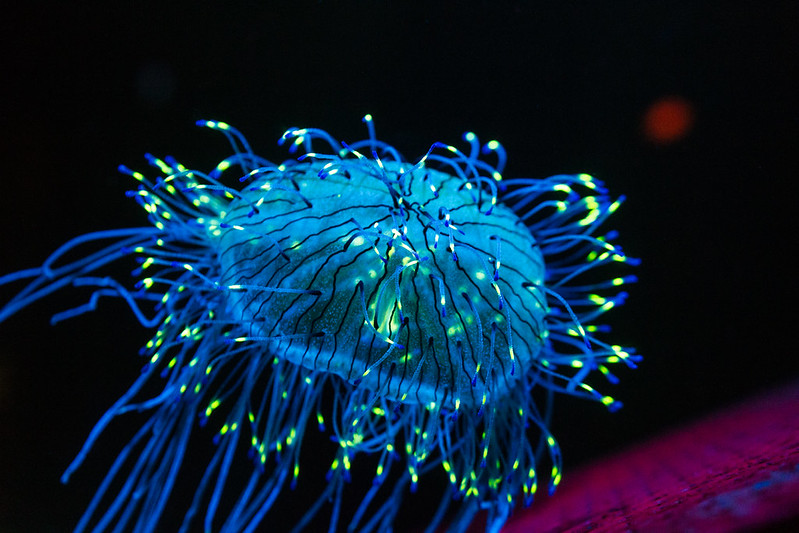
Banner image: A bioluminescent jellyfish photographed at Monterrey Bay Aquarium in 2015. Bioluminescence is far more common in marine animals than land animals. Image by Chris Favero via Flickr (CC BY-ND 2.0).