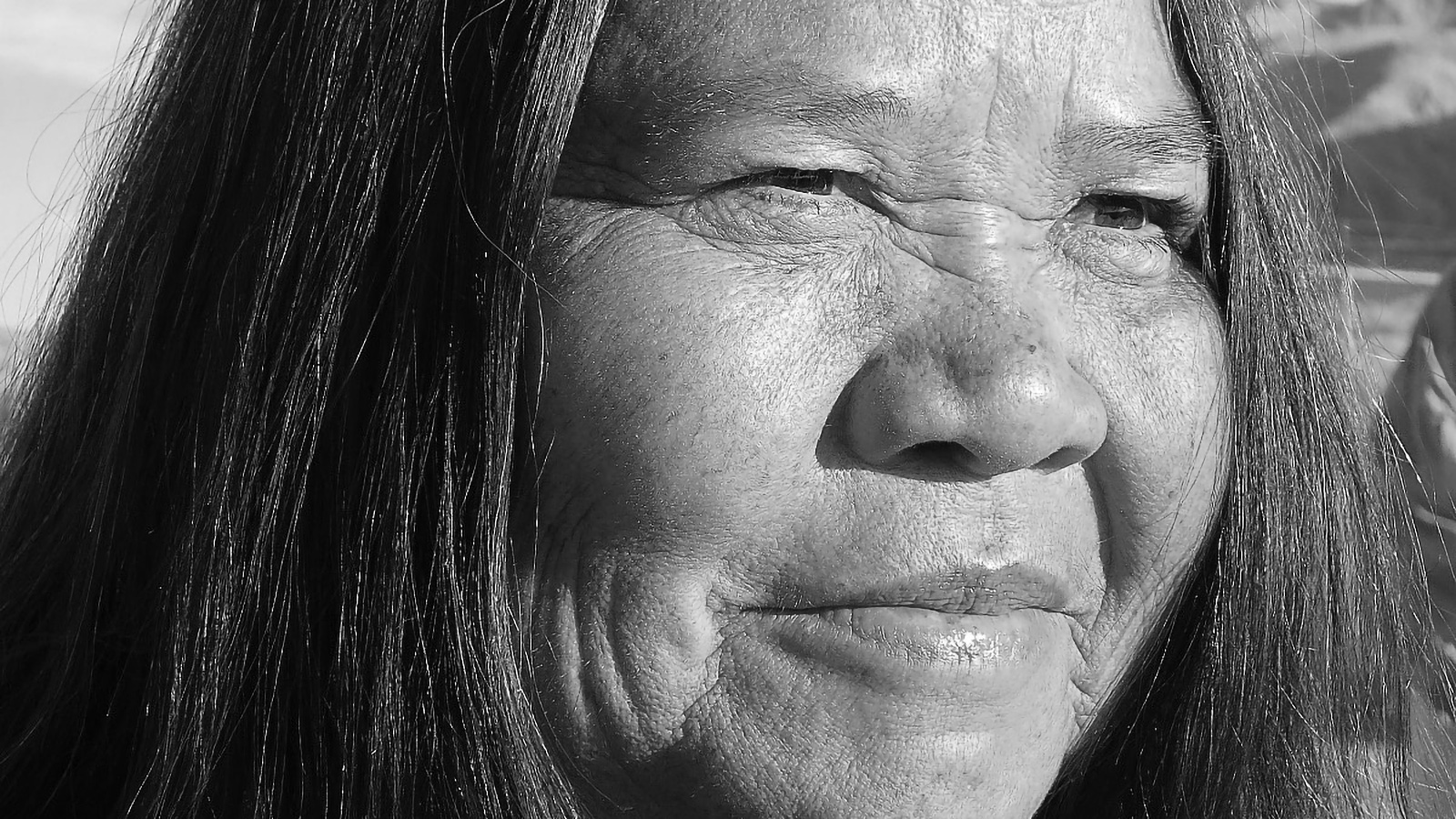
- For decades, Kathy Jefferson Bancroft challenged the idea that Owens Lake was merely a technical problem, insisting it be understood as a living place with history, meaning, and obligations.
- As Tribal Historic Preservation Officer for the Lone Pine Paiute–Shoshone Tribe, she worked at the intersection of Indigenous knowledge and Western science, pressing agencies to account for longer timescales and deeper responsibilities.
- Her advocacy helped protect sacred sites, resist destructive mining and mitigation schemes, and reshape how land and water decisions were made in California’s Owens Valley.
- Bancroft’s work rested on a simple proposition that unsettled bureaucracies: water is not something to be managed at will, but something that carries memory, limits, and consequence.
See All Key Ideas
In California’s interior, a long, straight aqueduct carries snowmelt south to a city that grew as if water were a birthright. Along the way it passes a valley that was once defined by water and birds, and is now defined, in part, by what remains when water is removed. A lakebed can become a workplace. The wind can become a health hazard. And a landscape with thousands of years of human memory can be treated as a technical problem to be managed on a fiscal calendar.
For the Paiute and Shoshone people of Payahüünadu, the land and water are not abstract inputs. They are history, responsibility, and relationship. That view often collided with the habits of agencies and companies that preferred smaller boxes: dust over here, hydrology over there, cultural sites as a checklist item, and tribal “consultation” at the end of a process rather than the beginning. Kathy Jefferson Bancroft spent decades refusing to accept that partition.
Few people did more to insist that this valley be treated as a place with obligations, not just an asset with constraints. She died on January 25, 2026, at 71. Only after one understands the place she guarded does her work make sense.
Bancroft was born and raised in Owens Valley. In a 2017 interview with Charlotte Cotton for Metabolic Studio, she described hearing, as a baby, stories from her grandmother about Owens Lake and about life when the lake was full. Her grandmother remembered migrating birds that “would darken the sky for days,” and a valley with “a lot of water and a lot of food.” The same grandmother had also heard a prediction from an elder: “You’re going to see a day when this lake is dry.” People dismissed it as impossible. It happened anyway.
In 2002 she moved home and began working on the Owens Lake dust-mitigation project as a tribal cultural-resource monitor, keeping watch on what the Los Angeles Department of Water and Power was doing on the exposed lakebed. Later she became the Tribal Historic Preservation Officer for the Lone Pine Paiute–Shoshone Tribe, overseeing a team that, as she put it, “watch[es] everything that goes on out here.”
She resisted labels. When asked when she became an “activist,” she answered that she did not think of herself that way, and seemed genuinely startled by the word. But she also described the moment when procedure failed: after she raised objections through official channels, she returned to find a crew arriving to begin demolition work in an area important to her family. “Hold on a minute. Stop!” she recalled thinking. The plans were suspended. A rally followed, bringing together tribal members and townspeople who “would never even talk to each other” in normal life. The work was called off. It was, she noted, not gone for good.
Bancroft’s authority came from a blend of lived knowledge and formal training. She earned degrees in biology and chemistry and used that background without letting it become the point. She worked with scientists, including geologists, and spoke of Indigenous knowledge as “rooted in generations of careful observation.” She described her role as “translating between” Indigenous and Western knowledge systems in order to “have a seat at the table to protect my homelands.” Her method was practical: show up, learn the details, keep notes, and insist that decisions account for a longer timescale than a project plan.
That insistence shaped her view of Owens Lake. To officials, the lakebed could be framed as a “site.” To Bancroft it was a whole living place, threaded with sacred locations and with pain. “This whole valley is sacred,” she told Cotton. “Here is where my ancestors walked…on every part of this valley.” She spoke of “six or seven massacre sites on the lakebed,” and of the need to preserve and respect them, not to excavate them as curios.
Her fights ranged outward: opposition to mining projects such as those at Conglomerate Mesa; scrutiny of dust-mitigation schemes that scraped hills for gravel; and pressure on agencies to treat tribal participation as fundamental rather than decorative. She also built alliances, including with Japanese-American communities linked to Manzanar, recognizing that a valley can hold more than one story of dispossession.
Bancroft returned, again and again, to a simple proposition that sounded almost impolite in a meeting room: “It’s a lake, it’s supposed to be a lake.” She thought in systems, not categories. She also thought in duties. “Nobody has a right to water, it’s a water responsibility,” she said.
Water, she liked to remind people, is not easily governed. It follows its own logic, on its own timescale, indifferent to permits, deadlines, and claims of ownership.
Kathy Jefferson Bancroft. From Walking-Water.org