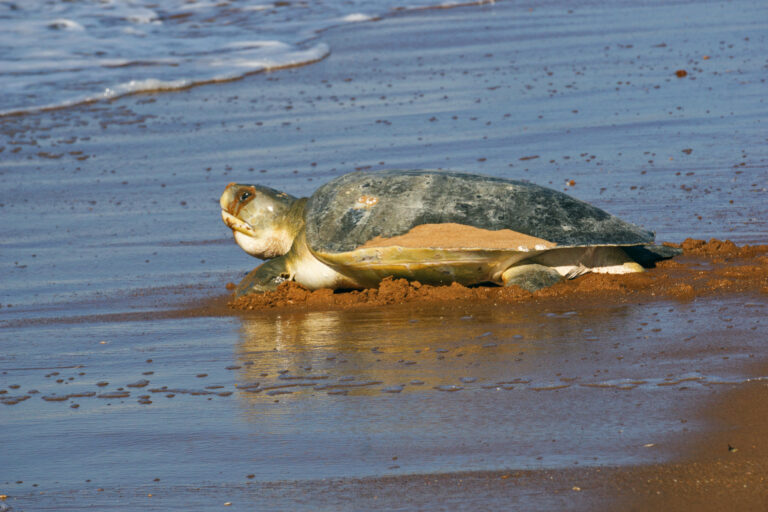
In northwestern Australia lies a remote and wildly diverse region called the Kimberley. There, the iron-red soils of the Pindan Country connect forests and the Great Sandy Desert, all bracketed by a vast stretch of Indian Ocean coastline. Its springs and wetlands host migratory birds. Offshore, sawfish, as visually striking as they are rare, ply the waters just beyond the unbroken Eighty Mile Beach, itself a nesting site for the little-known flatback turtle (Natator depressus). The Kimberley has also long been a home to humans, as rock art more than 17,000 years old attests, and among the heirs of that legacy are the Karajarri people. Over the past 30 years, the Karajarri secured legal recognition of their claims to the land, later establishing an Indigenous Protected Area (IPA), Karajarri Pirra Ngurra, that now covers an area of land nearly the size of Rwanda in the state of Western Australia. They also developed a ranger program that draws on long-held cultural knowledge of the landscape. In March 2026, the Karajarri people dedicated Karajarri Jurarr Ngurra, Australia’s first “Sea Country” IPA, comprising 237,489 hectares (nearly 587,000 acres) of marine and coastal ecosystems. It includes part of Malumpurr, the Karajarri word for Eighty Mile Beach. The IPA “strengthens long‑standing efforts by Karajarri Traditional Owners and Karajarri Rangers to protect the region’s biodiversity and keep Country healthy,” Malarndirri McCarthy, Australia’s minister for Indigenous Australians, said in a March 20 government statement about the Karajarri Sea Country IPA dedication. The aim of the Karajarri IPAs…This article was originally published on Mongabay



