- As global demand for steel is rising, Indonesia’s steel industry is one of the country’s largest industrial greenhouse gas emitters and is set to become far more polluting if current trends continue, according to a nonprofit report.
- Indonesia’s high emissions stem largely from its reliance on coal-based blast furnace steelmaking, which uses coal both as a chemical input and as a source of the extremely high heat required to smelt iron ore.
- The climate footprint of Indonesia’s steel industry is closely tied to public health risks for communities living near major production hubs; steelmaking releases hazardous air pollutants that are linked to respiratory and cardiovascular disease and reduced productivity.
- The Ministry of Industry has introduced policies intended to promote more sustainable practices across industrial sectors, including steel, but the recent report found that these policies lack binding sector-specific emissions targets, clear transition timelines and enforcement mechanisms.
See All Key Ideas
JAKARTA — Indonesia’s steel industry is becoming one of the country’s fastest-growing sources of greenhouse gas emissions, even as it receives far less public attention than other carbon-intensive sectors.
The industry is already one of the country’s largest industrial emitters, and is set to become far more polluting if current trends continue, according to a report by environmental NGO Action for Ecology and People’s Emancipation (AEER).
Global demand for steel is rising, driven by the expansion of electric vehicles, renewable energy and infrastructure projects. Against this backdrop, Indonesia’s crude steel production climbed to around 16.8 million metric tons, making it the world’s 15th-largest steel producer in 2023, according to the World Steel Association.
AEER estimates that Indonesia’s steel output could grow twelvefold by 2060, with emissions rising 11.7 times from 2023 level if the industry continues to rely on coal-based production.
At that scale, steel alone could account for around 31% of Indonesia’s national greenhouse gas emissions by 2060 if current policies remain unchanged, potentially putting Indonesia’s net-zero target out of reach.
Indonesia’s high emissions stem largely from its reliance on coal-based blast furnace steelmaking, which uses coal both as a chemical input and as a source of the extremely high heat required to smelt iron ore.
“The steel industry is one of the largest emitters within the industrial sector, making it a top priority for decarbonization. Steelmaking processes require extremely high temperatures, resulting in very high emissions,” said Timotius Rafael, a researcher at AEER, as quoted by local news.
AEER found that around 80% of Indonesia’s steel is produced using blast furnace-basic oxygen furnace (BF-BOF) technology, the most carbon-intensive method. Cleaner production routes such as electric arc furnaces (EAF) account for only about 20% of output, and remain constrained by limited scrap metal supply, carbon-intensive electricity and weak policy support.
This matters because BF-BOF steel typically emits around 2 metric tons of carbon dioxide per ton of steel, while EAF steel can emit less than 0.1-0.5 tons, depending on the electricity source.
As a result, Indonesia’s steel emissions intensity is estimated at 1.6 tons of CO₂ per ton of steel, placing it firmly in the high-carbon category under emerging global benchmarks, according to a separate report by nonprofit research group Climate Catalyst.
The government has acknowledged the risks posed by rising steel emissions. Industry Minister Agus Gumiwang Kartasasmita has said his ministry expects the steel sector to help drive industrial decarbonization and reach net-zero emissions by 2050.
“The steel industry has to become an example in embracing sustainability principles and playing an active role in minimizing environmental impact,” Agus said in October 2023, as quoted by local media.
To support this goal, the government has rolled out a series of policy frameworks, including the 2025-29 midterm development plan, a carbon pricing regulation issued in 2025 and an industrial decarbonization road map.
However, AEER found that these policies lack binding sector-specific emissions targets, clear transition timelines and enforcement mechanisms, allowing high-emissions steel expansion to continue largely unchecked — even as export markets increasingly demand lower-carbon steel.
In a response to Mongabay, the Ministry of Industry rejected the suggestion that policy is insufficient, saying its approach focuses first on improving emissions data and intensity reductions before introducing sectoral limits.
The ministry said it aims to “decouple” production growth from emissions by lowering emissions intensity per ton of steel through efficiency improvements, greater use of scrap metal and increased reliance on low-carbon electricity.
The ministry has strengthened emissions reporting through its national industrial database, SIINas, as a basis for monitoring and verification, and says it plans to move toward sector-specific emissions limits once data systems are in place.
A steel plant. Image by Jean-Etienne Minh-Duy Poirrier via Flickr (CC BY-SA 2.0).
Subpar green standards
The Ministry of Industry has also introduced a national green industry standard, known as SIH, intended to promote more sustainable practices across industrial sectors, including steel.
The ministry said some binding requirements already exist under SIH, including a 2024 regulation that sets product-level emissions limits for flat steel.
In its analysis, Climate Catalyst compared SIH with three international benchmarks: ResponsibleSteel, the Global Steel Climate Council’s Steel Climate Standard and the Low Emission Steel Standard.
The group found that while SIH partially aligns with international standards, it lacks several key elements, including mandatory third-party verification, full accounting of supply-chain emissions, and product-level carbon intensity tracking.
Without upgrades, Climate Catalyst warned, Indonesia risks losing access to markets such as the European Union, which will begin imposing a carbon levy on certain imported goods, including steel, under the Carbon Border Adjustment Mechanism (CBAM) starting in 2026.
CBAM applies default carbon values — often higher than actual emissions — when verified data are unavailable, potentially penalizing exporters with limited monitoring systems.
AEER estimates that coal-based steel could face €40-€90 ($48-$107) per ton in added costs under the policy — far higher than cleaner alternatives.
Aligning SIH more closely with international standards would allow Indonesian steel exports to demonstrate compliance more credibly and remain competitive as global climate rules tighten, Climate Catalyst said.
The group also pointed to the importance of green public procurement, arguing that stronger enforcement could create a guaranteed domestic market for early-stage low-carbon steel, helping local producers scale up before facing full exposure to international competition.
The Ministry of Industry said it is preparing exporters for CBAM by strengthening emissions data collection and verification, noting that the EU’s carbon levy will rely on embedded-emissions calculations and auditable records.
The ministry has encouraged investment in lower-emissions technologies and improved monitoring to help Indonesian steel remain competitive as climate-linked trade rules tighten.
Blast furnace. Image by zephylwer0 via Pixabay.
Health impacts
The climate footprint of Indonesia’s steel industry is closely tied to public health risks for communities living near major production hubs.
Steelmaking releases hazardous air pollutants such as fine particulate matter (PM2.5 and PM10) and gases including nitrogen dioxide, sulfur dioxide and carbon monoxide, which are linked to respiratory and cardiovascular disease and reduced productivity.
AEER found that residents near steel clusters in Cilegon, Banten and Morowali, Central Sulawesi, face chronic air pollution alongside rising rates of respiratory illness and skin disorders.
In Ciwandan subdistrict, home to Indonesia’s two largest steel producers, PT Krakatau Steel and PT Krakatau Posco, local health records show 6,514 cases of acute respiratory infection (ARI) in 2023, followed by 5,091 cases in 2024 — equivalent to 9-12% of the district’s population.
Data obtained by AEER from the Ciwandan community health center show that ARI cases in Tegal Ratu, a neighborhood directly adjacent to steel facilities, rose from 665 cases in 2023 to 1,065 in 2024. Between January and August 2025, cases had already reached 699, exceeding the total for all of 2023.
Residents interviewed by AEER reported daily disruption from dust, noise and industrial odors, along with symptoms such as persistent coughs, flu-like illness, itching and skin irritation. Monitoring data showed PM2.5 concentrations exceeding air quality standards, contributing to poor air quality in the area.
The broader health burden of air pollution extends beyond industrial zones. Then Suyanti, director of environmental health at the Ministry of Health, has said air pollution is the fifth-highest risk factor for death in Indonesia while also driving major economic losses.
“Air pollution has a direct impact on health — causing outpatient and inpatient treatment costs for respiratory diseases to surge,” she said, noting that illnesses such as pneumonia, ARI, chronic obstructive pulmonary disease and lung cancer account for the largest share of national health insurance spending.
AEER also links steel-driven industrial development to wider environmental degradation, including the loss of natural water absorption areas, mangrove damage and altered drainage systems.
These changes coincided with severe flooding in Cilegon between late 2025 and early 2026, which disproportionately affected neighborhoods near industrial sites, inundated hundreds of homes and disrupted major transport routes.
Following the floods, some residents in Ciwandan breached fences belonging to PT Krakatau Steel, saying the barriers obstructed floodwater flow.
Ahmad Hafid, chair of Commission I of the Cilegon City legislative council, said factory construction had removed natural drainage paths and infiltration areas, while even routes for rainwater to flow into the sea had been blocked, causing floodwaters to spill into residential areas.
AEER argues that reducing emissions from the steel sector is therefore not only a climate imperative, but also a measure to protect public health and reduce environmental risks.
The group recommends establishing buffer zones between steel plants and nearby housing — particularly where industrial sites lie within 300 meters (980 feet) of residential areas — alongside closer coordination among local governments, companies and communities.
AEER also calls for real-time air quality monitoring systems in industrial zones, with publicly accessible data, to give residents direct information about their environment and strengthen accountability.
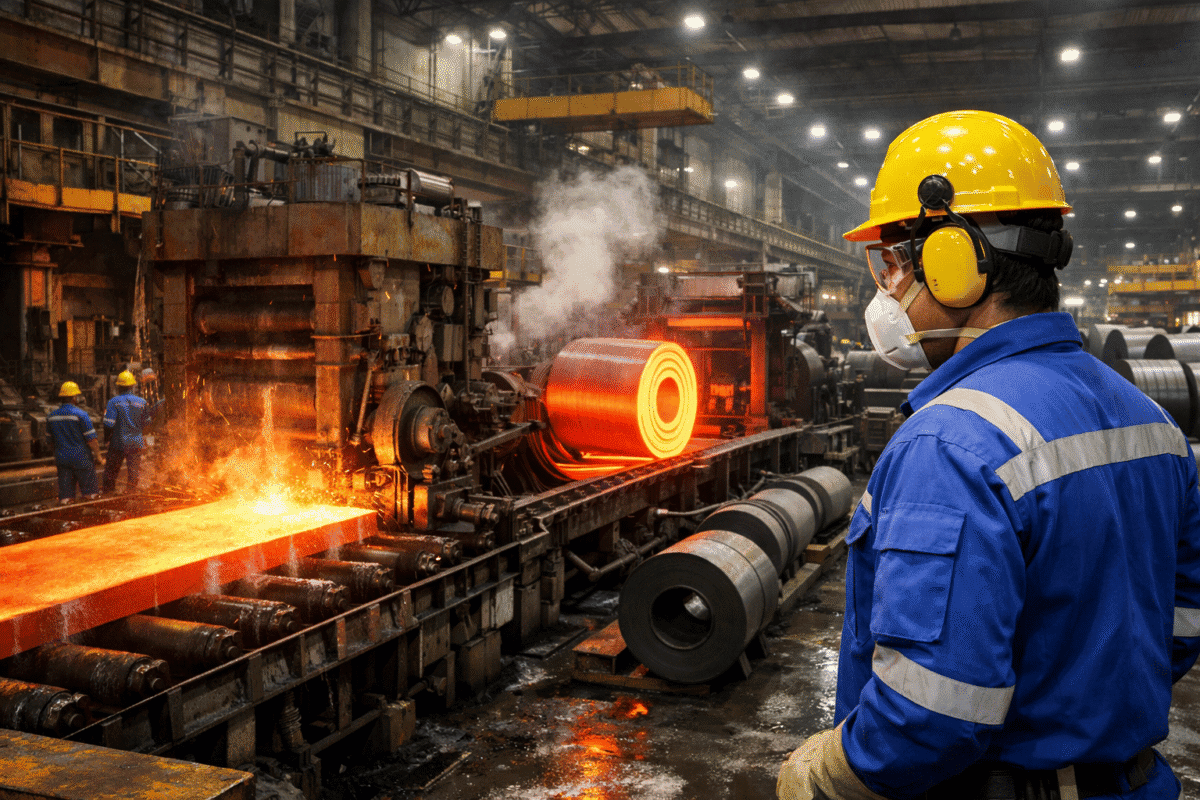
Banner image: A steel factory in Indonesia. Image courtesy of Krakatau Steel.
FEEDBACK: Use this form to send a message to the author of this post. If you want to post a public comment, you can do that at the bottom of the page.