- Residents in different districts across the Indonesian province of Aceh say gold mining activity in the interior of forest areas continues despite the province’s leaders agreeing a crackdown on illegal mining.
- Fuel shortages have been reported at local gas stations, which some attribute to demand from excavators working to unearth gold ore from inside forest areas.
- In August, Mongabay reported that gold miners had encroached in to a crucial reintroduction forest in Aceh for critically endangered Sumatran orangutans rescued from the illegal wildlife trade.
- Environmental advocacy group Walhi says there are more than 1,000 units of heavy equipment working at more than 450 illegal mining operations in Aceh, while a former provincial official said the government is aware of mining in around half of Aceh’s districts.
See All Key Ideas
NAGAN RAYA, Indonesia – Two weeks after government and law enforcement leaders vowed to crack down on illegal gold mining in the semiautonomous Indonesian province of Aceh, local communities on the ground say excavators are still at work in the forest interior.
“Excavators continue to access the verges of the rivers. Similarly, fuel and supplies keep being sent to this mining site,” Amran, a community leader from Seunagan in Nagan Raya district, told Mongabay Indonesia.
Aceh, on the island of Sumatra, is Indonesia’s westernmost region and home to crucial high-conservation-value tropical forests and peatlands, including the Leuser Ecosystem, a stronghold for Sumatran elephants, orangutans, rhinos, sun bears, and tigers. Yet these habitats remain under pressure from lucrative extractive industries.
In late July, top government, security, and law-enforcement officials in Aceh convened to order all illegal gold mining in the region to be halted by Aug. 17, Indonesia’s independence anniversary.
However, sources on the ground around some of Aceh’s known illegal mining locations told Mongabay Indonesia that many of these operations continued working as normal as of late August.
“Diesel is always out of stock at gas stations because it’s being used by the heavy equipment digging for gold by the riverbanks and on the mountainside,” said Razali, who lives in Fajar in South Aceh district.
At a mining site in Pidie district, people reported still seeing the tarpaulin shelters used by miners.
“If it’s just an announcement, it won’t have any effect,” Hamdani, a resident of Tangse in Pidie district, said in response to the government deadline. “They [groups of gold miners] as a team are strong enough to guard the area where they operate.”
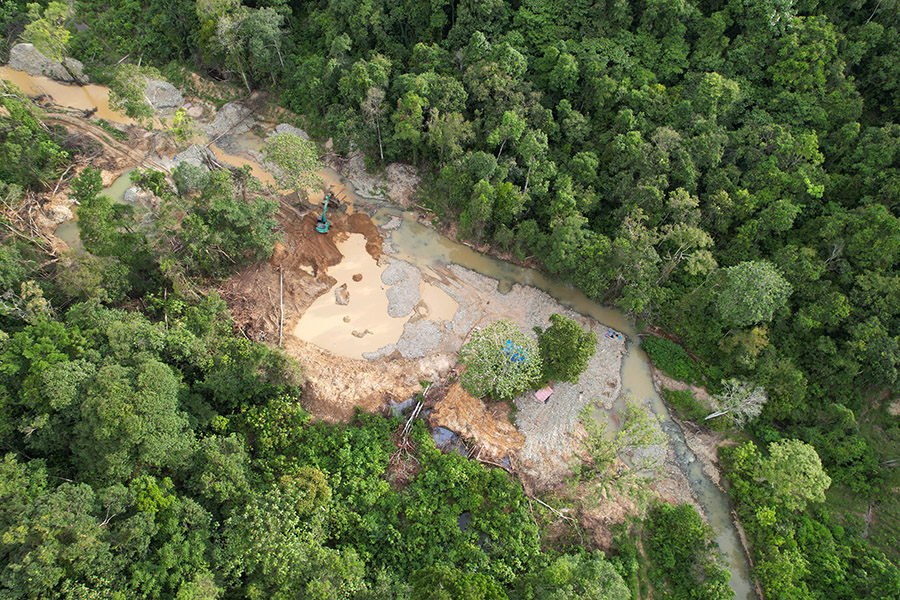
An aerial photo showing an illegal gold mining pit in Sungai Mas District, West Aceh Regency, Aceh. Photo: Junaidi Hanafiah/Mongabay Indonesia.
Call for crackdown
The regional coordination meeting of law enforcement and government leaders held in July concluded that “all actors are required to cease operations and remove heavy equipment and mining tools by Aug. 17, 2026.”
The announcement also reiterated a ban on the use of cyanide and mercury, and that miners could face prosecution under a range of laws, including a 1999 forestry law and 2020 mining law.
Illegal miners use mercury because it binds to gold in crushed ore, while cyanide can extract remaining gold particles. Both chemicals are widely used, and both present extreme risk of death or long-term cognitive decline.
M. Nasir, who was the leading civil servant in Aceh until he was replaced by Indonesian President Prabowo Subianto in August, said the government was aware of illegal gold mining activities in the districts of Aceh Besar, Aceh Jaya, Central Aceh, Gayo Lues, Nagan Raya, Pidie, South Aceh, Southwest Aceh, and West Aceh.
“These activities cause environmental pollution, increased risk of social conflict, increased risk of workplace accidents, and lost potential revenue for the state and regions,” the then-Aceh provincial secretary said on Aug. 22.
Ruddi Setiawan, the Aceh police chief, called for greater institutional collaboration to confront miners.
“It’s going to take robust cooperation,” said Ruddi, a former police chief on the island of Bali. “We need to collaborate.”
An illegal gold mine in Nagan Raya that has a widespread impact on environmental sustainability. Photo by Junaidi Hanafiah/Mongabay Indonesia.
Environmental damage
Ahmad Shalihin, director of the provincial chapter of the Indonesian Forum for the Environment (Walhi), the country’s largest environmental pressure group, called on authorities to raid all mining sites and seize expensive heavy equipment from the miners.
“The state must pursue the financiers, freeze their assets, and bring them to justice,” Ahmad said. “This gets to the real source of the problem.”
Walhi research from 2023-2025 concluded that 23,433 hectares (57,904 acres) of forest cover were damaged during this period by illegal mining activities.
“That’s equivalent to four times the area of Banda Aceh,” Ahmad said, referring to the provincial capital city.
“More than 1,000 units of heavy equipment have been identified as operating in forest areas,” he added. “And there are over 450 illegal mining operations across various regions of Aceh.”
Some 10,552 hectares (26,075 acres), or 45% of the total damaged area, occurred in protected forests, the Walhi analysis showed. And more than 80% of the damage was concentrated in three main river systems: the Meureubo, Seunagan, and Woyla rivers, the latter of which accounted for almost a third of the total damage.
River water that has turned murky due to illegal gold mining operations in the headwaters of the Krueng Aceh River. Image by Junaidi Hanafiah/Mongabay Indonesia.
The footprint of illegal mining includes dams for water storage, sluices used by miners to separate ores, roads for heavy equipment access, and the areas cleared for worker encampments.
The illegal gold trade is also highly dangerous work. In West Sumatra province, Walhi estimates dozens of miners have been killed. Meanwhile, authorities have seized several tons of mercury this year.
The continued use of mercury and proliferation of illegal gold mining runs counter to Indonesia’s commitments under the internationally agreed Minamata Convention, in addition to its national action plan to reduce mercury use in the mining sector.
Mongabay reported in August that gold miners had encroached into a crucial reintroduction forest in Aceh for critically endangered Sumatran orangutans rescued from the illegal wildlife trade.
Walhi’s Ahmad called on the government to remove all heavy machinery being used in these forests, to bring prosecutions, and work to restore ecosystems damaged by gold mining.
“If fuel supplies are cut off, the distribution of mercury is stopped, heavy equipment is seized, and illegal gold trading routes are paralyzed,” Ahmad said, “then we’re confident that mining activities will be incapacitated.”
This story was first published here in Indonesian on Sept. 2, 2026.
Banner image: An illegal gold mine in Nagan Raya, Aceh. Image by Junaidi Hanafiah/Mongabay Indonesia.
Cite this article
Junaidi Hanafiah (2026). Illegal gold mining continues in Indonesia’s Aceh despite government crackdown pledge. Mongabay Conservation news. DOI: https://doi.org/10.66709/news-328689