- Spoorthy Raman is a staff writer at Mongabay, where she covers wildlife, biodiversity and the complexities of the wildlife trade.
- She began her environmental journalism journey with a Mongabay internship in 2022, which opened the door to writing for other outlets including Hakai, Audubon, BioScience, Nature and others.
- Raman says her inspiration comes from a lifelong curiosity about science, a love for nature, and an admiration for the living world.
- She’s especially proud of her reporting on biodiversity, wildlife and Indigenous food traditions, including award-winning work on baby Dungeness crabs, wild rice restoration in the Great Lakes, and species affected by the wildlife trade.
See All Key Ideas
“Sitting at my desk on an island in the Atlantic, I can speak to some of the best scientists, conservationists and people invested in protecting the planet across the world,” says Mongabay staff writer Spoorthy Raman. From her home in St. John’s, Newfoundland, on Canada’s east coast, she gathers perspectives on the state of nature that span countries, cultures and ecosystems.
Raman’s journey at Mongabay began with an internship in 2022, following a stint as a science communicator. This then led to bylines in outlets like Hakai, Audubon, BioScience and Nature, and to recognition, including the Sustainability, Environmental Achievement & Leadership award and a Digital Publishing Award in 2024. Now a full-time member of Mongabay’s Wildlife Desk, she reports on a range of issues related to biodiversity, with specializations in animal behavior and the complex worlds of the wildlife trade and poaching. These last two areas can be particularly grim, yet serve as a poignant reminder of why the work matters. “With every image of dead wildlife I see as part of my work, I am reminded of the enormous biodiversity loss this is contributing to,” Raman says.
Across the more than 100 stories she has produced at Mongabay, a few projects have been especially meaningful. One is her reporting on wild rice restoration by Indigenous peoples across the Great Lakes region of Canada and the United States. Another is about the thriving illegal wildlife trade in California, driven by the pet trade. She’s especially proud of her ongoing series on the return of the gray wolf to California and how communities are navigating coexistence with a resurgent predator.
Raman walking through the iconic Garry Oak meadows in British Columbia, Canada, about which she wrote for Mongabay. Image by Spoorthy Raman.
That work has taught her much about tenacity and perception. “Wildlife is resilient and, if given a chance, can bounce back from the lowest levels of decline,” and wolves are a striking example of this, she says. At the same time, living alongside predators has grown increasingly challenging for people, with fear often filling the gaps in our understanding. Although scientific knowledge of wolf behavior and ecology increases by the day, “our current fear of predators, especially in North America, is sometimes unreasonable,” Raman says.
She also sees parallels between her reporting and personal life. Raman adopted a free-ranging street dog, Pippi, from India, and the process of learning about his behavior — fears of his own humans included — parallels her conversations with wolf behavior experts. She’s also written about that journey in her columns for Indian newspaper the Deccan Herald as well as a body of work on pet behavior inspired by Pippi.
Pippi and Raman basking in the sun. Image courtesy of Vimal Simha.
As Raman reflects on the breadth of her coverage, she returns to the collaborative nature of Mongabay’s newsroom. “When my stories reach the readers, I would like to remind them that it’s not just my work that they see, but a team effort,” she says. With her 100-article milestone behind her and the 200 mark beckoning, Raman holds one guiding principle especially close: “As journalists, we are custodians of stories told to us, and I believe it’s a privilege for us to tell them to the world truthfully.”
What follows is a conversation with Raman about her career at Mongabay, including the stories she’s proudest of and the values that guide her reporting. This interview is part of Inside Mongabay, a series that spotlights the people who bring environmental and conservation stories to life across our global newsroom.
An interview with Spoorthy Raman
Mongabay: What inspired your interest in the work you do for Mongabay?
Spoorthy Raman: As a child, I had the privilege of spending a few months in a year on my grandparents’ farm, where the sight of the birds, snakes and the occasional deer was enthralling. Growing up with pets meant animals carved a special place in my heart. My first introduction to the world’s fascinating biodiversity came through reading the works of Poornachandra Tejaswi, an acclaimed Kannada writer and naturalist, who then introduced me to the writings of Gerard Durrell. In the following years, the admiration for the living world and our planet merged my curiosity about science and shaped me as a journalist who finds joy in writing about all things wild.
Mongabay: What do you most enjoy about your work?
Spoorthy Raman: I love that, sitting at my desk on an island in the Atlantic, I can speak to some of the best scientists, conservationists and people invested in protecting the planet across the world, as part of my day-to-day work. I also enjoy the many intriguing conversations I have within the newsroom with my colleagues as I craft stories and bring them to life. When my stories reach the readers, I would like to remind them that it’s not just my work that they see, but a team effort.
Raman on a boat exploring the Padre Islands off the coast of Houston as part of an Institute for Journalism and Natural Resources (IJNR) field trip in 2022. Image by Spoorthy Raman.
Mongabay: How does the beat you work on shape the way you report on environmental issues?
Spoorthy Raman: Covering wildlife and the wildlife trade shows me firsthand some of the craziest ways humans have commodified life forms we share the planet with, and put a price tag on them, dead and alive. With every image of dead wildlife I see as part of my work, I am reminded of the enormous biodiversity loss this is contributing to. So when I have a chance to report on alive and thriving wildlife, such as spotting something exciting on trail cameras or revealing a mystery, I grab it with both hands and tell my readers why such good news matters.
Mongabay: What project are you proudest of and why?
Spoorthy Raman: Wild rice is not the first thing we think about when we talk about the Great Lakes, but for the many Indigenous people living on both sides of the Canada-U.S. border, this grain is a culturally vital food. My interest in wild rice and a chance meeting resulted in this feature story for Mongabay that details the recent efforts by many tribes in the U.S. to revive the revered manoomin (wild rice). During the reporting, I had some great conversations with representatives of the tribes involved in the effort, who shared many intriguing aspects of their history and culture, and that was a humbling experience for me to be on the other side of the table.
Prior to joining Mongabay, I worked on a long-form narrative feature on baby Dungeness crabs for Hakai, which brought me to the field as a journalist for the first time. The reporting involved peering through several studies, speaking to First Nations in Canada for whom the Dungeness crab is a cultural food, and to citizen scientists and researchers counting the baby crabs to infer about their future in a warming world. It was good to know the story was received well and won a prestigious award.
Raman holding a baby Dungeness crab during her reporting trip to Galiano Island, off Vancouver Island, British Columbia. Image by Spoorthy Raman.
Since joining Mongabay, I have worked on several stories relating to the wildlife trade, where some of the traded species — such as ants, iguanas and hornbills — have flummoxed me.
Mongabay: What is one of your favorite stories you’ve written, edited or produced for Mongabay, and why?
Spoorthy Raman: As someone who often writes about wildlife and loves wildlife, every story I have produced for Mongabay is close to my heart. If I have to pick one, it’d be a series I am working on about how California’s rebounding wolf numbers are changing the landscape and people’s lives, and how they are forging a way to live alongside a new predator. The first part of the series talks about how this conservation success is turning into a controversy; the second part details how ranchers are reacting to livestock losses from wolves; the third part reports on an unprecedented escalation with California authorizing the first wolf kills; and the fourth part details how some ranchers are choosing coexistence over conflicts by trying approaches to keep wolves away from their livestock. The reporting took a while, and I had to speak to several wolf biologists, state agencies, ranchers and conservationists. I knew reporting on human-wildlife conflict is tricky, but this series helped me learn the many nuances involved.
Mongabay: What are three interesting takeaways from this story?
Spoorthy Raman: First, wildlife is resilient and, if given a chance, can bounce back from the lowest levels of decline. Wolves are a great example of this. Second, living alongside a predator has become increasingly challenging for humans across the world, and our historical tolerance of them has decreased. This has led to conflicts and controversies.
And lastly, what we don’t understand, we fear. Unfortunately for the wolves, this is true. Our understanding of wolf behavior and role in the landscape is evolving, and as a result, our current fear of predators, especially in North America, is sometimes unreasonable.
This is Raman’s favorite photo of Pippi, taken a few days after they moved to Canada. Image by Spoorthy Raman.
Mongabay: Do you have a behind-the-scenes moment that stands out from working on this story?
Spoorthy Raman: My pet dog Pippi comes from the streets of India, where free-ranging dogs have evolved their behavior and ecology with people around, but not as owners or pet parents. So when we brought him home as a year-old-adult, there was a learning curve to understand his behavior and the world as he perceives it.
When I spoke to wolf biologists to understand wolf behavior and human perception of these canids, including our fears, the conversations reminded me of my initial struggles in understanding Pippi. To me, they sounded similar but on a larger scale and involved Pippi’s wild cousins.
Oh, and in every cute wolf photo in that story, I saw Pippi’s face!
Mongabay: What advice would you give to someone following your footsteps?
Spoorthy Raman: There’s no one path to foraying into environment journalism — each of us has had our own journeys and I hope you carve your own. Bring a generous serving of passion and curiosity along. But don’t forget to learn something new at each step — every story, every interview and every interaction gives an opportunity to know more. As journalists, we are custodians of stories told to us, and I believe it’s a privilege for us to tell them to the world truthfully.
Pippi enjoying the sight of icebergs off the coast of Newfoundland. Each year, during the spring, ancient icebergs travel on the “iceberg alley” from Greenland. Image by Spoorthy Raman.
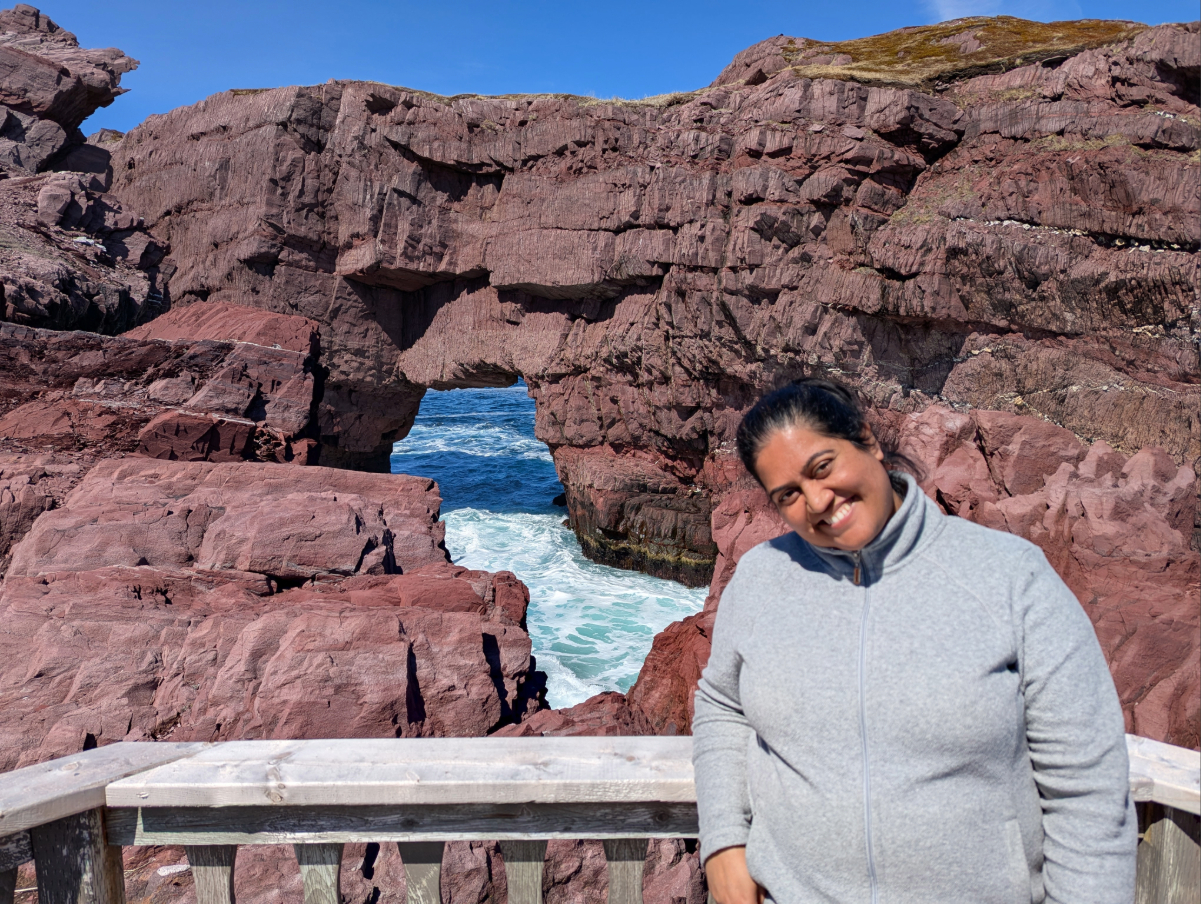
Banner image: Raman enjoys calling Newfoundland, Canada, home as she loves being surrounded by the ocean. Image courtesy of Vimal Simha.