- Facebook parent company Meta has closed nine groups on the social network after reporters from Mongabay and Bellingcat found evidence of illegal wildlife trade being conducted openly on the platform in Indonesia.
- In one Facebook group, reporters last year found an advertisement for a rhinoceros hornbill (Buceros rhinoceros), a protected species.
- “Bad actors constantly evolve their tactics to avoid enforcement, which is why we partner with groups like the World Wildlife Fund and invest in tools and technology to detect and remove violating content,” Meta said in a statement.
See All Key Ideas
This story was produced in collaboration with Bellingcat. Read their version here.
JAKARTA — A new report by Mongabay and independent journalism organization Bellingcat has uncovered several Facebook groups selling protected species in Indonesia, one of the most biodiverse countries in the world.
In a Facebook group whose Indonesian name translates to “West Bogor Animal Selling and Trading Forum,” reporters last year found a member of that group advertising a rhinoceros hornbill (Buceros rhinoceros) for sale. In Indonesia, all hornbill species are protected by law.
In comments below the post advertising the caged bird, one member warns: “Careful not to get caught.”
“That’s the risk,” replied the seller.
Another advertisement featured two infant Javan silvery gibbons (Hylobates moloch), fewer than 2,500 mature individuals of which are left in the wild. This species is also protected by law.
The West Bogor Animal Selling and Trading Forum group on Facebook added more than 200 advertisements in just one week. Eighteen of them were for threatened species.
In total, reporters uncovered a total of nine Facebook groups selling animals like these threatened apes and hornbills. Three of the groups have been active for more than five years. Meta, Facebook’s parent company, states that trade of animals on its platforms is prohibited.
Among thousands of adverts posted in the nine groups were a handful of animal photos with the same poster in frame, giving away the location as Station Sato, a quiet pet store in Cibinong, a southern suburb of Indonesia’s capital, Jakarta.
The inside of Station Sato, seen in mid-November 2025. Image by Achmad Rizki Muazam/Mongabay Indonesia.
Wildlife crimes
After Bellingcat identified the Facebook groups with photos taken at Station Sato, Mongabay visited the pet store three times, starting with a pair of undercover trips in October and November last year.
On one visit, we found three Javan coucal chicks (Centropus nigrorufus) confined without their mother. The chicks were likely around 2 weeks old.
The IUCN, the global wildlife conservation authority, first listed the Javan coucal as a vulnerable species on its Red List in 1994. That status was reaffirmed in the most recent assessment, published in 2025 amid a continuously declining population, now estimated at fewer than 10,000 mature individuals.
The store manager, Jordan Bastian, removed two of the protected birds from a cage and fed them rice bran. The Javan coucals were priced at 175,000 rupiah each, around $11 a bird.
Jordan said the chicks were taken from the wild in Tasikmalaya, a nearby district with a mix of heavy industry and urbanized areas, as well as surviving pockets of forest.
He claimed the birds were supplied by an acquaintance with a wider inventory of animals ready for sale.
Jordan runs the store, he said, on behalf of his father. Almost all of Station Sato’s sales are made online, Jordan said, with a network of brokers using Facebook and its sister company, WhatsApp, to connect with buyers. During three visits to Station Sato, Mongabay saw no sales, only window shoppers looking at caged animals.
A two-week-old Javan coucal is fed by the manager of the Station Sato pet store in Bogor in mid-November 2025. Image by Achmad Rizki Muazam/Mongabay Indonesia.
A long-tailed macaque (Macaca fascicularis) in a cage at the Station Sato pet store in Bogor. Image by Achmad Rizki Muazam/Mongabay Indonesia.
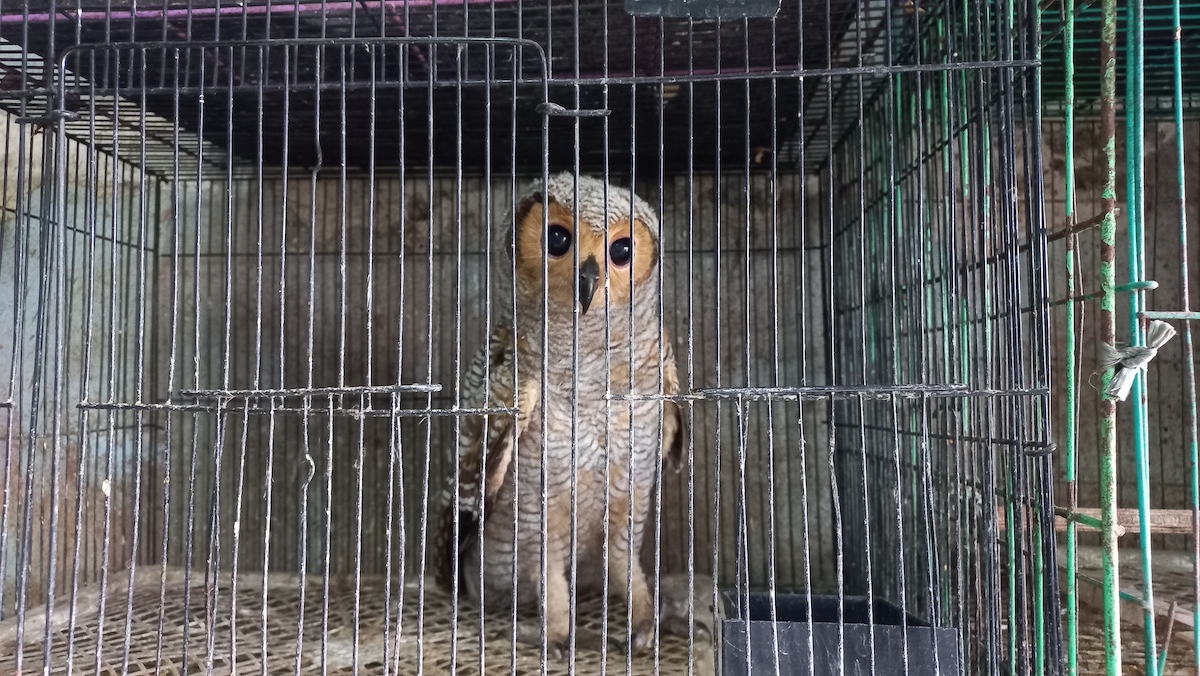
Station Sato sells owls, these belonging to an unprotected species. Image by Achmad Rizki Muazam/Mongabay Indonesia.
The store also advertises its animals on Tokopedia, the largest online marketplace in Indonesia, now owned by ByteDance’s TikTok.
Many of Station Sato’s 71 current listings on Tokopedia have been miscategorized by the seller as books, toys and other seemingly inert categories of goods.
Tokopedia prohibits the sale of endangered or protected wildlife on its platform, but its guidelines are perhaps unclear regarding the sale of other animals, including pets.
Station Sato used Tokopedia to obtain customers for its captive civets and reptiles, as well as long-tailed macaques (Macaca fascicularis), an endangered species whose wild populations have declined by 50-70% over the past three generations due to habitat loss and exploitation for medical research.
The business also sold barn owls (Tyto alba) and Oriental scops owls (Otus sunia).
Secret squirrels
On Nov. 28, Mongabay and Bellingcat presented these findings to Dwi Januanto Nugroho, the head of the Indonesian Ministry of Forestry’s law enforcement arm, and Satyawan Pudyatmoko, the ministry’s head of conservation.
Both officials pledged to investigate the report of animals sold by Station Sato.
On Dec. 1, officials from the provincial conservation agency of West Java province, where Cibinong subdistrict is located, conducted a spot check at Station Sato.
Stephanus Hanny Rekyanto, the head of conservation at the agency, the BKSDA, attended the inspection.
“We went inside and checked every animal … We did not find any protected species,” Stephanus said.
He added the only wildlife they found on sale at Station Sato were several owls and reptiles, none of which were illegal to trade.
“The shop owner previously dealt with protected wildlife several times,” Stephanus told Mongabay at his office in December. “But he learned his lesson — after that, he stopped selling protected species.”
Stephanus added that inspectors were satisfied the owner complied with regulations on protected wildlife trade under Ministry of Environment and Forestry Regulation No. 106/2018, which is the government’s updated list of protected species.
In response, reporters showed Stephanus a photo of a Javan coucal taken on Nov. 8 as evidence that a protected species was present at Station Sato. Stephanus said inspectors did not find any Javan coucals during their inspection.
Stephanus said he lacked the expertise to identify juvenile birds, and called in a bird breeder who happened to be at the conservation agency office to identify the chick in the photo.
“This is a Javan coucal, sir,” the breeder said.
Three two-week-old Javan coucals are caged without their mother at Station Sato pet store in Bogor, in mid-November 2025. Image by Achmad Rizki Muazam/Mongabay Indonesia.
Even if protected wildlife were found during the site visit, Stephanus said, the conservation agency did not have the authority to prosecute Station Sato.
However, Stephanus said Station Sato had since been placed on a watchlist, and that officials had warned Jordan, the store manager, not to break the law.
“We emphasized that selling protected wildlife is a criminal offense,” Stephanus said. “Even when selling unprotected species, we advise compliance with applicable regulations.”
In February, Mongabay’s reporter returned to Station Sato, identifying themselves as a journalist to ask Jordan about the findings.
When shown his store’s Tokopedia advert for a Javan coucal, Jordan said he was unaware the species was classified as vulnerable by the IUCN or listed as protected in Indonesia. Tokopedia did not respond to a request for comment about the listing.
“Selling protected animals now is confusing,” Jordan said, adding that his Tokopedia account had been suspended for selling squirrels. “The profit is small, the risk is huge — better to stick to the safe ones.”
Enforcement capacity
The value of the illegal wildlife trade in East Asia and the Pacific is often quoted as around $2.5 billion per year, with Indonesia accounting for as much as $1 billion, on top of the “enormous economic, environmental and social losses,” according to the United Nations Development Programme.
Facebook began working with WWF and other environmental groups in 2016 through the creation of the Coalition to End Wildlife Trafficking Online, which aimed to cut wildlife trade on the platform by 80% within four years.
In 2019, Facebook banned the sale of live animals on the platform, except by verified sellers with legitimate purposes. The following year, the Coalition to End Wildlife Trafficking Online introduced alerts warning users about the illegality of wildlife trade when relevant search terms were entered.
Despite these efforts, it remains unclear the extent to which the trade has declined, if at all. Academics and NGOs say the illegal wildlife trade is constantly expanding, with online marketplaces playing a key role.
Screenshots of tortoises, monkeys and owls for sale posted in the Facebook groups reviewed by Bellingcat for this investigation, October 2025.
Data gathered by Garda Animalia, an Indonesian wildlife nonprofit, showed an increase in advertisements for five threatened groups of animals — cockatoos, gibbons, macaques, parrots and slow lorises — between 2020 and 2025. Its monitoring covers dozens of Facebook groups trading the species.
“There are so many groups,” Muhammad Iqbal Patiroi, research lead at Garda Animalia, told Mongabay. He added that sellers often used fake names, concealed their locations, and conducted transactions through an escrow system to reduce risk of detection by authorities.
One factor that may be supporting the illegal wildlife trade on online marketplaces like Facebook is that criminals routinely used crude shorthand to conceal what they’re really doing.
The abbreviation “WC” is commonly used in animal trading for “wild-caught.” The term was used frequently across all nine groups uncovered by Bellingcat, which specializes in open-source investigations. Meanwhile, traders use a simple code system for pricing, presumably in a bid to cloak the nature of their business from automated moderation systems.
In this code, letters correspond to Indonesian rupiah denominations: “A” represents the 100,000-rupiah note (about $6) and “B” the 50,000 note (about $3). Numbers indicate the quantity of notes, so “A3” would mean 300,000 rupiah, slightly less than $20.
Screenshot of a conversation on Facebook discussing the price of animals. Blurring by Bellingcat.
Owls for sale, posted to Facebook by a broker linked to the Station Sato pet store. Left: Labelled “Wc” for wild-caught. Right: “BC” for bred in captivity.
Dwi Januanto, the forestry ministry law enforcement chief, said organized crime “can evolve faster than the law enforcement system.”
Bellingcat asked Meta whether its moderation systems was on top of these basic codes used for pricing (either as text or embedded in images), or key terms such as “WC.”
“Bad actors constantly evolve their tactics to avoid enforcement, which is why we partner with groups like the World Wildlife Fund and invest in tools and technology to detect and remove violating content,” Meta said in a statement.
Meta has since closed nine online groups, which comprised tens of thousands of members in total.
“We removed the Facebook groups and profiles in question for violating our Restricted Goods and Services Policy,” Meta said in a statement.