- Almost half of the Western Indian Ocean’s shark and ray populations are considered threatened with extinction, as populations decline.
- The Important Shark and Ray Areas (ISRAs) project has mapped out 125 areas across the Western Indian Ocean that are critical for the survival of many species.
- Yet only 7.1% of these ISRAs fall within existing marine protected areas, and just 1.2% are in fully protected areas where fishing is prohibited.
- Researchers identified challenges related to fishing pressure as the most significant threat to sharks and rays in the region.
See All Key Ideas
Sharks and rays in the Western Indian Ocean are facing an extinction crisis. Almost half of the region’s 270 known species (46%) are currently threatened with extinction. A recently released study by the Shark Specialist Group of the IUCN, the global wildlife conservation authority, mapped out areas that are vital for the species’ survival, while finding that only a fraction of them overlap with currently protected areas.
The research identified 125 Important Shark and Ray Areas (ISRAs) covering 2.8 million square kilometers (1.1 million square miles) across the Western Indian Ocean, which stretches from South Africa to the Indian subcontinent and includes island nations like Seychelles and the Maldives.
“The most striking finding is how poorly these important habitats are currently protected,” Rima Jabado, chair of the Shark Specialist Group, told Mongabay. Only 7.1% of ISRAs overlap with any marine protected area, and just 1.2% fall within fully protected no-take zones, where no fishing is allowed. “The vast majority of places that are essential for sharks and rays remain open to fishing pressure,” Jabado said.
An Important Shark and Ray Area is a defined part of the ocean that’s critical for the survival of one or more shark, ray or chimaera species. “What distinguishes an ISRA from other marine areas is that it is identified using standardized, evidence-based criteria that reflect how they use space throughout their life cycle,” Jabado said.
A shoal of spinetail devil rays (Mobula mobular), whose conservation status worsened in 2025 from endangered to critically endangered on the IUCN Red List. Image courtesy of Stella Diamant.
The main criterion for the designation of an ISRA is the regular and predictable occurrence in an area of sharks and rays, either as residents or as seasonal visitors. The mapped areas range from surface waters to depths of around 2,000 meters (6,600 feet), and vary dramatically in size. The smallest, Maroshi Thila in the Maldives, covers just 0.03 km2 (0.01 mi2). The largest, the Western Agulhas Front, which lies outside any country’s national jurisdiction, spans 1.45 million km2 (nearly 562,000 mi2).
The Western Indian Ocean covers 8% of the world’s ocean area and is home to a high number of species found nowhere else, including certain sharks, rays and cetaceans. It’s both a biodiversity hotspot and one of the most heavily exploited marine regions on the planet — millions of people living in coastal nations across the region rely on the ocean for food.
ISRAs in the Western Indian Ocean region. ISRAs come in a wide range of sizes. Though not easily visible on the map, there are 27 small ISRAs just in the waters of the Maldives, an archipelagic nation to the southwest of India. Image courtesy of IUCN SSC Shark Specialist Group.
“There is high dependence on fishing and marine resources, including sharks and rays, for nutrition and income, yet there is a generally poor understanding of true fishery impacts,” said Rhett Bennett, program manager for the Western Indian Ocean shark and ray conservation program at the Wildlife Conservation Society.
Scientists call the Western Indian Ocean a conservation “dark spot” where intense fishing pressure collides with conservation efforts. The problem stems from both industrial and artisanal fleets, and includes widespread, often unregulated use of destructive fishing gear like gill nets; lack of data on real fishing effort; widespread operation of unlicensed vessels; fishing in protected areas or no-take zones; and general inadequacy of policy and enforcement measures by coastal countries.
“We need local management using a variety of strategies to allow fisher livelihoods and species conservation to coexist,” Jesse Cochran, lead author of the Shark Specialist Group’s new paper, told Mongabay via email. ISRAs are one tool among many that can inform the development of such strategies, he added.
Because of the lack of scientific data on sharks and rays in the study region, the scientists made use of government and fisheries records, as well as citizen science, allowing them to document species that, without alternative data sources, would remain largely invisible.
In some instances, otherwise data-limited species were included in the process on the basis of unpublished records, Cochran said. This provided the opportunity of designating ISRAs in areas where such species, often classified as critically endangered on the IUCN Red List of Endangered Species due to the paucity of observations, are likely to be present.
Examples are the inclusion of the reproductive habitats for the critically endangered halavi guitarfish (Glaucostegus halavi) in the northern Red Sea, and an aggregation of the critically endangered ornate eagle ray (Aetomylaeus vespertilio) in the Maldives, Cochran said. “Both species are poorly studied and both are severely threatened. We were able to map some high-use habitats for them because the ISRA process cast a wide enough net.”
Data biases posed one of the key challenges for researchers who came together in Durban, South Africa, in 2023 to identify the areas in the Western Indian Ocean. For instance, large, shallow-water species are better represented than deepwater species. Several ISRAs were identified for deepwater sharks and rays that are rarely seen but often caught as bycatch — species among the most vulnerable due to slow growth and low reproductive rates.
Some species such as the highly threatened electric rays appear poorly represented within the Western Indian Ocean ISRAs due to lack of data.
The Western Indian Ocean is a critical habitat for the endangered whale shark (Rhincodon typus). Image courtesy of Stella Diamant.
There’s greater interest in capturing the ecological value of marine spaces as countries move toward the goal of protecting 30% of the world’s oceans by 2030, as agreed under the Kunming-Montreal Global Biodiversity Framework. Currently, 6.4% of the Western Indian Ocean, or 1.8 million km2 (nearly 700,000 mi2), is protected; of which less than one-third (31%) is fully protected, where fishing is prohibited.
“As countries move towards their 30×30 conservation targets, they need to ensure that spatial conservation measures are placed in ecologically important areas,” said Bennett from WCS.
The authors of the report call on governments to make sharks and rays a focal point when it comes to conservation and the designation of new protected areas.
“ISRAs are guiding management prioritization and identifying key study sites for some species while also highlighting critical knowledge gaps for others,” Cochran said, referring to largely understudied species like electric rays.
However, researchers warn that merely increasing the number of marine protected areas without strategic planning isn’t the solution.
“MPAs would have the greatest benefit for sharks and rays, if surrounded by effective fishery management in areas adjacent to the MPAs, which would reduce the risk of mortality as mobile animals exit the MPA boundaries,” Bennett said. “Species prioritization and habitat targeting based on the ISRAs would be much more effective.”
Some species may require other conservation strategies than protection sites, including restrictions on certain types of fishing gear, seasonal closures, and go-slow zones, Cochran said.
“Using ISRAs to guide the placement or redesign of MPAs ensures that new protections are ecologically meaningful, increasing the likelihood that spatial conservation will translate into real population-level benefits for sharks and rays, rather than just adding area on a map,” said Jabado, the Shark Specialist Group chair.
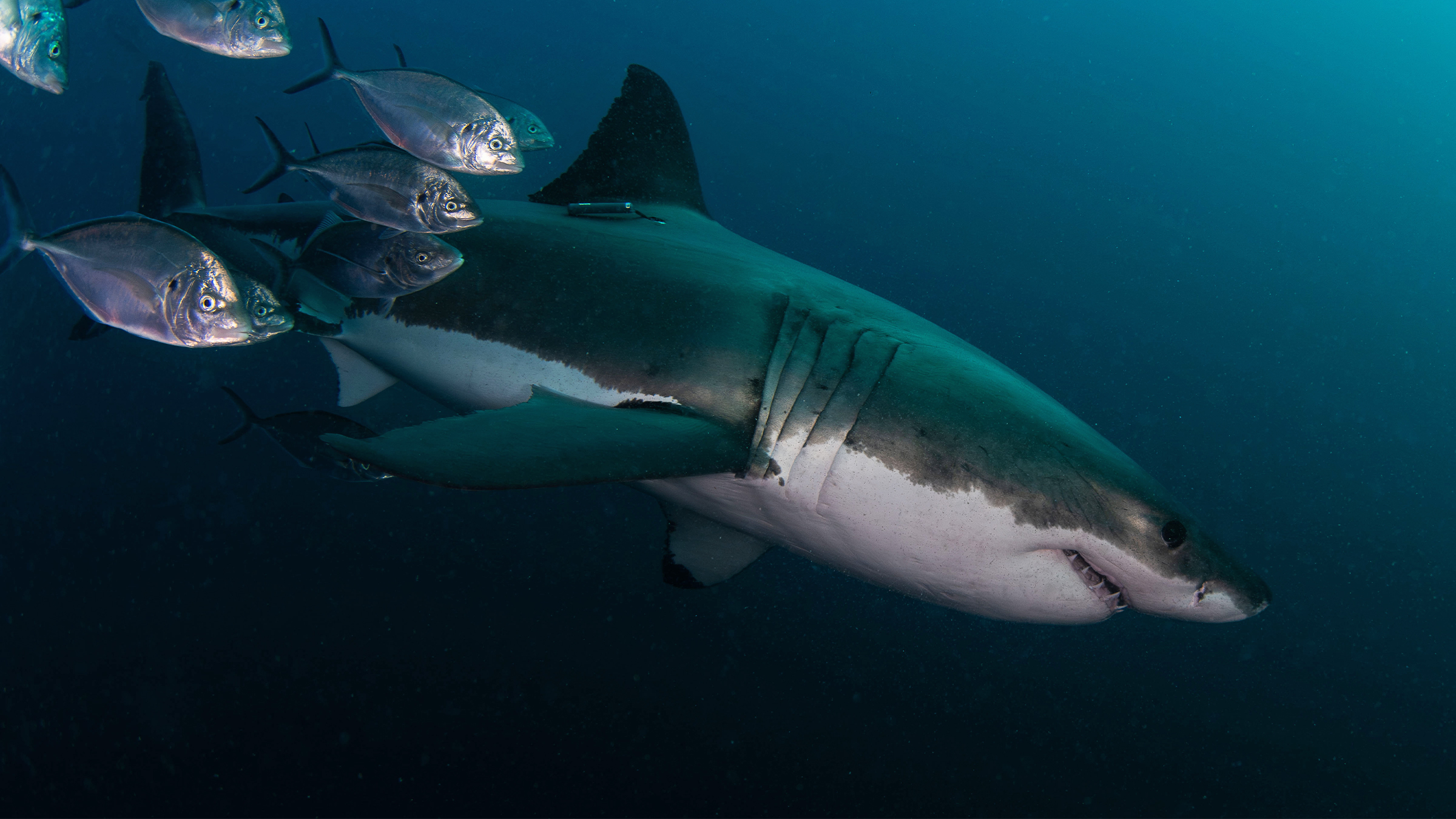
Banner image: A great white shark (Carcharodon carcharias). Image courtesy of Balazs Fodor / Ocean Image Bank.
Global tracking study reveals marine megafauna hotspots lie largely unprotected
Citations:
Cochran, J. E., Charles, R., Temple, A. J., Kyne, P. M., García‐Rodríguez, E., Gonzalez‐Pestana, A., … Jabado, R. W. (2026). Only one percent of Important Shark and Ray Areas in the Western Indian Ocean are fully protected from fishing pressure. Ecology and Evolution, 16(1), e72690. doi:10.1002/ece3.72690
Dulvy, N. K., Pacoureau, N., Matsushiba, J. H., Yan, H. F., VanderWright, W. J., Rigby, C. L., … Simpfendorfer, C. A. (2024). Ecological erosion and expanding extinction risk of sharks and rays. Science, 386(6726). doi:10.1126/science.adn1477