- Following local Indigenous Brao reports of health issues stemming from water since gold mining began in the area in 2023, Cambodian authorities tested water and sediment from the O’Ta Bouk River in February.
- To date, no results of water, sediment or fish sampling has been made public, despite experts urging more comprehensive testing and communities languishing in uncertainty over the safety of the river.
- All of this is taking place in Virachey National Park, one of Cambodia’s oldest and most remote protected areas, home to many endangered species, where the Cambodian government awarded an 18,900-hectare mining exploration license to a politically connected company.
- Brao fishers who live along the banks of the O’Ta Bouk River say there are no fish in the water, which they attribute to persistent problems linked to pollution; farmers who use the O’Ta Bouk’s waters for irrigation question whether to plant another year’s crops.
See All Key Ideas
PHNOM PENH, Cambodia — Authorities from Cambodia’s Ministry of Environment were dispatched to Mondul Yorn, a small village in the remote northeastern province of Ratanakiri, on Feb. 13 to conduct water and sediment testing on the O’Ta Bouk River following community complaints of health problems linked to declining water quality.
Then, from Feb. 17-20, the Inland Fisheries Research and Development Institute (IFReDI), a government agency that sits under the Fisheries Administration, sent two teams to catch 34 species of fish from the Sesan River and the O’Ta Bouk, a tributary that flows into the Sesan, itself a key tributary of the Mekong River.
The O’Ta Bouk flows south through a gold mining operation in Ta Veng district before it reaches Mondul Yorn, where Indigenous Brao communities have reported experiencing skin rashes and itching sensations after coming into contact with the river’s water since gold mining began in mid-2023.
To date, no results of water, sediment or fish sampling have been made public, despite experts urging more comprehensive testing and communities languishing in uncertainty over the safety of the river.
IFReDI officials taking samples on the O’Ta Bouk River in February 2026. Photo sourced from IFReDI’s Facebook.
A park in peril
Villagers living along the O’Ta Bouk report the river had turned brown and murky starting roughly in mid-2023; the mud on its banks, sticky. Many of the Brao farmers and fishers have avoided entering the water, drinking it or bathing in it or fishing in the river. These problems persisted when Mongabay visited the O’Ta Bouk in November 2025, and communities report they are ongoing as of March 2026.
All of this is taking place in Virachey National Park, one of Cambodia’s oldest and most remote protected areas, spanning some 405,000 hectares (1 million acres) and home to an estimated 89 species, including many endangered and critically endangered animals. It’s one of Cambodia’s least explored national parks, as well as one that’s attracted nearly $2 million from international donors to ensure the park’s protection.
But neither the endangered wildlife nor the conservation funding prevented the Cambodian government from awarding an 18,900-hectare (46,700-acre) mining exploration license to Global Green (Cambodia) Energy Development, a politically connected company, on June 29, 2023. Later that year, on Dec. 19, 2023, Global Green was also granted a 4,000-hectare (almost 10,000-acre) economic land concession that sits within the 18,900-hectare mining concession. Ownership of the mining license appears to have been transferred to another company in January 2025, more than a year after complaints about pollution began.
A resident shows reporters a photo taken on July 30, 2025, of his sister’s leg after she entered the O’Ta Bouk river to bathe. They told reporters that the red welts developed around three days after her skin made contact with the water. Photo by Andy Ball/Mongabay.
Mongabay has seen no evidence suggesting that control of the 4,000-hectare land has changed from Global Green. The Ministry of Environment, the Ministry of Agriculture, Forestry and Fisheries and the Ratanakiri provincial administration would not confirm this when asked by Mongabay.
Mongabay reported on this issue in November 2025, where initial testing revealed dangerous levels of contamination. Cambodian Minister of Mines and Energy Keo Rattanak dismissed the story as “fake news” at the time. Shortly after doing so, the government quietly sent officials to assess the situation on the ground.
Now, more than two months after tests were conducted, the Cambodian government has still not published the results or provided guidance to the affected communities on how to live with the contamination threat.
Mines identified by the Stimson Center match areas along the O’Ta Bouk River where Global Green was granted an 18,900-hectare exploratory mining license in 2023. The concession was transferred to Thea Karng Development Investment in January 2025. Image by Emilie Languedoc / Mongabay.
Troubled waters
“I heard from the officer who joined the trip with the environment ministry that their officers came to collect water samples from Modul Yorn,” one Brao resident of Ta Veng district, who requested anonymity due to the sensitivity of the issue, told Mongabay in March 2026. “Both the environment ministry and the fisheries authorities visited earlier this year; I asked them if they found anything, to let me know. As of now, they haven’t told me anything.”
According to the resident, no information has been provided to the communities or local officials regarding the water, sediment and fish samples taken in February 2026.
“When [our community] reported the mining operation to the local authorities, they responded that there was no mining operation, so we are not sure if they conspired with each other or not; we just don’t know,” the resident added.
Mongabay repeatedly sent questions via Telegram, a messaging app popular in Cambodia, to the Ministry of Environment and the IFReDI, which were both involved in testing water, sediment and fish along the O’Ta Bouk and Sesan rivers. Environment Minister Eang Sophalleth did not respond to questions, while Heng Kong, director of IFReDI, declined to share results from the tests conducted.
“We found that the concentration of those heavy metals relatively low to the proposed standard,” said Kong. “We could not analyze for all species, selected only family.”
IFReDI posted on their official Facebook page detailing the tests conducted on water, fish and sediment from the O’Ta Bouk River, but to date, the results remain unpublished. Photo sourced from IFReDI’s Facebook.
Kong declined to clarify which standard he was using and has since not answered further questions posed by Mongabay. No government agency has released these findings or informed affected communities of any safety protocols needed.
Fishers among the Indigenous Brao communities that live along the banks of the O’Ta Bouk told Mongabay in March there were no fish in the water, which they attributed to persistent problems linked to pollution.
“People haven’t dared to use the water because it is too murky,” said another Ta Veng district resident, noting that only a few farmers had access to wells. “It might be hard for the coming farming season.”
For those who farm along the riverbanks and use the O’Ta Bouk’s waters for irrigation, the question of whether to plant another year’s crops weighs heavy amid the silence from the government.
“Whether it is to avoid criticism, protect business interests or control the narrative, withholding contamination data puts communities at risk,” said Lisa Mean, a member of Mother Nature Cambodia. “The people living along the O’Ta Bouk River cannot make safe decisions if they are kept in the dark.”
A Brao Indigenous resident of Mondul Yorn village harvests rice at their plantation along the banks of the O’Ta Bouk River. The village’s Indigenous Brao community has heavily relied on the O’Ta Bouk River for generations to farm, fish, and source drinking water. Photo by Andy Ball/Mongabay.
Whose gold mine is it anyway?
Global Green did not respond to questions sent by email and its representatives could not be reached by phone. However, on Jan. 18, the company responded to a viral social media campaign launched on Jan. 17 by Mother Nature Cambodia, issuing a statement saying, “Our company has never conducted gold mining and other mineral mining activities in the national park located in Ta Bok Village, Ta Veng Leu Commune, Ta Veng District, Ratanakiri Province, as claimed by Mother Nature Cambodia.” The company also stated that it “is not affiliated with tycoon Try Pheap and his family.”
After Pheap was sanctioned by the U.S. government in 2019, ownership of some of his businesses, including Global Green, transferred to Hann Sinath, a man reported to be a representative of Pheap by pro-government news.
While Global Green denied any involvement in the mining operations that have contaminated the O’Ta Bouk River, documents seen by Mongabay and verified by relevant government officials suggest the company controlled the mining exploration site when pollution was first reported by communities in late 2023 to early 2024, and that Pheap himself remained involved in the project.
U.S. think tank the Stimson Center published data in 2025 identifying mining operations across mainland Southeast Asia through extensive satellite imagery analysis, with 12 suspected mines seen opening in 2024 around the O’Ta Bouk River. Most of these 12 are located within the 4,000-hectare concession awarded to Global Green in 2023.
Satellite imagery from Google Earth shows how the gold mine was built atop the O’Ta Bouk River from late 2023 to the end of 2024, a period when documents show Global Green controlled the mining concession. Image by Emilie Languedoc/Mongabay.
Documents, verified by relevant authorities in Cambodia, show that in 2024, Global Green commissioned an environmental impact assessment for the 18,900-hectare mining site along the O’Ta Bouk River. While another document, dated July 1, 2024, and signed by Pheap, shows the tycoon joined an inspection of the mining site, a visit for which he was listed as “team leader.”
Less than two weeks after Mongabay’s first article published in November 2025, the Ministry of Environment announced a review of environmental impact assessments produced for Global Green’s other mining operations in Preah Vihear province.
According to a ministry source, officials had previously inspected the mine suspected to be the cause of contamination in the O’Ta Bouk River over the course of December 2024 and January 2025. Time-stamped and geotagged photos published in pro-government media place Ministry of Environment officials inside Global Green’s mining exploration area in December 2024.
Months after Mongabay’s first story published, reporters received documents that have since been verified by officials and show that, on Jan. 23, 2025, the Ministry of Mines and Energy awarded an 18,900-hectare mining exploration license to Thea Karng Development Investment.
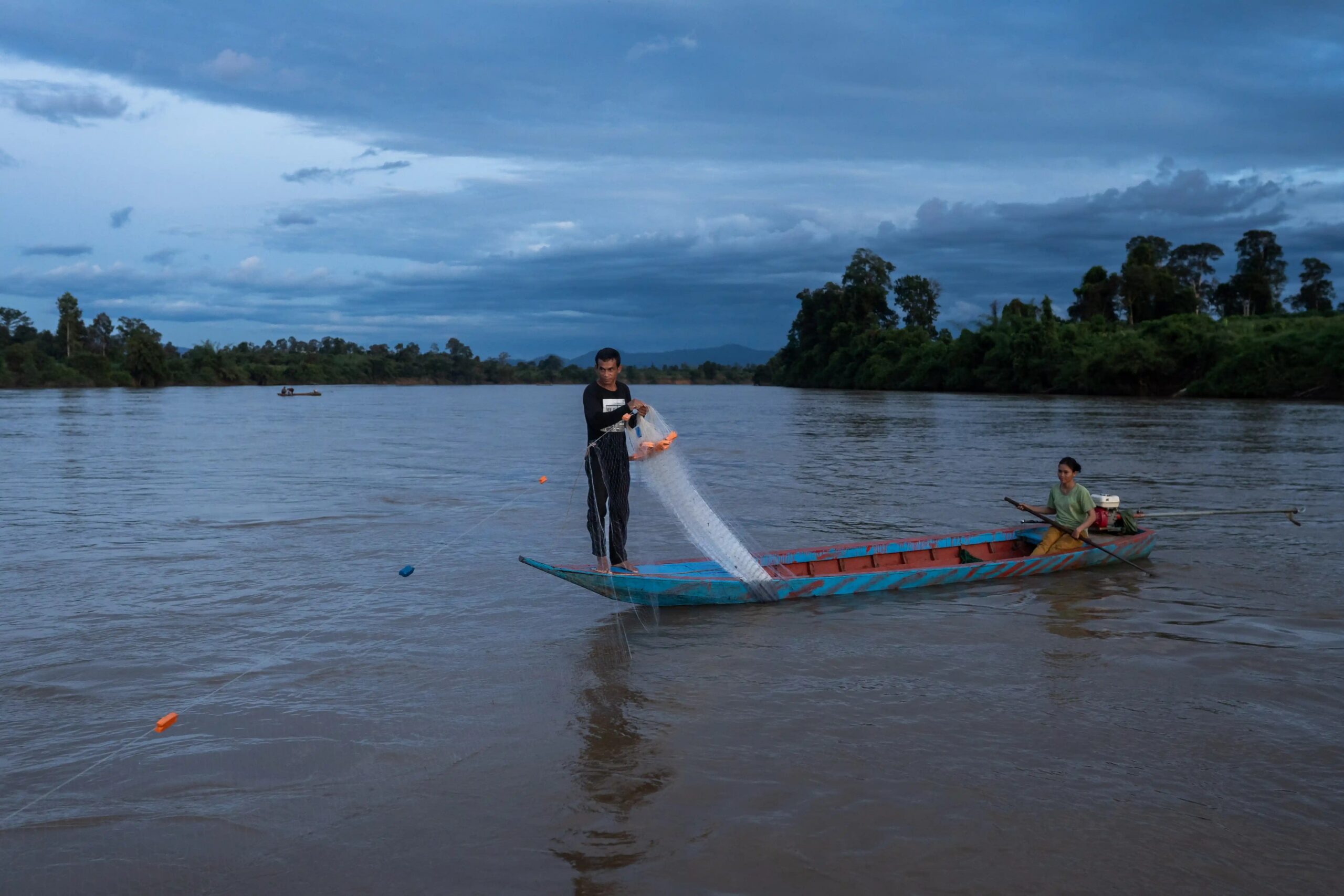
A fisher lays nets on the O’Ta Bouk River, just a few hundred meters from the O’Ta Bouk-Sesan confluence. Communities living along the river’s banks told Mongabay that the O’Ta Bouk no longer follows a seasonal color change. Instead, they said, it’s turned “muddy” all-year-round. Photo by Andy Ball/Mongabay.
The company was incorporated less than nine months prior and chaired by real estate mogul Hong Piv, an adviser to the Cambodian Oknha Association, an official institution representing the interests of Oknhas, Cambodians who have paid at least $500,000 to the government for the honorific title that roughly translates to tycoon or lord.
This 2025 mining license doesn’t mention Global Green, but coordinates for the mining area match the 18,900-hectare license granted to Global Green in 2023. Thea Karng Development Investment’s 2025 mining license also notes that the license is valid from June 29, 2023, which precedes the company’s founding and is the same date Global Green were granted their exploratory mining license. Thea Karng Development Investment’s license extends until June 29, 2026, Global Green’s original deadline.
On Feb. 7, 2025, another document shows Global Green transferred its July 2024 environmental impact assessment over to Thea Karng Development Investment, including the company’s responsibility to implement the findings of the study within the mining site.
On Jan. 19, Cambodian mining authorities also took to social media, saying Thea Karng Development Investment owned the mining site atop the O’Ta Bouk River.
Tun Chhaypech, listed as a director at Thea Karng Development Investment, confirmed his identity when reporters contacted him but declined to answer questions without authorization from his boss. He has since not responded to Mongabay’s calls or messages.
Indigenous Brao residents of Ta Veng district in Ratanakiri told Mongabay that fear of the water pollution persists. Photo by Andy Ball/Mongabay.
Greater testing and law enforcement needed in face of mining boom
Cambodia is not alone in facing the problem of contaminated rivers. Across mainland Southeast Asia, governments and civil society are grappling with pollution from unregulated mines flowing through the region’s rivers, contaminating water sources, fish and crops. Incidents have been reported in Laos, Myanmar and Thailand, while the Mekong River Commission has urged more governments to test rivers for heavy metal contamination as the rising global demand for critical and rare earth minerals has unleashed a new mining boom across the Mekong.
But while Cambodia has conducted testing, there appears to be little, if any, government action based on the results.
While government officials have attacked reporting on the issue as “fake news,” nobody involved in regulating or operating this mine whom Mongabay contacted responded to our requests for comments to clarify this issue or matters related to the ongoing pollution reported by communities downstream on the O’Ta Bouk.
A boat on the O’Ta Bouk River, the longest river in Virachey National Park. Photo by Andy Ball/Mongabay.
The Cambodian government has shown it has the capacity to deal with these problems, shutting down a polluting mining operation in Kampong Chhnang province in December 2025 after local residents complained of a fish die-off. This stands in stark contrast to Virachey, where Indigenous communities have been kept in the dark.
Ung Eang, a secretary of state and spokesperson for the Ministry of Mines and Energy, did not respond to questions sent via the Telegram messaging app regarding mining operations on the O’Ta Bouk River.
“A system that operates to benefit elites like this should not be called a government for the people, but rather a government for its own sake,” said Lisa, the Mother Nature Cambodia activist. “We must stand up, especially the communities that understand better than anyone else the importance of water as the source of their lives. Of course, [the government] should do more testing. People’s lives should come before economic growth, especially when that ‘growth’ only benefits a small group of well-connected elites.”
Banner image: A Brao fisher drops his nets in the O’Ta Bouk River, despite fears of contamination linked to gold mining. Photo by Andy Ball/Mongabay.