- A pair of California condors reintroduced by the Yurok Tribe to Northern California appear to be incubating the first egg in the Pacific Northwest in more than a century, nesting in a remote old-growth redwood.
- The birds, both nearly 7 years old and among the first cohort released in 2022, are being monitored via satellite transmitters; direct confirmation of the egg is not yet possible.
- The discovery is a milestone for a species whose global population dropped to 22 individuals in 1982 and has since recovered to 607 — though threats still including lead poisoning and avian influenza persist.
- The Northern California Condor Restoration Program, a partnership between the Yurok Tribe and Redwood National and State Parks, plans to continue annual releases for at least 20 years, with the goal of establishing a self-sustaining Pacific Northwest flock.
See All Key Ideas
A pair of California condors reintroduced to the Pacific Northwest by the Yurok Tribe appears to have established the species’ first nest in the region in more than 100 years, program officials announced in early March.
Based on shifts in behavior and satellite flight data, biologists with the Northern California Condor Restoration Program (NCCRP) determined that the female condor, known by her Yurok name Ney-gem’ Ne-chween-kah (“She carries our prayers”), likely laid an egg inside a hollow in an old-growth redwood tree along Redwood Creek drainage in early February. Her mate, called Hlow Hoo-let (“At last I fly”), has been sharing incubation duties.
Both birds are roughly 6 years and 10 months old, right at the cusp of sexual maturity for the species, which typically begins breeding between the ages of 6 and 7.
“This is a huge moment for our Northern California flock,” said Chris West, the NCCRP program manager and Yurok Wildlife Department senior biologist. “It is important to remember that these are wild birds. We trap them occasionally for health monitoring, but if they nest, and how successful they are, is totally up to them, with as little interference from us as possible.”
The nest site is too remote for direct visual confirmation, so staff are relying on wing-mounted transmitters and field observations to monitor the pair’s progress. The program is exploring the use of drones to get a look at the nest. The egg, if present, would take 55-58 days to hatch, with both parents taking turns on incubation shifts, a behavior typical of the species.
California condor Ney-gem’ ‘Ne-chweenkah’ which translates to “She carries our prayers”, may be the first to have laid an egg in Yurok territory on morethan 100 years. She was the only female in the first released NCCRP cohort. Image courtesy of Matt Mais/ Yurok Tribe
The discovery of the nest carries significance for the Yurok people. The California condor (Gymnogyps californianus) or prey-go-neesh in the Yurok language, is sacred to the tribe, and its feathers and songs are integral to Yurok World Renewal ceremonies.
In 2003, a panel of Yurok elders designated the condor as the top priority for land-based species restoration on their ancestral territory. The tribe spent nearly two decades conducting studies, evaluating contaminant risks, and building partnerships before releasing the first cohort of four condors in May 2022.
The species’ slow reproductive cycle makes every breeding attempt consequential. They nest only every other year, laying just a single egg per clutch, and it takes more than a year of parental care before a chick can fend for itself .
“I have been waiting for this moment since the first condors arrived in 2022,” said Tiana Williams-Claussen, director of the Yurok Wildlife Department.
Although the news is hopeful, biologists are tempering their expectations. First-time condor parents often fail to hatch their first egg due to inexperience with incubation. “As a scientist, I know I shouldn’t get my hopes up too high, but that doesn’t mean I can’t cheer for these young parents’ success,” Williams-Claussen said.
This female California condor may be the first to next in the Yurok territory in Northern California for more than 100 years. Photo Matt Mais/Yurok Tribe
The nesting comes at a cautiously optimistic time for the species. The California condor’s entire population stood at 607 individuals, according to a December 2025 count by the U.S. Fish and Wildlife Service. That marks a dramatic recovery from 1982, when only 22 of the birds remained.
By 1987, every surviving condor had been captured for a last-ditch breeding program. Reintroductions began in 1991, and have since expanded to sites in Central and Southern California, Arizona, Baja California, and now the Pacific Northwest.
Still, the species faces persistent threats. Lead poisoning from ammunition fragments in carrion remains the leading cause of condor mortality, and avian influenza killed more than 20 condors in the Southwest flock in recent years.
A young California condor named Pey-noh-pey-o-wok’ (I am friend or kind or good natured) was found dead in the backcountry of Redwood National Park in January 2025, the first loss for the northern California flock. He was roughly 18 months old. The cause of death was determined to be lead poisoning.
“A natural death would have been less painful for us, the humans watching as he started to flourish in the wild. Pey-noh-pey-o-wok’ was known for his friendliness, preening and huddling together with other condors, sharing food easily. He had only been flying free for a few months. That he was brought down by something human caused and preventable is devastating,” said Williams-Claussen.
Twenty-four condors now fly within Yurok ancestral territory, and the NCCRP plans to release at least one new cohort each summer for the next two decades. Whether this new nesting attempt leads to a successful hatching, the fact that reintroduced condors are attempting to breed in their historical northern range represents a meaningful step for a recovery effort more than four decades in the making.
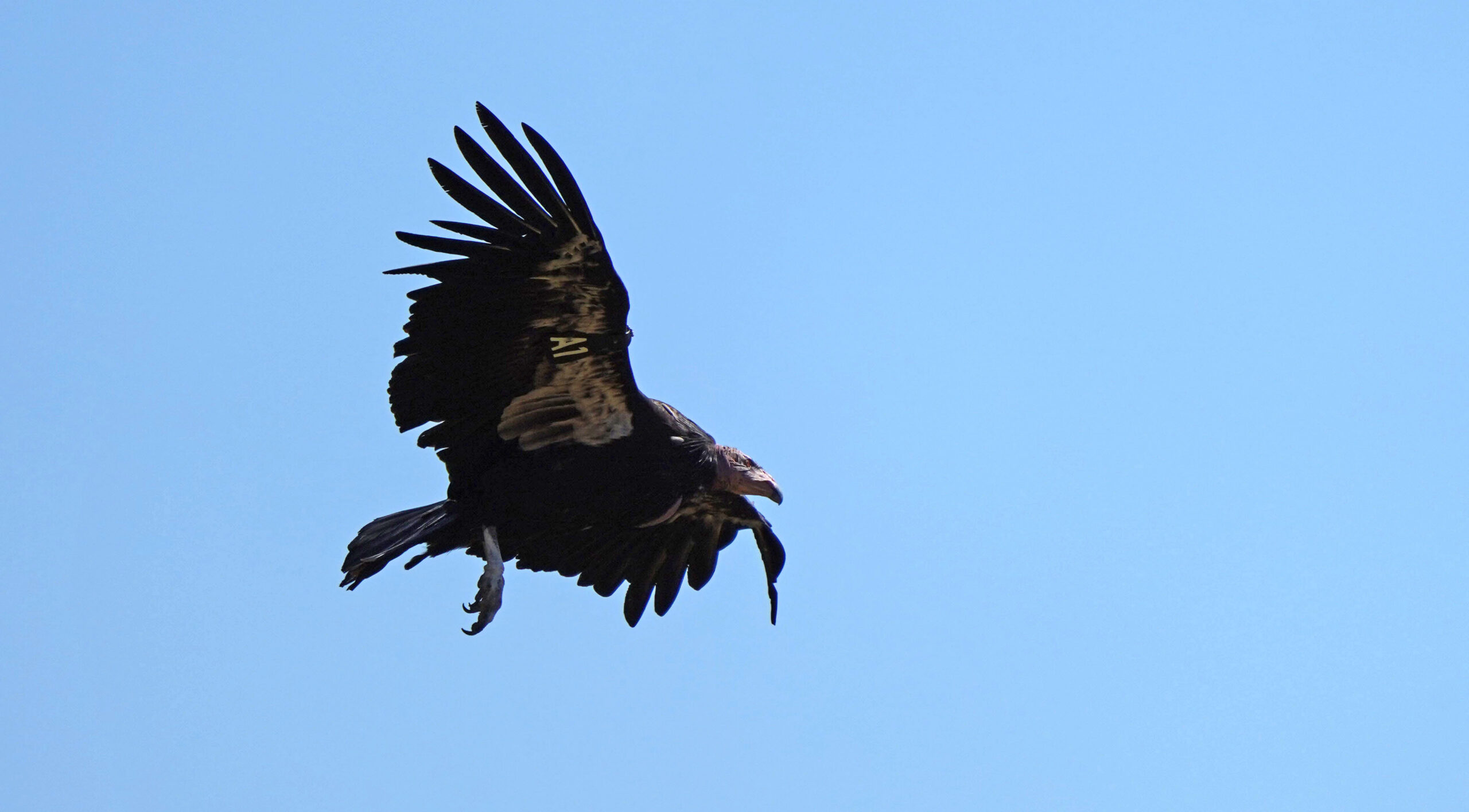
Banner image of California condor named Hlow Hoo-let (“At last I fly”), flies free in the Yurok territory in Northern California. Photo Matt Mais/Yurok Tribe
Liz Kimbrough is a staff writer for Mongabay and holds a Ph.D. in ecology and evolutionary biology from Tulane University, where she studied the microbiomes of trees. View more of her reporting here.
Largest dam removal ever, driven by Tribes, kicks off Klamath River recovery
FEEDBACK: Use this form to send a message directly to the author of this post. If you want to post a public comment, you can do that at the bottom of the page.