- Ahead of Bangladesh’s first national elections post the uprising of the previous government in 2024, major political parties have proposed environmental protection plans, which experts term “inadequate” and “unrealistic.”
- Crucial issues like biodiversity conservation, climate change-driven internal migration and other environmental actions, like taking up appropriate projects and deliberate fund management, are not addressed, experts say.
- They also say the election manifestos completely ignore the reforms in environmental laws enacted by the interim government.
See All Key Ideas
Feb. 12 marks Bangladesh’s first national election poll since the 2024 mass uprising and the consequent fall of the Awami League government after 15 years in power, a period its political opponents blame for policies that accelerated environmental degradation, among other faults.
In the lead up to the 13th Jatiya Sangsad (National Parliament) Election, there were expectations that the political parties that led the uprising would come up with conservation-based and climate change-focused policies to make up for the decade-long environmental losses.
In their election manifestos, the major opposition parties have outlined mass tree plantation, expectation for electricity from renewables, pollution control, industrialization outside wildlife zones, climate diplomacy and resilient agriculture.
However, conservation experts express their frustration with these manifestos, saying that the policy documents lack “merit” and a “realistic implementation plan.”
“The environmental protection and climate change mitigation plans, mentioned in the manifestos, are not clear to us,” Arafat Rahman, general secretary of the Bangladesh Biodiversity Conservation Federation’s (BBCF), an umbrella organization uniting several environmental and conservation organizations, tells Mongabay.
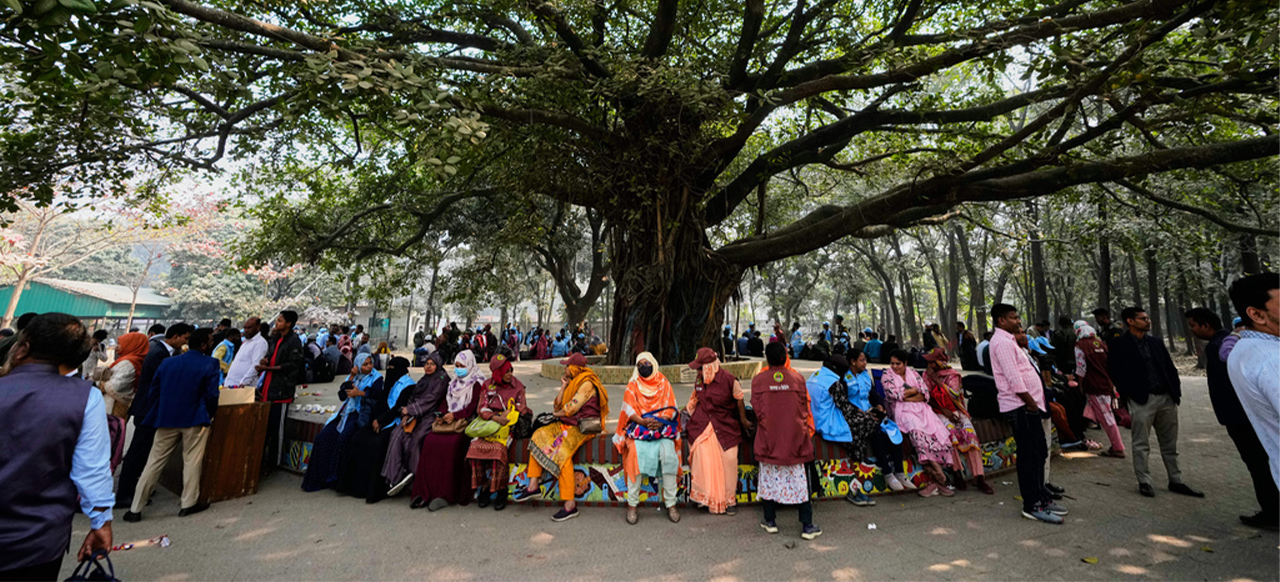
On Feb. 6, BBCF hosted a dialogue in Bangladesh’s capital Dhaka.
The keynote of the dialogue read that Bangladesh has failed to protect the environment despite having laws and regulatory bodies, as the political commitment was weak and institutional accountability was absent.
The organization thus called on political parties to include clear, understandable and enforceable commitments in their election manifestos to address the lapses in environmental and biodiversity conservation.
Bangladesh Biodiversity Conservation Federation (BBCF) recently organized a national dialogue on political parties’ election manifesto. Image courtesy of BBCF.
What the manifestos offer
More than 50 political parties are contesting in Bangladesh’s national elections this year. Of them, only a few have unveiled their election manifestos.
At least two pre-poll public surveys have predicted that either the Bangladesh Nationalist Party (BNP) or the Bangladesh Jamaat-e-Islami (Jamaat) would lead the next elected government.
BNP’s promises:
In its election manifesto, BNP has pledged to plant at least 250 million trees across Bangladesh over the next five years.
Additionally, the party has promised to launch a centralized Measurement, Reporting and Verification (MRV) system to reduce carbon emission from energy, agriculture and waste sectors; to ensure at least 20% of the country’s electricity needs are generated from renewables by 2030; and to green newly formed islands in rivers, canals, chars (alluvial islands) and the Meghna estuary.
The party has also promised that, if elected, it will stop deforestation, encroachment of forest and chars, hill-cutting, industrialization within wildlife habitats and sanctuaries while promoting green-building mechanism, carbon credit revenue earning, waste management and plastic recycling.
BNP chairman Tarique Rahman presents the party election manifesto. Image courtesy of BNP media cell.
Jamaat-e-Islami’s promises:
Bangladesh Jamaat-e-Islami, in its election manifesto, introduced a Three Zeros Vision — zero environmental degradation, zero waste and zero flood risk — to be pursued in Bangladesh by 2030.
Pledging environment-compliant industrialization, the party has also promised to restore wetlands and has shared a plan for abolishing the wetland leasing system in haor (a type of wetland) areas to preserve them as “protected sanctuaries.”
Additionally, the party has pledged to lead Bangladesh as a key player in global climate diplomacy, raise the demand for climate justice, strengthen advocacy for climate finance and reinforce loss and damage response to Bangladesh and other vulnerable countries.
Additionally, the party has promised to formulate policies for a gradual transition towards climate-resilient agriculture, with all major crops to be adapted to withstand adverse climate conditions.
Jamaat-e-Islami amir Shaifqur Rahman addressing an election campaign rally. Image courtesy of Jamaat media cell.
NCP’s promises:
The youth-based National Citizen Party (NCP), which emerged in February 2025, formed by the leading organizers of the 2024 mass-uprising, has pledged in its election manifesto to make the installation of effective Effluent Treatment Plants (ETP) in every industrial factory mandatory.
The party also pledged that it will strictly regulate illegal dumping of lead-acid batteries and prohibit the use of lead in paints, toys and consumer goods to prevent lead pollution.
Additionally, the party, if elected, has said it will undertake priority-based river dredging and wetland restoration plans using hydrographic data, satellite imaging and community-based mapping.
The party has said it will ensure restoration of the natural flow of rivers and strictly control unplanned development in flood-prone areas.
NCP convener Nahid Islam addressing an election campaign rally. Image courtesy of Jamaat media cell.
Critics unsatisfied with the pledges
Sohanur Rahman, executive coordinator of the youth-based NGO YouthNet Global, has assessed the 2026 election manifestos of a few major political parties.
According to his assessment, the BNP’s election manifesto offers no clear financing mechanism for climate adaptation and loss and damage, nor a phase-out strategy to reduce fossil fuel dependence.
Besides, environmental and social risk assessments for large dams and mega projects remain unclear, and rights of nature, climate finance governance and transparent citizen monitoring mechanisms remain absent in BNP’s manifesto, according to Sohanur’s assessment.
Regarding Jamaat-e-Islami’s election manifesto, Sohanur says that the party has not presented a clear renewable energy transition, climate finance strategies and climate adaptation pathway.
He adds that the NCP’s election manifesto has put limited focus on climate adaptation, resilience, afforestation and disaster risk reduction strategies for climate-exposed communities.
“Most manifestos largely ignore climate-induced migration, urban slum resilience, air and lead pollution, and ecosystem protection,” Sohanur says.
Md Shamsuddoha, a climate change-related policy expert and CEO of the policy research and advocacy organization Center for Participatory Research and Development (CPRD), says that political parties which presented election manifesto lack a proper understanding on climate change issues.
“The manifestos largely miss some crucial issues like climate justice for Bangladesh as [a] regular receiver of loans for climate change adaptation and mitigation,” he says.
He adds that the political parties have ignored addressing governance issues like failure in protecting existing forest lands and the mismanagement and embezzlement of climate funds by spending them on non-climate projects.
Shamsuddoha adds, “Targeting 2030 for ensuring 20% electricity from renewables or planting 250 million trees is unrealistic. These are nothing but populist promises. The previous government also set such a plan but failed.”
Monirul H. Khan, a professor at Jahangirnagar University and a renowned zoologist, says that the main focus should be on biodiversity conservation, which has not been addressed properly in the election manifestos.
He says that although he finds the tendency of the political parties mentioning environmental and climate change issues in their election pledges “positive,” the need for policy implementation after the election win is crucial.
Pointing out that the election manifestos have largely ignored the environmental policy reforms achieved by the interim government, he says, “There is a common tendency that a newly elected government cancels policies taken by the previous government. However, continuation of the reformed environmental laws during the time of the interim government will ultimately benefit the country’s biodiversity and environment.”
The interim government, which was formed on Aug. 8, 2024, after the fall of the Awami League regime, issued the Forest and Tree Conservation Ordinance, 2025, the Wildlife (Conservation and Security) Ordinance, 2025, the Sound Pollution (Control) Rules 2025, and some other laws to sharpen regulatory instruments.
Banner image: Election officials wait to collect election materials at Dhaka Residential Model college on the eve of national election in Dhaka, Bangladesh, Feb. 11. Image by AP Photo/Anupam Nath.
Feedback: Use this form to send a message to the author of this post. If you want to post a public comment, you can do that at the bottom of the page.