Sitting along the southern rim of the South China Sea, Brunei Darussalam occupies a vital position in Southeast Asia. While global commentary often centers on high-friction flashpoints, Brunei stands out as a stable maritime country committed to peace and international law.
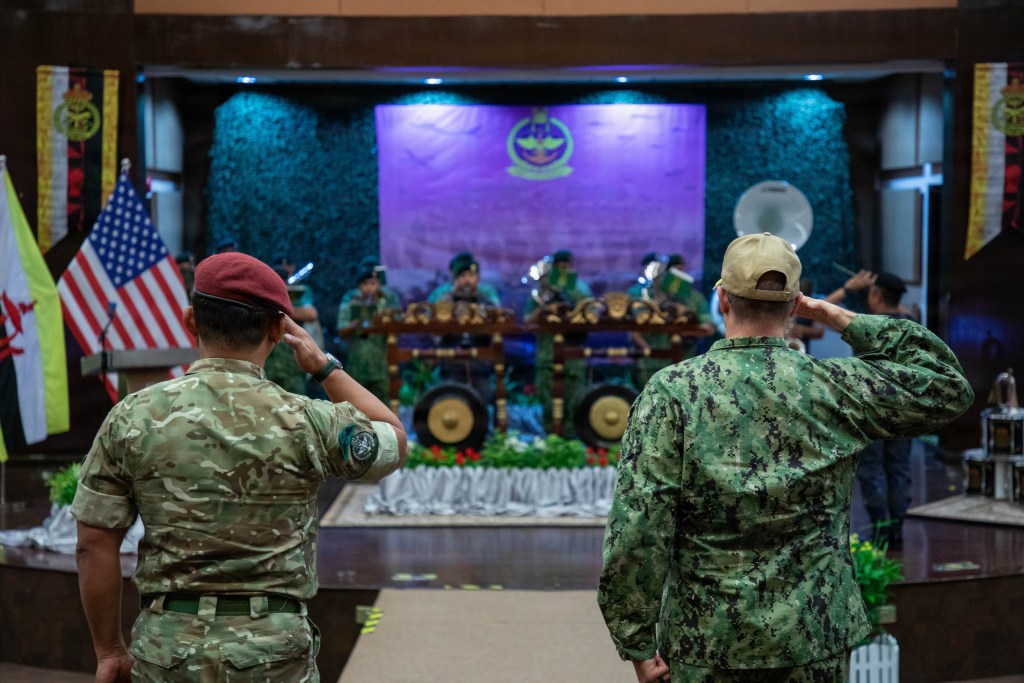
This commitment to regional stability has long served as the foundation for the Brunei-US defense relationship. Bilateral ties date back to the 1850 Treaty of Peace, Friendship, Commerce, and Navigation, later formalised for modern defence cooperation through a 1994 Memorandum of Understanding.
For decades, operational familiarity has grown through annual joint exercises like Cooperation Afloat Readiness and Training and Southeast Asia Cooperation and Training (CARAT), alongside military education exchanges.
Yet today’s strategic landscape presents fresh challenges that require both countries to do more. Transnational risks—including illegal fishing, maritime smuggling, cyber threats, and natural disasters — as well as geopolitical tensions demand a more dynamic partnership. Bandar Seri Begawan and Washington should strengthen their partnership by focusing on four key areas.
First, both capitals should formalise the strategic partnership framework. Washington should commit to sustained engagements to upgrade the framework so that attention to Bandar Seri Begawan remains steady.
Concurrently, Brunei can streamline bilateral operational procedures by working with US counterparts to update logistical agreements, such as the Acquisition and Cross-Servicing Agreement. Doing so will facilitate smoother joint exercises, port calls, and emergency response operations, providing a seamless baseline for cooperation.
Second, Bandar Seri Begawan and Washington should work together to modernise maritime capabilities and operational readiness. Washington should transfer more advanced technologies to help safeguard Brunei’s exclusive economic zone, including modern radar systems, satellite imagery platforms, and maritime domain software, while establishing faster pipelines for real-time information sharing through the US Pacific Command.
For its part, Bandar Seri Begawan should continue modernising the Royal Brunei Armed Forces maritime fleet to integrate these incoming technologies. By defining specific procurement priorities and articulating targeted operational needs, Brunei can make sure US technical assistance aligns with its national defence objectives and supports economic resilience under Wawasan Brunei 2035, the country’s long-term national development plan. Such operational push is backed by Bandar Seri Begawan’s fiscal commitment, highlighted by a 32% surge in Brunei’s defence budget to B$796.3 million in 2024.
Modernising maritime domain awareness should prioritise safeguarding Brunei’s critical offshore energy infrastructure, commercial gateways like Muara Port, and subsea pipelines against physical sabotage, hybrid pressures, and environmental hazards.
In an increasingly digital maritime environment, security cooperation should also extend to critical communications. Joint initiatives should incorporate cybersecurity defences for maritime port logistics and the physical protection of undersea telecommunication cables that land in Brunei, safeguarding the conduits of regional commerce. Securing these commercial nodes is essential, as the United States is a key economic partner, driving foreign direct investment into Brunei’s downstream energy sector and supporting the country’s shift away from crude oil dependency.
Crucially, to make such cooperation meaningful, Washington should address internal regulatory friction by streamlining bureaucratic export controls so that defence equipment and spare parts reach the Royal Brunei Armed Forces without delays.
Third, defence cooperation should be anchored in the Association of Southeast Asian Nations (ASEAN). The United States should respect Brunei’s commitment to non-alignment and ASEAN centrality.
Rather than pushing for exclusive arrangements, Washington should support Brunei’s inclusion in wider sub-regional training networks alongside mutual partners like Malaysia, Singapore, Australia, Japan, and the United Kingdom, building complementary touchpoints alongside established regional frameworks.
Meanwhile, Brunei can leverage its diplomatic standing in ASEAN to champion US engagement, such as in the ASEAN Defence Ministers’ Meeting-Plus.
By promoting practical, non-traditional security cooperation — such as climate resilience, humanitarian assistance and disaster relief, and maritime environmental protection — Brunei can bring regional partners and the United States together on common ground. Integrating partnerships with trusted neighbors reinforces ASEAN centrality by providing additive layers of stability.
Fourth, the partnership should invest in cultivating the next generation of thinkers and doers. The United States should expand funding for civil-military education exchanges, offering additional dedicated seats for young Bruneian officers at US service academies and war colleges, while continuing robust US officer participation in the Royal Brunei Armed Forces Command and Staff Course. Washington should also sponsor joint track-2 strategic dialogues between US think tanks and local institutions.
In turn, Bandar Seri Begawan should encourage its emerging generation of diplomats, military officers, and strategic analysts to participate in these programs, ensuring institutional capacity expands alongside defense hardware. Establishing dedicated research working groups within local universities or defense colleges will help institutionalise strategic memory and policy expertise for decades to come.
Strengthening the Brunei-US relationship is not about establishing permanent foreign bases or navigating major-power rivalries. Its value lies in capacity building, mutual respect, and a shared commitment to regional stability under international law, complementing, rather than disrupting, Brunei’s cherished tradition of quiet diplomacy and strategic balance.
By sharing responsibility across these four areas, both countries can build a relationship that is reciprocal, resilient, and responsive to the evolving needs of the Indo-Pacific. For Washington, it demonstrates a reliable, long-term commitment to Southeast Asia. For Brunei, it reinforces national sovereignty and maritime security while preserving its cherished diplomatic equilibrium.
• David Santoro is President and CEO of the Hawaii-based Pacific Forum, which runs the annual Honolulu Defense Forum (HDF), an event that facilitates dialogue between public and private-sector actors to advance regional stability and cooperation across the Indo-Pacific.