
Key Points
— Ecuador’s consolidated public debt fell to 49% of GDP in 2025, beating the COPLAFIP legal ceiling of 57% and tracking toward the 40% target for 2032 — but this measure excludes obligations to the social security institute, public enterprises, and state banks.
— When all obligations are included, aggregate debt closed December 2025 at $91.88 billion — 69% of GDP and a historic record — even after the Finance Ministry wrote off $853 million owed to Petroecuador without making any actual payment.
— Ecuador faces $12.3 billion in debt service in 2026 alone — 43% of projected ordinary revenues — including $1.09 billion to the IMF, $677 million to the IDB, and the first major principal payments on bonds restructured in 2020, in what analysts call the country’s most critical fiscal year since the pandemic.
The Ecuador Debt Accounting That Flatters the Numbers
Ecuador’s fiscal framework contains an accounting distinction that masks the true scale of its obligations. Under the COPLAFIP — the Organic Code of Planning and Public Finance, modified in 2020 — the consolidated debt indicator excludes liabilities owed to the Ecuadorian Social Security Institute, public enterprises like Petroecuador, and state-owned banks. By this filtered measure, Ecuador debt stood at $65.54 billion or 49% of GDP at year-end 2025, comfortably below the 57% ceiling and on a glide path toward the 40% target mandated for 2032. The government’s Pulso Económico bulletin presented this as progress. This is part of The Rio Times’ comprehensive coverage of Latin American financial markets and economic developments.
But the Observatorio de la Dolarización, an independent fiscal watchdog, revealed that aggregate public debt — which includes all state obligations regardless of creditor — closed December 2025 at $91.88 billion, equivalent to 69% of GDP. This represents a historic record, achieved despite the Finance Ministry’s year-end decision to write off $853 million in debt owed to Petroecuador without any actual cash payment — an accounting maneuver that reduced the nominal total but changed nothing about the state’s real fiscal position. The 20-percentage-point gap between the two measures is not a statistical curiosity; it represents over $26 billion in obligations that the government acknowledges exist but excludes from its headline compliance metric.
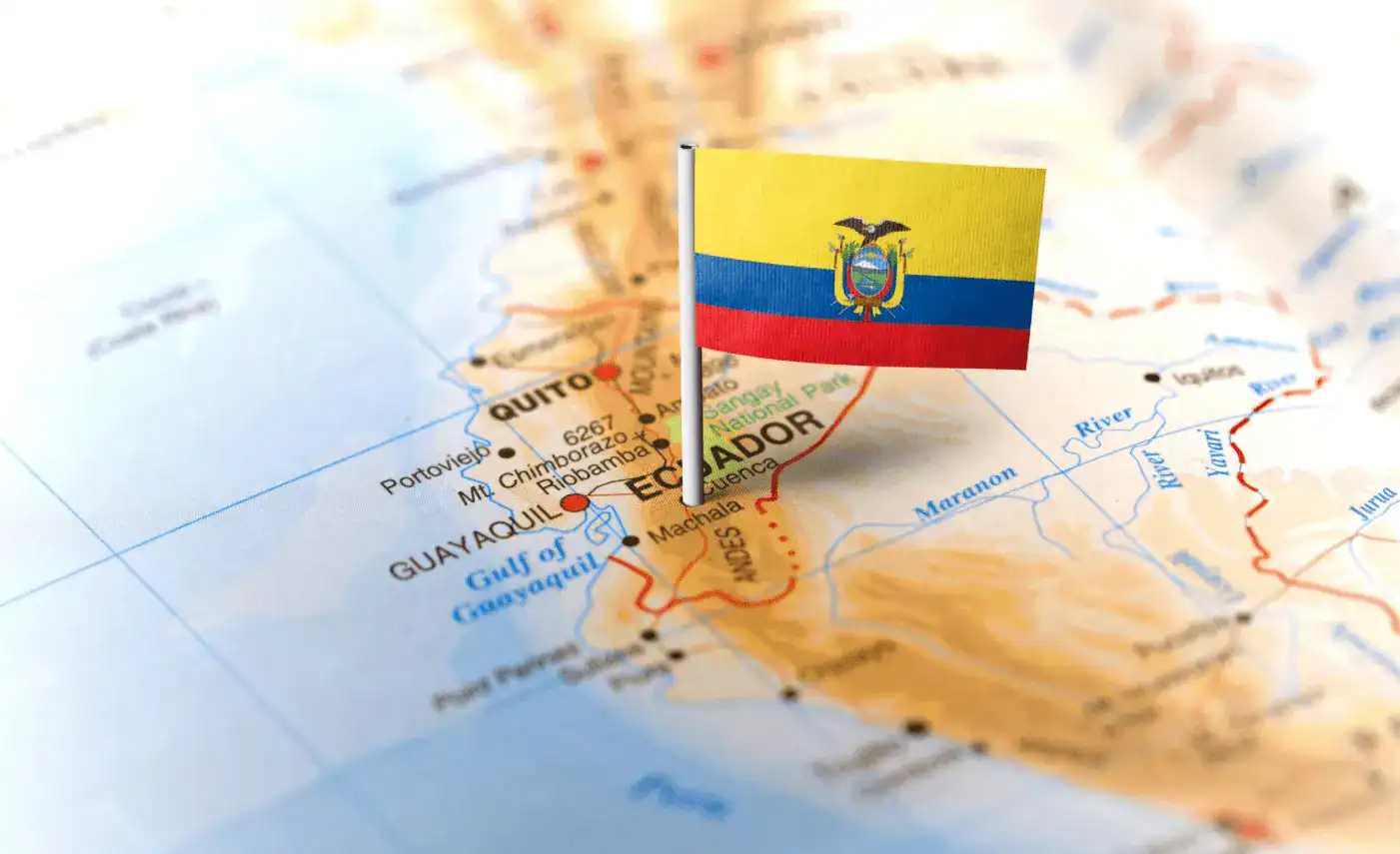
Ecuador Debt Nears Target but True Burden Is 69% of GDP. (Photo Internet reproduction)
The 2026 Wall: $12.3 Billion in Debt Service
The consolidated number may meet its legal benchmark, but Ecuador’s real challenge is cash flow, not accounting ratios. The 2026 budget projects $8.35 billion in debt amortizations — $3.95 billion to external creditors and $4.4 billion internally — a 43% increase over the $5.84 billion paid in 2025. When interest is added, total debt service reaches approximately $12.3 billion, consuming 43% of ordinary government revenues. The IMF alone requires $1.09 billion in 2026, rising to $1.29 billion in 2027, $1.4 billion in 2028, and $1.6 billion in 2029. The IDB is owed $677 million this year. And the restructured sovereign bonds from 2020 — the 2030, 2035, and 2040 series — begin stepping up principal repayments as grace periods expire: roughly $1.06 billion in 2026, $2 billion in 2027, $2.3 billion in 2028, and $3.1 billion in 2029.
Leonardo Vera of Oxford University described the confluence as resembling a new debt crisis. The 2026 budget requires $16 billion in total financing — a figure analysts have called unrealistic given current market conditions and Ecuador’s country risk premium of 523 basis points as of mid-December 2025. Finance Minister Sariha Moya has signaled interest in another debt swap, similar to Ecuador’s conservation-linked exchanges, but achieving the terms she envisions would require the risk premium to fall to 300 points — a level the country has not reached. Meanwhile, the primary fiscal balance remains in deficit at negative 2.1% of GDP, meaning Ecuador is borrowing not just to service existing debt but to fund basic government operations. The debt trajectory, even under the Ministry’s own optimistic scenario, continues rising to 57.2% by 2028 — breaching the very ceiling the consolidated measure currently claims to meet.
The debt has more than doubled since Rafael Correa left office in May 2017, when aggregate obligations stood at $41.89 billion. Lenín Moreno added $21 billion despite austerity promises. Guillermo Lasso added another $14 billion in his truncated term. Noboa has added roughly $8 billion since November 2023. Each government inherited and deepened the structural deficit, and each left a larger debt wall for its successor. The distinction between consolidated and aggregate debt may satisfy legal reporting requirements, but it does not change the underlying reality: Ecuador’s state owes $91.88 billion, every dollar of which must eventually be serviced or restructured, regardless of which accounting column it occupies.
Read More from The Rio Times


