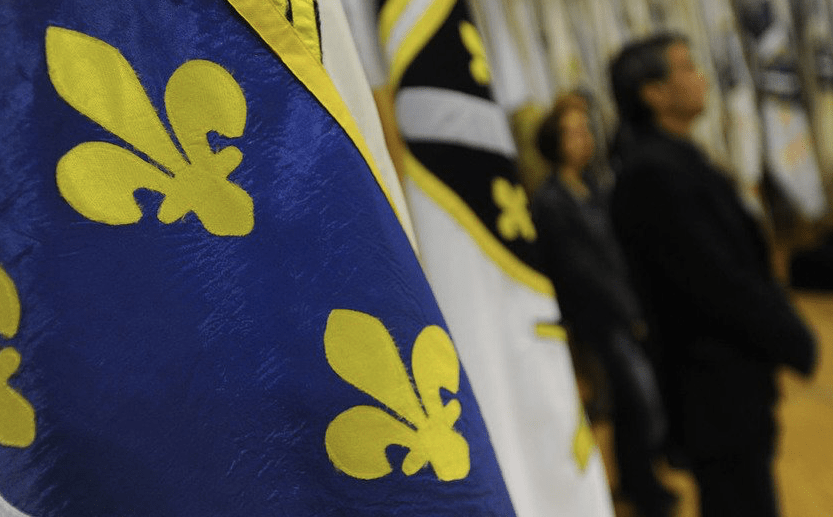
While Republika Srpska is considering legal punishment for displaying the flag with fleurs-de-lis, which is a symbol of Medieval Bosnia and Herzegovina, it should be noted that the flag was hoisted at the United Nations in 1992, when Bosnia and Herzegovina was internationally recognized. It was used until 1998, when the High Representative, Karlos Westendorp, officially imposed the flag used today.
The fleurs-de-lis (lilies) followed the Dragons, the national football team players. They are found on the current state and entity coats of arms, as well as on the royal crown, and carry no national connotation, while confirming an eternal state continuity.
The Historical Origin of the Symbol
The fleurs-de-lis have never been more disputed and used in Bosnia and Herzegovina’s modern history. The Bosnian royal symbol dates to the middle ages and was particularly popular at the time of the King Tvrtko I Kotromanić.
Six white fleurs-de-lis on the white background were the coat of arms of this dynasty, which all people in Bosnia and Herzegovina are proud of. How did one historical symbol that united all nations in Bosnia and Herzegovina become a problem for two nations? It is they whose history is inseparably tied to the fleurs-de-lis.
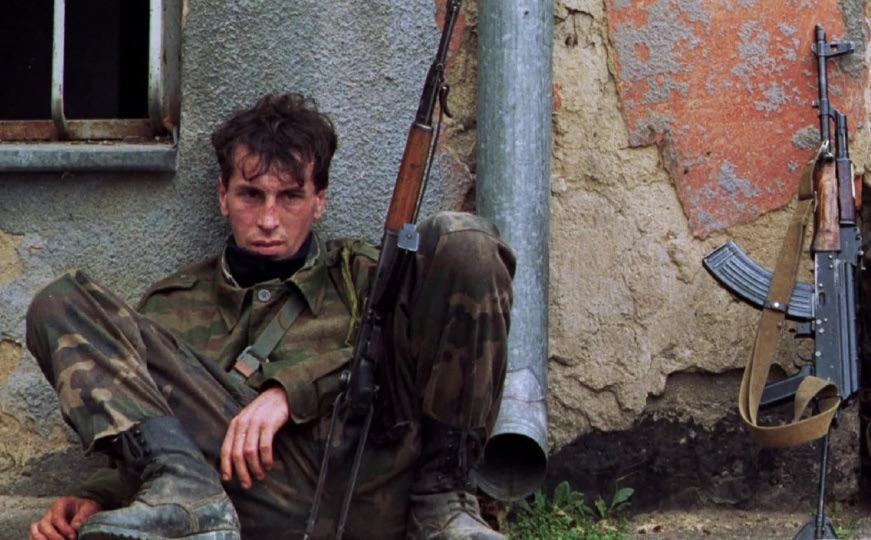
“Coat of arms with six fleurs-de-lis on the white background was first shown in the movie ‘The Battle of Kosovo’ in 1989, where that flag is clearly visible in several shots. It is about a symbol of the Medieval Bosnian Kingdom, the coat of arms of the Kotromanić dynasty, which then symbolized the state, and had no national connotation, nor does it today,” said Amir Kliko, a historian at the Institute for Research of Crimes against Humanity and International Law.
Political and Social Perception
“Until May 4th, 1992, when fleurs-de-lis were adopted at the Presidency of Bosnia and Herzegovina as a symbol of the flag and coat of arms, 99% of the population had never heard about fleurs-de-lis. I remember Radovan Karadžić’s statement that fleurs-de-lis are their symbol as well as King Tvrtko’s, but that they won’t accept them because it was taken over by their opponents. Professor Enver Imamović deserves the most credit for affirming fleurs-de-lis, designed by Zvonimir Bebek. Later, following the conflict between the Army and the HVO, it reached a point where resistance to the fleurs-de-lis also began to form among some Croats in Bosnia and Herzegovina,” said Academician Suad Kurtćehajić, a professor at the Faculty of Political Science of the University of Sarajevo.
Legal and Institutional Use
Why is it that the fleur-de-lis, which historians state, cannot be tied to either a specific nation or a single historical moment, is not an issue on the flag of Republika Srpska, nor on the monument to Tvrtko Kotromanić, yet it can be subject to sanctions, the confiscation of flags with fleur-de-lis, and the destruction of property?
These cases are recorded in the territory of Republika Srpska when flags with fleur-de-lis flutter across our country during World Cup matches.
But that is not the end of the story. The fleur-de-lis, they said, is still officially used in Bosnia and Herzegovina.
“Blue Coat of Arms with fleur-de-lis is still officially used in the institutions of Bosnia and Herzegovina. It is still an emblem on the uniform of a regiment of the Armed Forces of Bosnia and Herzegovina and is legally present in use,” Kliko emphasizes.
The Constitutional-Legal Aspect
An expert for Constitutional Law confirmed that there is no legal basis to sanction those who display the flag with fleur-de-lis. The attempt at criminalization will not pass the Constitutional Court of Bosnia and Herzegovina.
“This is contrary to state laws, which nurture the tradition of military structures that acted during war. On the other hand, when it comes to the eventual penalizing or sanctioning of such actions, in order for it to be defined as a criminal offense at all, in accordance with the principles of the rule of law, there must be a clearly established public interest that is protected through such a criminalization policy.”
However, that cannot be confirmed in this case. This is about the destruction of one’s own property, which is already illegal, and at this moment, even without amendments to the criminal code, there is no legal basis whatsoever for such conduct.
“I don’t doubt the outcome, but citizens must be persistent in order to obtain compensation from Republika Srpska due to illegal conduct,” said the expert for Constitutional Law, Nedim Ademović.
The more the fleur-de-lis is challenged, the greater its use is, the historians will say. This is confirmed by those for whom the flag with fleur-de-lis, as also ruled by the Court in Banja Luka, is a legitimate flag that celebrates only one thing: the historical continuity of the state, whose fleur-de-lis carried no national connotation.