
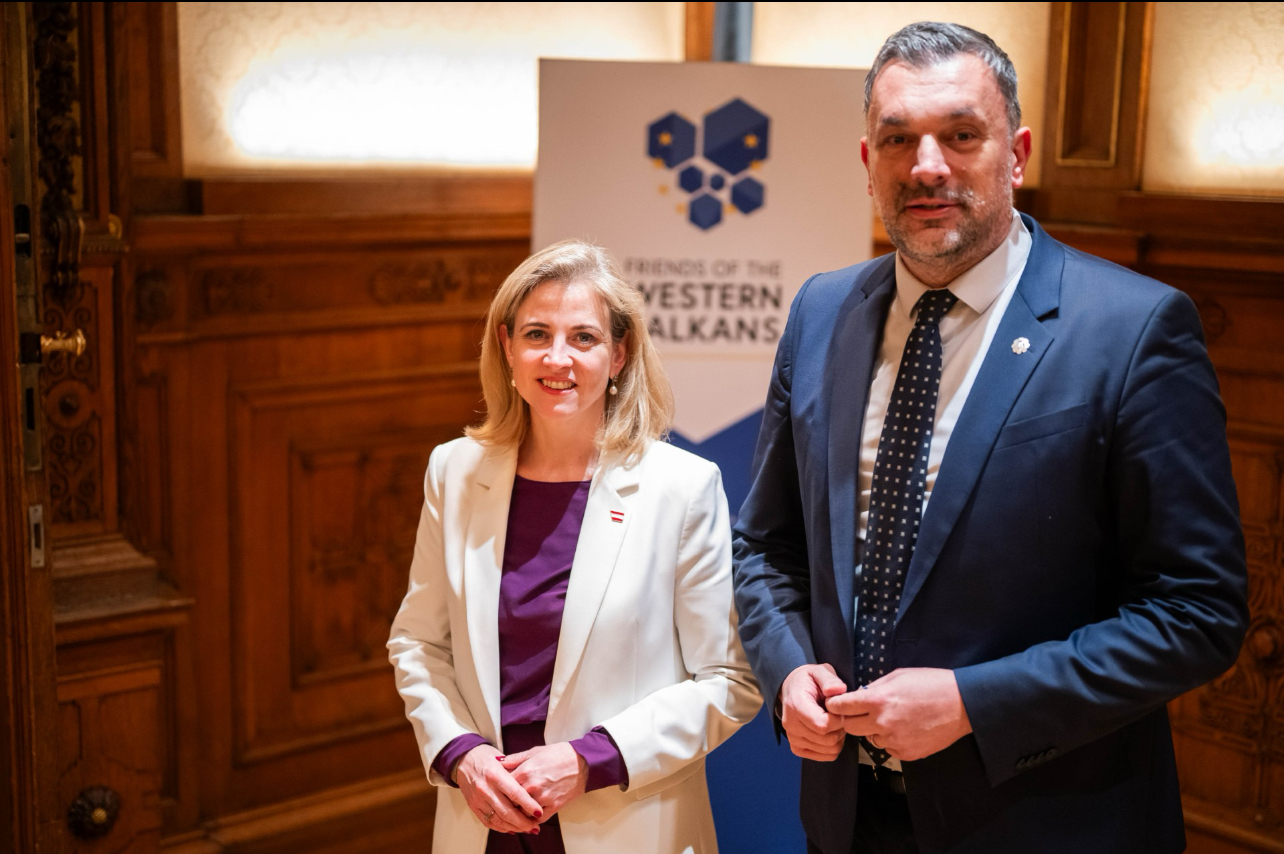
On 4 December 2025, the Minister of Foreign Affairs of Bosnia and Herzegovina, Elmedin Konaković, participated in the meeting of the Ministers of Foreign Affairs of the Group of Friends of the Western Balkans and the Ministers of Foreign Affairs of the Western Balkans countries in Vienna, at the invitation of the Minister for European and International Affairs of the Republic of Austria, Beate Meinl-Reisinger.
The meeting, dedicated to the upcoming priorities in the Western Balkans integration process, energy, security and deepening European integration, was also attended by the EU High Representative for Foreign Affairs and Security Policy Kaja Kallas and the Director of the Energy Community Secretariat Artur Lorkowski.
In his address, Minister Konaković emphasized that Bosnia and Herzegovina remains firmly committed to the fundamental European values - democracy, the rule of law, human rights and the fight against corruption. He emphasized that these principles are not just formal conditions on the European path, but are the foundation of the vision of Bosnia and Herzegovina as a modern, resilient and inclusive state, ready to actively contribute to the construction of a united and prosperous Europe. He said that regional cooperation, stability and solidarity are key to accelerating European integration.
He then stressed that Bosnia and Herzegovina supports the Joint Statement, which highlights the importance of the EU enlargement policy as a geopolitical priority of importance for common security and progress, and expressed our country’s full support for the conclusions regarding the inclusion of partners from the Western Balkans in the meetings of the EU Foreign Affairs Council, as well as for more frequent visits of senior EU officials to the region. In his address, he also pointed out the urgent need to combat disinformation and false narratives about the EU and the enlargement process.
He welcomed open dialogue with civil society organizations and emphasized that young people must be at the center of the European integration process. He added that young people, through education, mobility, cultural exchange and digital programs, will have the opportunity to actively contribute to the European future of the Western Balkans. Integration into the European Union, as he emphasized, is not a loss of identity – but its strengthening and contribution to a diverse and strong Europe. Speaking about concrete reform activities on Bosnia and Herzegovina’s European path, Minister Konaković recalled that Bosnia and Herzegovina submitted the Reform Agenda within the Growth Plan to the European Commission in September this year, and that the signing of the Frontex Status Agreement enabled the arrival of more than 100 Frontex Standing Corps officers, who will provide support to the BiH Border Police. He expressed hope that Bosnia and Herzegovina would soon adopt two key European laws and appoint a chief negotiator, which would enable the opening of the negotiation process as soon as possible.
When it comes to energy, security and EU integration issues, Minister Konaković emphasized that Bosnia and Herzegovina has significant potential for strengthening energy independence through diversification of energy sources, modernization of infrastructure, regulatory reforms and intensification of regional cooperation. In this context, he emphasized the strategic importance of the Southern Interconnection project, which contributes to diversifying gas sources, reducing dependence on existing routes and strengthening the country’s energy security.
He underlined the strong support for this project by the US administration, which considers it one of the priorities of its policy towards Bosnia and Herzegovina. He added that the implementation of the Southern Interconnection would not only ensure the energy security of Bosnia and Herzegovina, but also its strategic importance in regional gas transit towards Central and Eastern Europe.


