
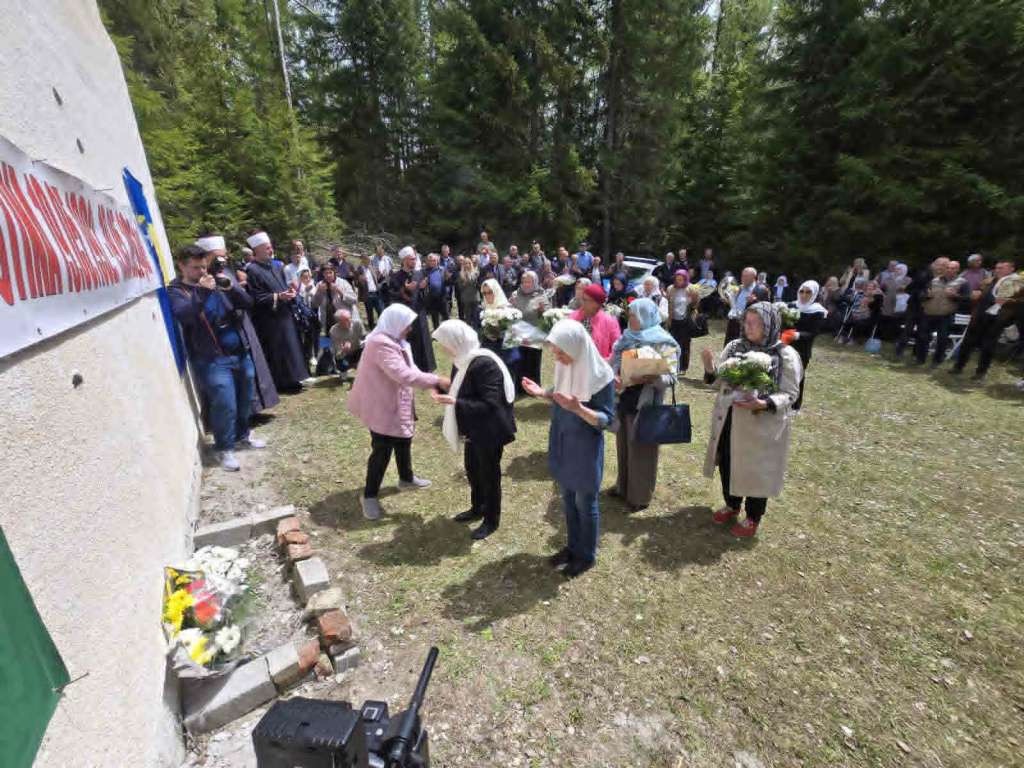
The 34th anniversary of the suffering of Bosniaks was marked today at the site of the former infamous Mostina home in the Čajniče Municipality, in one of the most serious crimes committed in the territory of that municipality during the past war.
As part of the program organized by the Majlis of the Islamic Community of Čajniče, in cooperation with the Mufti’s Office of Goražde and the Association of Citizens for Return to Čajniče, a prayer was recited for the souls of the murdered martyrs. The families of the murdered, representatives of the Islamic Community and numerous delegations laid flowers at the site of the suffering of 42 civilians killed in 1992 in the former hunting lodge.
Milada Velić, daughter of the murdered Zijad Velić, recalled the suffering of her family and the fate of the Bosniaks of Čajniče.
“My father Zijad Velić was imprisoned here, tortured, then taken to Pljevlja and later returned and killed. My mother was a living witness when people were imprisoned in the camp. We have been natives of Čajniče for hundreds of years. Six of my uncles were killed in World War II, and my father was killed in this war. The memories are difficult, we know that he was tortured several times. His eye was gouged out. After the Battle of Goražde, a great massacre was carried out and then he was brought here from Pljevlja,” said Velić.
She pointed out that the family only found their father’s remains after the second exhumation.
“My father was found during the exhumations that were carried out for the trial against Kornjaca and the others. We found the entire body, we recognized him by his teeth and the golden bridge. He was buried in the Kovači martyrs’ cemetery. At least my brother has found peace because he has a place to go to his father’s grave. But many families don’t have that. A large number of my aunt Džambegović’s family members were killed and they were never found. They don’t even have a grave,” said Velić.
“Sulejman Homoraš, who was himself imprisoned in Mostina, comes to this place every year. He is still searching for the remains of his uncle Ramiz Homoraš and his brother-in-law Hajrudin.
I am looking for my uncle and brother-in-law, and I come here regularly because I was imprisoned in Mostina myself. Fate wanted today to be Tuesday, the same day as the execution in 1992. A Serb took me out the day before. I was only 24 hours away from death. As long as I live, I will come here to keep the memory of the people who were killed,” said Homoraš.
The chief imam of the Majlis of the Islamic Community of Čajniče, Avdo Šišić, reminded that even after more than three decades, the families of the victims have not found the remains of all the killed.
According to the Institute for Missing Persons of Bosnia and Herzegovina, a total of 138 missing persons have been reported in the Čajniče area. To date, 90 victims have been identified, including 68 men and 22 women, while the fate of another 48 Čajniče residents is completely unknown.
He said that the culture of remembrance is important for preserving the truth about what happened.
Institutions are commemorating this and that is the least we can do ‘in the name of God’, said Šišić, adding that he is particularly hurt by the silence about the crimes committed and the lack of remorse of those responsible.
The only Bosniak councilor in the Čajniče Municipal Assembly, Izet Alihodžić, emphasized that people were brought to this location for no reason, mistreated, tortured and ultimately killed.
“Every year we repeat the same commemoration and return to the same tragedy. For the families of the murdered, it is more and more traumatic every year. Unfortunately, there is no significant progress in prosecuting those responsible or in finding mass graves. I appeal to everyone who knows where the graves are to report it to the authorities so that the bodies can be exhumed and buried with dignity. Many families still do not have a place where they can come and recite Fatiha with their loved ones,” Alihodžić emphasized.
Milorad Živković, Milun Kornjáča, Marjan and Slavko Jovanović were sentenced to prison terms of six to 11 years for the crimes committed in the Čajniče area, while Duško Tadić and Stevo Jovanović were acquitted.
In 2015, the Court of BiH confirmed the indictment against Duško Kornjáča, who is accused of persecuting the non-Serb population from the Čajniče area as part of a widespread and systematic attack. Kornjáča is still unavailable to the judicial authorities of BiH, although it is known that he lives in Serbia.
As part of the program marking the anniversary of the crime, the ceremonial premiere of the documentary film “Mrak nad Čajničem” by author Avdo Huseinović will be held tonight at the Goražde Cultural Center, Fena writes.


