This article is part of HuffPost’s biweekly politics newsletter. Click here to subscribe.
WASHINGTON — The Democratic Party has spent the past year defined by low morale, limited power and a lack of clear direction. But two weeks after a series of blowout wins across the country, the party now feels the wind at its back as President Donald Trump’s approval rating plummets, the redistricting wars break in their favor and they gain ground on the economic issues the electorate cares the most about.
Democrats are now facing an unexpected challenge: managing expectations.
Yes, the party’s short-term future now looks bright enough for Democrats to openly discuss winning back control of the Senate, and to start looking more closely at red-state governors’ races for pickup opportunities. GOP-held congressional districts once thought to be reach opportunities are now clear targets, with the party even spending money in a seat Trump won by 22 points last year in Tennessee.
“You can’t help but feel a little bounce in your step,” former North Dakota Sen. Heidi Heitkamp said. “I’m optimistic that they can take back the Senate. I would not have believed that before Election Day.”
The victories in Virginia and New Jersey — and to a lesser extent in California, New York City, Pennsylvania and Georgia — provided hard evidence the broad strokes of the party’s electoral strategy, built around a relentless focus on affordability, was working to win back many of the Latino, Asian and young voters who drifted to Trump in 2024.

The proof of concept, in turn, has unlocked a lot. Candidates who were on the fence about running feel better about their chances. Donors sitting on the sidelines are finally picking up the phone. Intraparty bickering, even over the party’s shutdown fold, seems less urgent when the candidates across the ideological spectrum broadly agree on messaging.
But party leaders are already issuing warnings about overconfidence, and operatives are acknowledging the limits of potential gains in an era of hyper-polarized elections. Matching 2018’s 41-seat pickup in the House is unlikely unless Trump’s approval rating, already at the lowest point of his second term, drops even further. The party’s problems with rural voters, who wield disproportionate power in the Senate, have not been solved. Voters who don’t follow politics — the ones who sunk Democrats in 2024 — are difficult to get a handle on.
“What I want to do is make sure that people don’t get complacent, right? We’ve got to keep our foot on the gas,” Democratic National Committee Chair Ken Martin told HuffPost. “You cannot rely on polls or special election wins to guarantee the next election. The only thing that can ever guarantee an election is hard work.”
The House map, shrunken by decades of political sorting and gerrymandering, contains precious few swing seats, meaning a blue wave would crest lower than it did eight years ago. The party’s overall brand remains linked to an unpopular former president. Even party loyalists take it for granted key leaders are hopelessly out of touch.
The immediate challenge is in Tennessee, where Democratic state Rep. Aftyn Behn is trying to pull off a major upset against Republican Matt Van Epps in a district that includes portions of Nashville but stretches from Alabama in the south to Kentucky in the north. Trump won the seat, which came open following the sudden retirement of GOP Rep. Mark Green, by 22 points in 2024.
But anger over Trump’s handling of the economy is reaching even into deep-red areas, and when combined with the party’s advantage in low-turnout contests, Democrats and Republicans both see a narrow path to victory for Behn in the Dec. 2 special election. That has prompted House Majority PAC, a super PAC run by allies of House Minority Leader Hakeem Jeffries, to spend $1 million on digital and television advertising in the race.
“As Democrats have racked up wins by running on affordability and lowering costs — our momentum continues to build,” said CJ Warnke, a spokesman for the group. “No Republican-held seat is safe, and HMP will do whatever it takes to win the House in 2026.”
Former Rep. Conor Lamb’s win in a western Pennsylvania special election presaged 2018’s blue wave in a similarly deep-red district. In that race, though, Democrats benefited from a massive gap in candidate quality that’s not present in Tennessee, Republicans have slammed the 35-year-old Behn for liberal policy positions and past comments she’s made calling herself “really radical,” all while portraying Van Epps as a clean-cut Army veteran.
“This could be the Conor Lamb race except Behn’s not Conor Lamb and Van Epps definitely isn’t Rick Saccone,” one Democratic operative who works on House races told HuffPost, referring to the lackluster GOP candidate Lamb defeated. “That doesn’t mean there’s no chance to win.” (The operative requested anonymity to speak frankly about the party’s challenges.)
Beyond the special election, House Democrats have added a handful of seats to their target list, including those held by North Carolina Rep. Chuck Edwards and Tennessee Rep. Andy Ogles. They’re also hopeful they can reignite donor interest in Bob Harvie, a Bucks County Commissioner who is challenging entrenched moderate GOP Rep. Brian Fitzpatrick in Pennsylvania but who has struggled with fundraising.
Part of the challenge comes from who is turning on Trump. While he is losing the Latino, Asian and young voters he added to his coalition in 2024, his approval rating among older and white voters has barely budged. And many House Republicans represent districts with paltry numbers of voters of color.
This problem is even more acute in the Senate. While Democrats feel strong about their chances to pick up seats in North Carolina and Maine, the next wave of potential pickup opportunities — Iowa, Ohio and potentially Alaska if former Rep. Mary Peltola runs there — are all the heavily white, rural states where Democrats have struggled in the Trump era.
Heitkamp, who was among the Democratic senators who lost seats in the Trump era, believes the party can benefit from an “incredibly depressed farm economy” and anger over the president’s tariffs.
“The challenge for the Democrats right now is to come up with an effective message with real concrete examples of things they would do if they were given power,” Heitkamp said, suggesting the party could potentially propose limits on credit card interest rates. “They need to find those to appeal to people working paycheck to paycheck.”
Optimism may be highest for governor’s races, where candidates have extra leeway to separate themselves from the party’s weak national brand. Kentucky Gov. Andy Beshear, the incoming chairman of the Democratic Governors’ Association, said the two gubernatorial victories in 2025 provide the broad strokes of a strategy for the party nationally.
“Our candidates all across America are going to be focused on making life a little bit better,” he said in an interview. “We’re going to elect Democratic governors in places people aren’t expecting them.”
Beshear was tight-lipped about specific targets, but Democrats have long been optimistic about State Auditor Rob Sand’s bid in Iowa and are now closely tracking the candidacy of Cyndi Munson, the minority leader of the state House of Representatives, in Oklahoma. Former Sen. Doug Jones is also considering a bid in Alabama, where he would have a rematch with GOP Sen. Tommy Tuberville.
The optimism was also palpable at a gathering this week in D.C. for Democracy Alliance, a coalition of liberal donors. “It’s been so doom and gloom in the past year,” said one attendee, requesting anonymity to speak frankly about interactions with the donor class. “There’s been an uptick in donors taking meetings.”
Democratic and liberal groups have struggled with fundraising this year ― the DNC, for instance, took out a $15 million loan. It’s created some whiplash. “I’ve had donors go from not picking up the phone to asking what R+25 district they should invest in,” another Democratic operative joked.
There’s also still worry about Trump’s unprecedented fundraising and how it could help the GOP ― his super PAC is spending money in Tennessee, for instance ― and fretting the party is not engaging in enough experimentation while it has a chance.
“We have to be comfortable taking risks, especially in between new cycles,” said Danielle Butterfield, the executive director of the super PAC Priorities USA. “We’ve gotten really good at the science of politics, but we’ve lost the art of campaigning.”
But much of the donors’ focus was also on preexisting problems. Many still wanted to talk about podcasts and influencers, according to attendees. Worries about how well Democrats are doing with voters who don’t follow politics closely — the exact group of people who sank the party in 2024 — are widely shared by both donors and operatives.
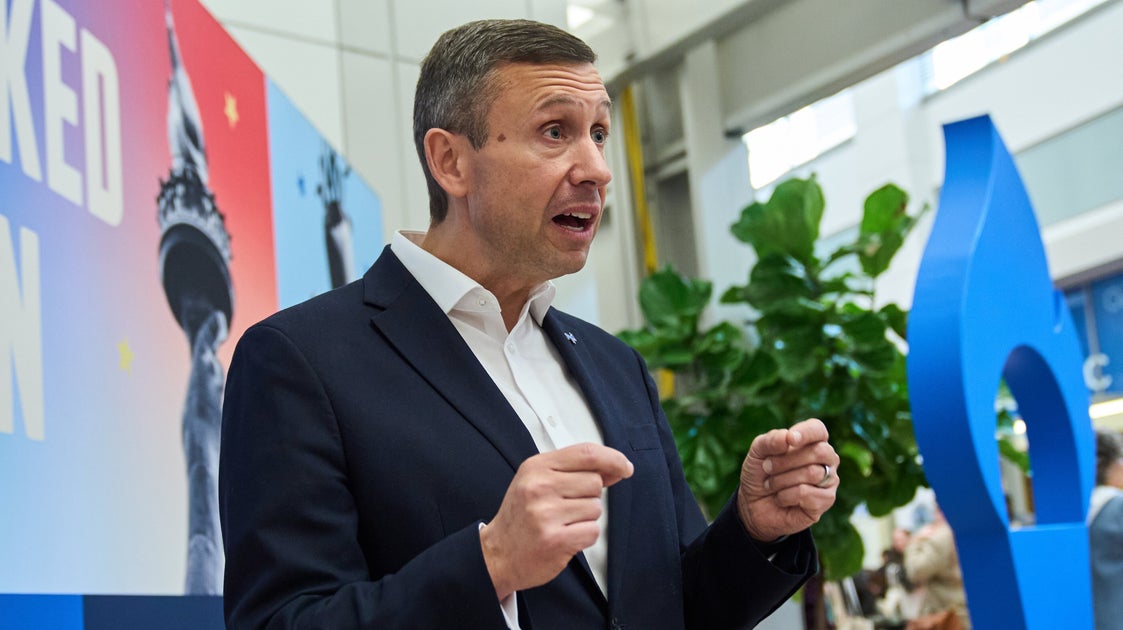
“All those voters who turned against us last year are still here, and we’re not going to see them again until 2028,” Democratic pollster David Shor told a crowd at Crooked Con, which the liberal podcast company Crooked Media hosted a few days after the election. “It’s incumbent on us to not forget they exist just because they’re not voting.”
There are encouraging signs. Samson Signori, the campaign manager for Abigail Spanberger’s successful campaign for governor in Virginia, said they found “passive news consumers” made up roughly a quarter of the gubernatorial electorate in the state and were “very persuadable, very swingy.”
“This is a diverse set of folks,” Signori told reporters at a briefing this week hosted by Third Way, the centrist Democratic think tank. “They come from all walks of life, all demographics, and from our perspective, it was just about running very tailored paid media communications to them, just driving home the affordability and lowering-cost message.”
Signori said the campaign was still evaluating data, but preliminary results indicate Spanberger won passive news consumers by nine points after Trump won the same group by five points a year earlier.