On Monday, the Supreme Court will hear arguments in a case that could have a major impact for the votes of millions of Americans — at least, assuming their votes are allowed to be counted.
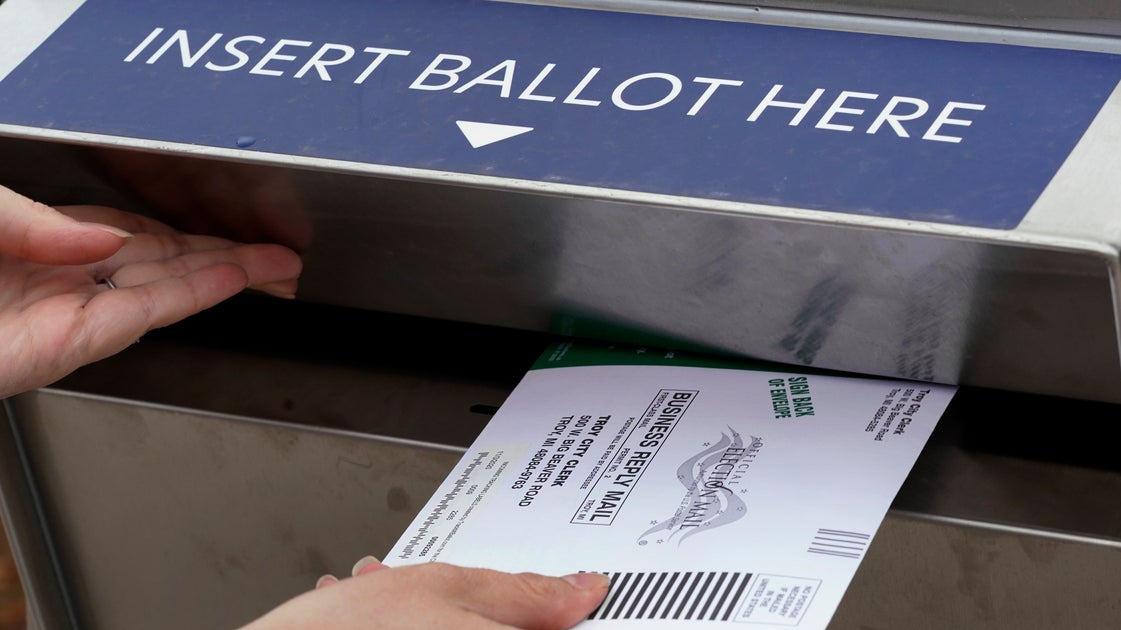
The case, Watson v. Republican National Committee, challenges whether state officials can count electoral ballots postmarked by Election Day and received less than a week after an election is held.
The case seeks to overturn a 2020 Mississippi state law that allowed absentee voters to mail in their ballots with a postmark as late as Election Day and allowed them to be counted if they were received within five days after Election Day. Notably, the state law was passed with bipartisan support and was signed into law by Mississippi’s Republican Gov. Tate Reeves.
But the Mississippi Republican and Libertarian Parties sued, claiming that counting votes that arrive after Election Day violates federal law. Congress, they contend, designated only a “singular day” for elections and the time allocated for counting, they say, is included in that day. In the petition to the Supreme Court, RNC political director James Blair further claims the extra time allotted to count ballots harms them by draining the RNC’s coffers if they are possibly forced to “spend more money on ballot-chase programs and poll-watching activities” instead of “traditional get-out-the-vote operations.”
Mississippi in turn, counters it has the constitutional right to govern its own elections and that “nothing in history shows that the federal election-day statutes block States from allowing post-election-day ballot receipt.”
Mississippi Secretary of State Michael Watson emphasized in the state’s filing to the court that the push to invalidate the state’s rights to dictate how its voters can vote would “invalidate laws in most States, will spark nationwide litigation, and will risk chaos in the next federal elections” — an assertion, he pointed out, that neither political party disagreed with. He added that changing the regulation would present “profound practical ramifications” for election administrators who would have to receive and count all votes in a single day.
Access to the ballot box, whether by mail or in person, used to be a bipartisan issue, Lindsay Langholz, vice president of policy and programs at the American Constitution Society, told HuffPost in an interview on March 17.
But the debate now over mail-in deadlines shows just “how quickly this issue and voting rights in general have changed to become a very partisan issue,” she said.
In 2024, a district judge ruled against the RNC and upheld Mississippi’s five-day grace period, pointing out that other states had similar policies and the counting period didn’t impact the electoral process. In its appeal to the the Fifth Circuit — considered one of the most conservative court venues in the nation — the RNC fared better. Led by Circuit Judge Andrew Oldham, a Trump appointee, the panel found that constitutional “text, precedent and historical practice” indicated only Election Day “is the day by which ballots must be both cast by voters and received by state officials.”
In dissent, Circuit Judge James Graves, highlighted that at least 28 states and the District of Columbia already have ballot receipt laws that technically preempt the notion of a “single day” for elections.
Graves pointed out that just 20 years ago, even the conservative Fifth Circuit was far more amenable to voters rights and access to the ballot box: In a ruling for a case known as Voting Integrity Project Inc. v. Bomer, the Fifth Circuit said that it “could not conceive that Congress intended the federal election day statutes to have the effect of impeding citizens in exercising their right to vote.”
Langholz attributes some of the shifts to President Donald Trump, who for six years has pushed what has become known as the “Big Lie” about the 2020 election — that it was riddled with fraud, including fraud by absentee voting and that is why he lost.
“I don’t think it’s exclusively because of messaging coming out of White House, but it’s not unrelated either,” she said.
Trump vehemently opposes mail-in voting, though he and many of his GOP allies utilize it to cast their votes. He has repeatedly pushed to end it by baselessly suggesting that mail-in voting leads to “massive voter fraud” and is a “hoax” perpetrated by Democrats who can’t win elections without it.
Many Republicans and especially Trump’s allies in Congress have leaned on this boogeyman to question the reliability of mail-in ballots, “in spite of zero evidence to back up those claims,” Langholz said.
“It also seems to be hurting their own voters as well in a way I don’t quite understand,” she noted.
Mail-in voting is popular among both Democrats and Republicans. The Pew Research Center found in 2025 that 58% of Americans support mail-in voting — a number that was actually a slight drop since the COVID-19 pandemic, when Pew found that 70% of Americans favored mail-in ballots, including almost exactly half of all Republicans surveyed. A recent study by the Brookings Institute found that in the 2024 election alone, the U.S. Postal Service processed nearly 100 million mail-in ballots.
But should the high court rule in favor of the RNC, the reliability of mail ballots could change for millions of absentee voters, including members of the military and their family members who live overseas.
If Mississippi prevails, then the tradition of mail-in voting — which has been around since the Civil War — continues as it has in the past, with states setting their own rules and processes for mail-in voting. (It is worth noting that Mississippi has some of the most restrictive voting rules in the nation already, according to analysis by groups like the Ford Foundation.)
But an RNC victory could potentially kick off a chaotic process where state officials could have just a few short months ahead of midterm elections to make adjustments to mail-in ballot rules.
Dozens of states have grace periods for mail-in ballots because there is a logical understanding that someone who has done “everything right,” to vote on time, Langholz said, should be accounted for.
“Voters who got the ballot in the mail by Election Day, but either because of the Postal Service or because life just happened, or because of weather, voters who did all the right things and cast a ballot within their state rules, should have that ballot counted. We should want pro-voter policies in America,” she said.
There are myriad reasons why people cast a mail-in ballot, and none should be viewed dubiously, Caren Short, the director of legal and research at the League of Women Voters, told HuffPost.
Mail-in voting is a useful tool for people with disabilities, service members, people who can’t get off work or can’t find child care, she notes. It’s great for elderly voters, or voters who simply won’t be present in their district or precinct on Election Day.
“We’re better as a country, as a nation, when more people can vote,” she said.
In a brief supporting Mississippi’s appeal to overturn the Fifth Circuit’s ruling, a group of military-affiliated individuals urged the Supreme Court to keep the grace period, including retired defense officials; former secretaries of the Army, Navy and Air Force; decorated generals; veterans; a slew of veteran nonprofit support groups; diplomats; and others represented by the Brennan Center for Justice.
“The logic of the Fifth Circuit’s ruling in this case would upend multiple, long-established state laws that specifically use grace periods to alleviate the unique barriers to voting faced by U.S. military and overseas voters,” Brennan Center lawyers wrote.
The League of Women Voters, along with 19 states, have also filed briefs supporting Mississippi’s lawsuit.
But the Supreme Court has already indicated it may have some sympathy with the RNC’s claim that it is injured if ballots are counted after Election Day. The fraud conspiracy perpetrated by Trump has some sway on the court, too.
In 2020, when the Supreme Court prohibited the counting of mail-in ballots received after Election Day in Wisconsin in a 5-3 vote, Justice Brett Kavanaugh argued in a concurring opinion that the counting after Election Day would “flip the results.” That position, however, completely ignores that even if all votes are received on Election Day, not every ballot is physically counted on Election Day.
More recently, in January, the justices ruled 7-2 that longtime Trump ally, Rep. Mike Bost (R-Ill.), who had supported the effort to overturn the 2020 election, had the right to allege injury and challenge how and when a state counts its votes in an election — even though he had won his race.
While the Bost and Watson cases are not a 1:1 comparison, the latitude given by Chief Justice John Roberts in the Bost ruling was considerable. Roberts found proving a “substantial risk of harm” in order to challenge how states govern their elections was unnecessary. Yet, the court was open to allowing challenges to voting procedure nonetheless.
Like Langholz, Short also worries about the potential “logistical nightmare” that will ensue ahead of midterms if the RNC wins this case. She doesn’t envision a world in which the Supreme Court rules in favor of the RNC, but then directs states to wait to implement the new deadline rules.
“I’m not an election official but it seems to me that this would, for many states, effectively eliminate the option of mail-in voting, disenfranchising millions of voters,” she said.
“You can’t say ‘it’s unconstitutional’ and wait until next year. It’s either constitutional or not,” she added.