GEORGETOWN, Guyana, (DPI) – The Guyana Office for Investment has facilitated a major USD 250 million diaspora-funded private sector investment with the commissioning of the TriStar Shore Base and Energy Terminal, signalling strong confidence by Guyanese abroad in the country’s economic direction and development agenda.
The investment of USD 100 million for Phase 1 was unveiled at this year’s Guyana Energy Conference and Supply Chain Expo and is among the largest private-sector diaspora-financed projects in Guyana to date. Phase 2 with an estimated USD 100 million investment, will be completed during the second quarter of 2026, followed by Phase 3 (an additional $50 million) by the end of 2026. The facility strengthens national oil and gas support infrastructure while expanding local participation in the sector’s rapidly growing value chain.
Chief investment officer and agency head of the Guyana Office for Investment, Peter Ramsaroop, MP, welcomed the project, noting that it aligns directly with the national development vision of president, Dr Mohamed Irfaan Ali, particularly the call for Guyanese in the diaspora to return home with capital, expertise and global experience to contribute to nation-building.
“This investment demonstrates the deep confidence that Guyanese abroad have in the country’s economic trajectory. It reflects a deliberate strategy to combine diaspora capital with structured local capacity development, ensuring that Guyanese workers and enterprises benefit meaningfully from growth in the energy sector,” Ramsaroop stated.
The USD 250 million initiative was initiated by US-based Guyanese investor Kris Persaud and is being developed with international technical support during its initial phase. Germany-based Martrade and offshore logistics specialists 3PL have been contracted to manage early operations while training Guyanese personnel in accordance with Guyana’s Local Content Framework.
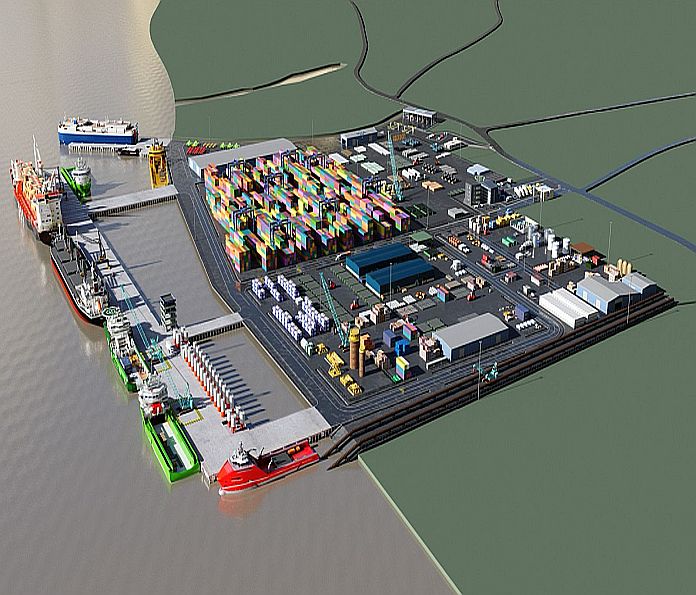
Located on the West Bank of Demerara, the TriStar Shore Base and Energy Terminal is a 24-hour multipurpose facility designed to service offshore Oil & Gas activities, containers, general and project cargo vessels. Phase One of the development is now operational and includes 320 metres of quayside with a seven-metre draft.
The facility has been engineered to handle heavy offshore cargo, with dock platforms tested to 86 tonnes per square metre and supporting land infrastructure built to withstand 40 tonnes per square metre — technical specifications that are uncommon within the Caribbean region.
Future phases of the project, planned to be completed by year-end, will include the development of a container terminal with capacity for 5,500 TEUs including portal harbor cranes for efficient handling, a roll-on roll-off terminal, and an inland container depot. These will be supported by pipe yards and logistics facilities across an additional 300 acres in the Tristar Gateway Park.
Operational capabilities will include floating hose assembly, isotank storage, tubular preparation, heavy-lift staging for subsea equipment, and crane capacity of up to 450 tonnes. Environmental management systems — including wash bays, inspection areas and a waste treatment plant — are being integrated in keeping with international safety and sustainability standards.
The long-term objective is for the facility to be fully managed and operated by Guyanese, supported by structured technical training, certification and exposure to global operating standards. Officials emphasised that the project is intended not only to support offshore operations but also to anchor skills transfer, create employment and ensure that a greater share of the value generated by Guyana’s energy sector remains within the domestic economy.
The USD 250 million TriStar Shore Base and Energy Terminal investment fits squarely within President Dr Mohamed Irfaan Ali’s long-term vision to transform Guyana’s maritime and logistics sector into a competitive regional hub that drives national prosperity. President Ali has repeatedly emphasised that strengthening port infrastructure, modernising maritime operations, and developing human capital are central pillars in positioning Guyana for expanded trade, investment, and economic diversification.
Central, also, to the president’s strategy, is the goal of upgrading and expanding Guyana’s port facilities to handle larger ships, increase cargo capacity, and make the country a viable destination for global maritime traffic. In public addresses, president Ali has outlined plans to deepen harbours, including the Demerara Harbour, to allow Guyana to accommodate modern vessels, reduce shipping costs, and attract regional and international trade. These improvements will be crucial in allowing Guyana to match the scale of its economic growth.
Within this context, the TriStar Shore Base investment complements and accelerates the maritime and logistics roadmap envisioned by H.E. Dr Mohamed Irfaan Ali. By enhancing the country’s shore base capacity with a modern, 24-hour operational facility, the project supports Guyana’s ability to service offshore energy operations locally, reduce reliance on external logistics hubs, and expand the nation’s role in regional maritime activity.