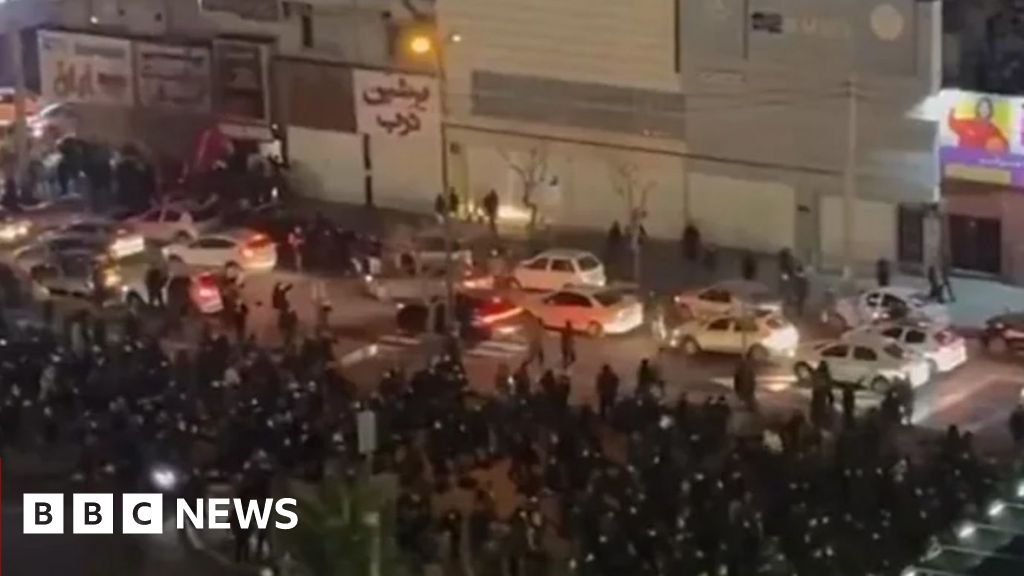
Watch: Protests break out in Iran’s capital city Tehran
Huge crowds of protesters have been marching through Iran’s capital and other cities, videos show, in what is said to be the largest show of force by opponents of the clerical establishment in years.
The peaceful demonstrations in Tehran and the second city of Mashhad on Thursday evening, which were not dispersed by security forces, can be seen in footage verified by BBC Persian.
Later, a monitoring group reported a nationwide internet blackout.
Protesters can be heard in the footage calling for the overthrow of Iran’s Supreme Leader Ayatollah Ali Khamenei and the return of Reza Pahlavi, the exiled son of the late former shah, who had urged his supporters to take to the streets.
It was the 12th consecutive day of unrest that has been sparked by anger over the collapse of the Iranian currency and has spread to more than 100 cities and towns across all 31 of Iran’s provinces, according to human rights groups.
The US-based Human Rights Activist News Agency (HRANA) has said that at least 34 protesters and eight security personnel have been killed, and that 2,270 other protesters arrested.
Norway-based monitor Iran Human Rights (IHR) has said at least 45 protesters, including eight children, have been killed by security forces.
BBC Persian has confirmed the deaths and identities of 22 people, while Iranian authorities have reported the deaths of six security personnel.
On Thursday evening, videos posted on social media and verified by BBC Persian showed a large crowd of protesters moving along a major road in Mashhad, in the country’s north-east.
Chants of “Long live the shah” and “This is the final battle! Pahlavi will return” can be heard. And at one point, several men are seen climbing on an overpass and removing what appears to be surveillance cameras attached to it.
Another video showed a large crowd of protesters walking along a major road in eastern Tehran, while in the north of the city a small gathering was heard chanting “Long live the shah” and “Death to the dictator” – a reference to Khamenei.
Protesters were also filmed chanting “Long live the shah” at a main square in the northern city of Babol.
It came not long after Reza Pahlavi, whose father was overthrown by the 1979 Islamic revolution and lives in Washington DC, had called on Iranians to “take to the streets and, as a united front, shout your demands”.
Iranian state media downplayed the scale of Thursday’s unrest. In some cases, they denied protests had taken place altogether, posting videos of empty streets.
Earlier in the day, footage from Lomar, a small town in the western province of Ilam, showed a crowd chanting “Cannons, tanks, fireworks, mullahs must go” – a reference to the clerical establishment. Another showed people throwing papers into the air outside a bank that appeared to have been broken into.
Other videos showed many shuttered shops in a number of predominantly Kurdish cities and towns in Ilam, as well as Kermanshah and Lorestan provinces.
It followed a call for a general strike by exiled Kurdish opposition groups in response to the deadly crackdown on protests in the region.
At least 17 protesters have been killed by security forces in Ilam, Kermanshah and Lorestan during the unrest, and that many of them have been members of the Kurdish or Lor ethnic minorities, according to Kurdish human rights group Hengaw.
On Wednesday, there were violent clashes between protesters and security forces in several cities and towns in western Iran, as well as other regions.
IHR said it had been the deadliest day of the unrest, with 13 protesters confirmed to have been killed across the country.
“The evidence shows that the scope of crackdown is becoming more violent and more extensive every day,” said the group’s director, Mahmood Amiry-Moghaddam.
Hengaw said two protesters were shot dead by security forces in Khoshk-e Bijar, in the northern province of Gilan, on Wednesday night.
Iran’s semi-official news agency Fars, which is close to the Revolutionary Guards, reported that three police officers were also killed on Wednesday.
It said two were shot dead by armed individuals among a group of “rioters” in the south-western town of Lordegan, and the third was stabbed to death “during efforts to control unrest” in Malard country, west of Tehran.
X
In videos from Mashhad, protesters can be heard chanting “Long live the shah”
On Thursday, US President Donald Trump reiterated his threat to intervene militarily if Iranian authorities killed protesters.
“I have let them know that if they start killing people, which they tend to do during their riots – they have lots of riots – if they do it, we are going to hit them very hard,” he said in an interview with the Hugh Hewitt Show.
Iranian President Masoud Pezeshkian earlier called on security forces to exercise “utmost restraint” when handling peaceful protests. “Any violent or coercive behaviour should be avoided,” a statement said.
Khamenei – who has ultimate power in Iran – said on Saturday that authorities should “speak with the protesters” but that “rioters should be put in their place”.
The protests began on 28 December, when shopkeepers took to the streets of Tehran to express their anger at another sharp fall in the value of the Iranian currency, the rial, against the US dollar on the open market.
The rial has sunk to a record low over the past year and inflation has soared to 40% as sanctions over Iran’s nuclear programme squeeze an economy also weakened by government mismanagement and corruption.
University students soon joined the protests and they began spreading to other cities, with crowds frequently heard chanting slogans critical of the clerical establishment.
The protests have been the most widespread since an uprising in 2022 sparked by the death in custody of Mahsa Amini, a young Kurdish woman who was detained by morality police for allegedly not wearing her hijab properly. More than 550 people were killed and 20,000 detained by security forces over several months, according to human rights groups.
The biggest protests since the Islamic revolution took place in 2009, when millions of Iranians took to the streets of major cities after a disputed presidential election. Dozens of opposition supporters killed and thousands were detained in the ensuing crackdown.