Data centres powering the artificial intelligence boom could demand more new electricity over the coming 15 years than Australia’s cars or homes, according to a Greenpeace report that warns the sudden and unprecedented growth threatens the country’s transition to renewable energy.
The report used government projections, suggesting that data centres’ demand for energy will increase more than sixfold from 2024-25 to 2040, surging from 2 to 13 per cent of the country’s total energy use.
It comes as a major electricity network provider warns it already does not have enough capacity to power every data centre currently in the planning pipeline.
Analysis commissioned by Greenpeace Australia Pacific said the current and projected energy use from a new wave of large, power-hungry data centres added to the challenge of climate policies aimed at closing coal-fired power stations and building enough renewable energy to replace them.
Know more about Australia’s AI data centre build-out? Email Cameron Wilson on wilson.cameron@abc.net.au or his secure email cmwlsn@protonmail.com.
The report said the increase was being driven in large part by artificial intelligence, which required large amounts of computing power to train and run systems such as chatbots, image generators and coding assistants.
The environmental group called for a moratorium on new data centres until governments legislated transparency measures and safeguards around the use of electricity, water and emissions.
The report’s author Ketan Joshi said that Australian Energy Market Operator (AEMO) figures showed data centres could account for 13 per cent of total national electricity demand in 2040 under a high-growth scenario.
Australian Energy Market Operator figures show data centres could account for 13 per cent of total national electricity demand in 2040. (Reuters: Ali Withers)
The report said AEMO’s projected demand from data centres in 2040 increased more than fivefold between its 2024 report and its 2025 report.
Greenpeace said that would put data centre demand at the same level or greater than the energy needed for electrification of cars, homes and potentially businesses.
The report said the projections of the scale of the data centre build-out were backed up by economic data showing an acceleration in data centre-related spending.
It cited Australian Bureau of Statistics data showing spending grew more than 60 per cent in the September 2025 quarter, reaching $2.6 billion — an increase of more than 140 per cent on the previous year.
An aerial shot of the site proposed for a data centre in Kemps Creek. (Supplied)
One proposed data centre in western Sydney — the Mamre Road Data Centre Campus at Kemps Creek — would result in 1.3 million tonnes of CO2-equivalent greenhouse gas emissions in 2032, according to its environmental impact statement, the Greenpeace report said.
Mr Joshi said this was about the same as the greenhouse gas emissions of all domestic flights within NSW in 2023.
Greenpeace said this presented a risk that the large energy demands of data centres would arrive faster than renewable energy, storage and transmission could be built.
“From a standing start, billions of dollars are now pouring into a massive pipeline of proposed new data centres, of unprecedented size, being built at incredible speed in our suburbs,” Greenpeace’s head of climate and energy Joe Rafalowicz said.
When that happens, the report said, coal and gas generators may need to run for longer or harder to fill the gap.
Greenpeace said Australia should require new data centres to source power from new renewable projects, disclose their energy use and emissions, and be subject to stronger approval rules.
‘Two years ago, none of this was forecast’
University of New South Wales senior research associate Dylan McConnell said the analysis captured the scale and speed of demand from new data centres.
Energy providers typically work on longer time frames, with power agreements and new project construction typically spanning several years.
Prior to the data centre boom of the last few years, increases in energy demand were “modest”, Dr McConnell said.
“If you go back even two years, none of this was forecast,” he said.
Dylan McConnell says the analysis captures the scale and speed of demand. (Supplied: Dylan McConnell)
The generative AI boom sparked by the release of ChatGPT at the end of 2022 has led to enormous growth in demand for computing power by global tech companies with products used by billions of users.
The resulting rush of local companies hoping to build data centres to serve this enormous demand completely up-ended the previous projections, Dr McConnell said.
“What we’re seeing in the last 12 months, and official projections, they’re big numbers. The projected new load by 2030 is another 10 terawatt hours, which is equivalent to all of Tasmania’s demand,” he said.
CEO of industry group Data Centres Australia Belinda Dennett said her organisation’s projections were aligned with AEMO’s until 2030. After that, she said it became harder to predict.
“The further out you get the less certain the projection becomes. Government policy will become a factor as to whether Australia captures the opportunity available to it,” she said.
Dr McConnell said even the comparison between the demand of data centres with the electrification of vehicles, homes and businesses did not capture the impact of the new load.
Dylan McConnell says growing energy demand paired with the slower pace of building new renewable projects means existing power plants may remain online for longer. (Mrs. Gemstone/flickr.com/CC BY-SA 2.0)
Electrification of vehicles and gas in houses is replacing an emission-intensive energy source with a lower-emission one.
“They’re not replacing consumption of fossil energy, they’re a new load,” Dr McConnell said.
He said this mismatch of growing energy demand with the slower pace of building new renewable projects meant existing power plants may remain online for longer.
“As a consequence, that means we are going to be burning fossil fuels for longer than we would otherwise be,” he said.
Energy provider warnings as developers line up
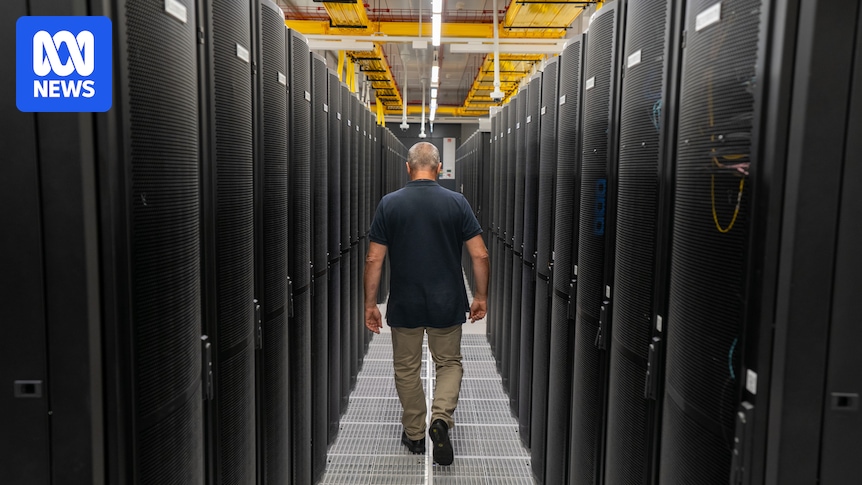
Inside the high-security data centres keeping the world online
Data centres whirr away, critical to so much of our daily lives, yet they don’t often make the headlines. But that is starting to change.
The warning comes as state and national energy bodies consider how the electricity system should deal with large data centres clustered around Sydney and Melbourne.
NSW state energy grid provider Transgrid told an NSW parliamentary inquiry last week that the scale, pace and concentration of data centre development represented a “material step-change”.
In March this year, the NSW government announced it was fast-tracking 15 data centre projects.
Transgrid executive general manager Jason Krstanoski told the inquiry that existing regulatory arrangements “were not designed for this level of large, clustered load growth” with a glut of proposed data centres planning to be built in western Sydney, the Australian Financial Review reported.
Mr Krstanoski said it did not have any data centres connected directly to its transmission network, but had received inquiries representing more than 10 gigawatts of potential load.
The NSW government announced it was fast-tracking 15 data centre projects. (ABC News: Rhiannon Stevens)
About 6 gigawatts of that had progressed to formal applications, although no operator had fully committed.
Mr Krstanoski said the new large loads should be required to pay for the infrastructure needed to supply them, including network upgrades triggered by a data centre, rather than spreading those costs across existing customers.
Earlier this year, the federal government’s Department of Industry, Science and Resources published a set of expectations for data centre developers.
These said the government would prioritise development applications that met certain expectations, including by bringing enough renewable energy generation and storage to offset their demand.
Australian agencies, businesses seek access to ‘dangerous’ AI model
A new generation of AI models deemed “too dangerous” for public release is driving Australia’s efforts to lure top AI companies to establish a major presence in the country.
A spokesperson for Assistant Minister for Science, Technology, and the Digital Economy Andrew Charlton said the government would not support projects that were not in line with these guidelines.
“The Australian Government will continue to work with states and territories on the implementation of the expectations,” they said.
Earlier this month, state energy and federal energy ministers were presented with set of proposals by the independent agency that advises government on the electricity market, the Australian Energy Market Commission.
One proposal would codify the government’s expectation and require data centre providers to “fully offset” all their power consumption with new renewable energy.
All the ministers except Queensland’s David Janetzki agreed with data centres being required to “fully offset their demand”, according to an official statement put out after the meeting.
Other proposals put to the ministers included requiring data centres to reduce their power use during peak demand and to report their energy use and emissions.
The AEMC will have to report back with options for how to implement these ideas in July.