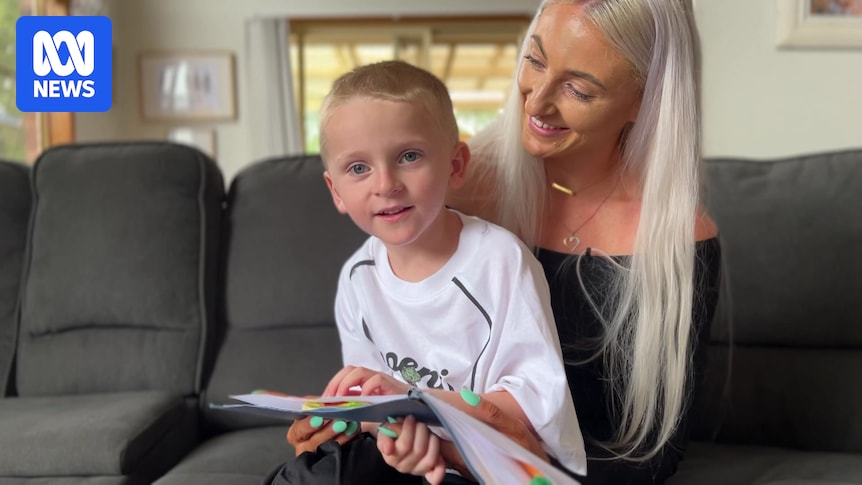
When Sarah Hardy’s son Reid was diagnosed with a rare eye condition in 2021 doctors told her “the best case scenario” was that her baby would be blind.
“We were always told Reid could be under an LED light and tell you if it was on or off and that would be as good as his eyesight got,” Ms Hardy said.
The now five-year-old Reid, who lives with his family in Port Macquarie on the NSW Mid North Coast, has autism and was born with septo-optic dysplasia (SOD) with optic nerve hypoplasia.
The rare condition, which affected just 54 Australians when he was diagnosed, hindered development of his optic nerve.
Reid underwent stem cell therapy to help treat his rare eye condition. (ABC Mid North Coast: Marina Trajkovich)
In 2023, after consulting with specialists and other families navigating the condition, Ms Hardy made the decision to take her then-two-year-old son to Thailand for stem cell therapy unavailable in Australia.
Stem cell treatments are strictly regulated in Australia and many therapies have not undergone clinical trials to prove they are safe and effective.
“[Doctors] said just to be open to new technologies and things coming out in the future, but obviously, we wanted to do as much as we could, so we started doing our own research,” Ms Hardy said.
Ms Hardy hopes Reid will one day repeat the treatment she said was “life-changing” for their family. (ABC Mid North Coast: Marina Trajkovich)
Ms Hardy said after several rounds of the procedure in Bangkok, she noticed a change in her son.
“We were laying in the bed and my husband had walked into the room and was just standing at the door, and Reid noticed someone was there and looked up and asked who was at the door,” she said.
“That was the first sign and just relief we’d made the right decision.”
Reid remains legally blind, but his mother said the surgery had “life-changing” benefits for Reid, who started school this year.
“I put him in the car the other day and he told me he could see me smiling,” she said.
“Just having that extra independence and safety is such a relief.
“There were no guarantees, it was a bit of a risk, but it paid off.”
Reid, who started school this year, uses Braille to read. (ABC Mid North Coast: Marina Trajkovich)
Overseas treatment risks
Stem cells, found all over the body, are building-block cells that can multiply indefinitely and become any other kind of cell.
Scientists are working to develop cellular replacement therapies to help repair and replace diseased or damaged cells.
Megan Munsie is a professor and leading international expert, specialising in emerging stem cell technologies at the Melbourne Medical School and the Murdoch Children’s Research Institute.
She said stem cell therapies were a rapidly growing area of science in Australia, already used to treat certain blood conditions like leukaemia.
Professor Megan Munsie is a leading researcher on the use of stem cells internationally. (ABC News: Marina Trajkovich)
But she said many of the treatments advertised overseas have not been approved for use or subjected to clinical trials in Australia.
“It’s really easy to advertise, it’s really easy to make claims, it’s pretty hard to follow up those claims with good research that’s validated and respected,” Professor Munsie said.
“We want to be able to make sure the products we’re developing are not only safe but they work, and they work consistently.”
She said many “rogue clinics that call themselves stem cell providers often aren’t even selling stem cells”.
“There are very few approved treatments, but that’s the same anywhere in the world,” Professor Munsie said.
Ms Hardy said she had no regrets about travelling overseas for treatment. (ABC Mid North Coast: Marina Trajkovich)
Ms Hardy said her son’s safety was her main concern as she explored the risks of the procedure with Chinese stem cell treatment provider Beike Biotechnology, which offers treatments in China and Thailand.
Beike Biotechnology did not respond to ABC requests for comment about its work or Reid’s treatment.
Ms Hardy said one of Reid’s doctors advised against the procedure due to efficacy concerns and the $50,000 operation and travel costs.
She said others helped her in the research process.
Reports on Reid’s vision before and after the stem cell operation claimed an improvement.
The report stated after two years his visual acuity improved from 1/60 or “profound vision impairment” to 3/60 or “severe vision impairment”.
Orthoptist vision assessments show Reid’s eyesight improved from a visual acuity of 1/60 (right) to 3/60 (left). (Supplied)
Not a ‘panacea’
Professor Munsie said she could not comment on individual cases.
But she warned against treating stem cells like a silver bullet, saying one of the main challenges was predicting and controlling how a stem cell would behave in the body.
“Perhaps we’re making nerve cells or kidney cells or liver cells or cells of the eye,” she said.
“We have to be careful not to see stem cells as a universal sort of panacea.”
Professor Munsie urged those considering treatment overseas to consult their doctors.
Ms Hardy said her biggest concern was for her son’s safety and independence. (ABC Mid North Coast: Marina Trajkovich)
Ms Hardy said she had no regrets about her family’s decision, and hoped Reid could have further stem cell treatment in Australia.
“It’s so much more accessible and could help so many families with so many different diseases,” she said.
“It would be life-changing for many people.”
Eyes on the future
Alex Hewitt is a specialist in genetic eye diseases and is particularly interested in how stem cells can be in treatments. (ABC News: Jordan Young)
Professor Alex Hewitt, who specialises in eye conditions at the University of Tasmania, said there was no “clear indication for a beneficial stem cell-based therapy for septo-optic dysplasia”.
He said while there were no stem cell therapies currently treating eye conditions in Australia they were among the most promising areas of stem cell research.
“The eyes are a very exciting site for these stem cell therapies, particularly because it is a relatively small organ so the number of cells that need to be replaced are small compared to other tissues,” Professor Hewitt said.
“As these studies progress and an evidence base does build up for these therapies, I’m very confident they will be available here in Australia.”