Most Australians consider themselves “DIYers”, with the trip to the hardware store a regular feature of weekends in many households.
About 57% say they are happy to get on the tools for home and garden repairs and improvements, according to one survey. But “do it yourself” culture comes at an environmental cost, whether it’s the noise and air pollution from petrol-powered mowers and blowers, or the cost and waste of tools and hardware bought new and only used once.
Switching from petrol to electric
Australia imports more than 1m outdoor power tools each year, such as lawnmowers, leaf blowers, hedge trimmers, chainsaws, chippers and pressure washers.
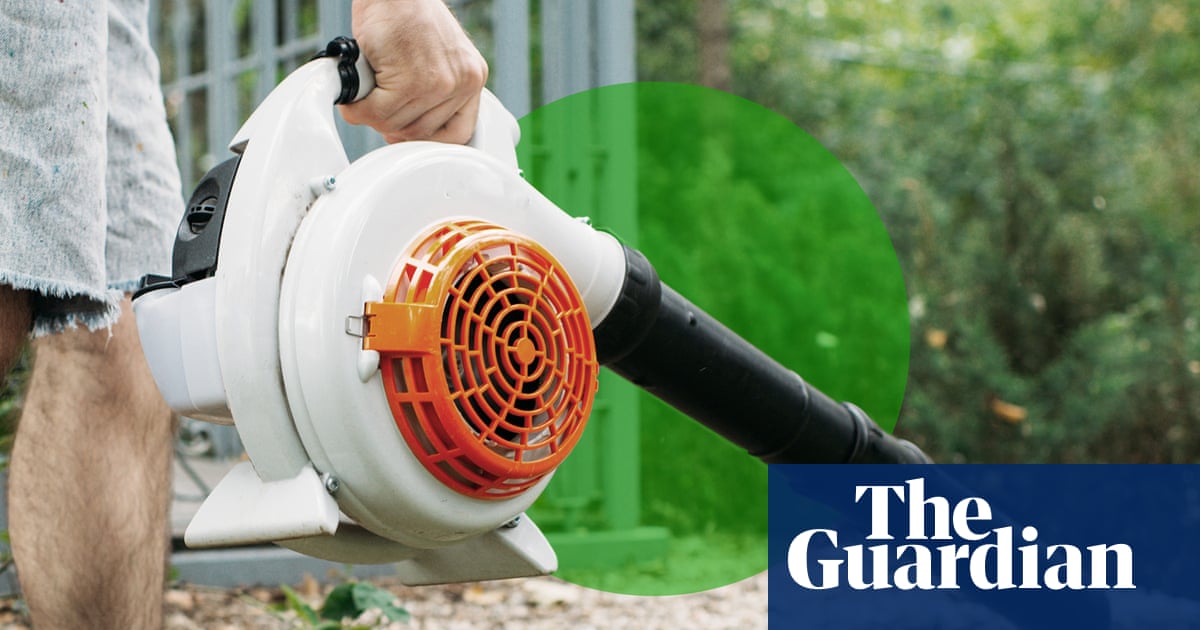
Those that are petrol-powered – running off two-stroke or four-stroke engines – are noisy, emit toxic exhaust (such as carbon monoxide, nitrogen oxides, volatile organic compounds and small particles) and contribute greenhouse gas emissions.
double quotation markWhether it’s a mower, or a blower, or a whipper-snipper, or a chainsaw. Whatever you need, it can all be electricHarry Barber
Operating a commercial leaf blower for an hour produces the same amount of air pollutants as driving 1,700km, according to the California Air Resources Board – about the equivalent distance of driving from Melbourne to Brisbane. An hour of lawn mowing is equivalent to driving about 480km.
On a summer weekend in Australia, these small non-road engines (mainly lawn mowing and recreational boating) contribute up to 20% of certain types of air pollution, including carbon monoxide and volatile organic compounds. In California, they overtook cars as the main source of smog-forming pollution in 2020.
Harry Barber, a transport consultant and volunteer at Electrify Yarra, says battery-electric alternatives are now available for most types of home and garden power tools, so there’s no need to keep petrol in the shed.
“Whether it’s a mower, or a blower, or a whipper-snipper, or a chainsaw. Whatever you need, it can all be electric.”
Shifting to electric power tools is a lot more affordable than switching to an electric car, he says. Most manufacturers tend to sell one battery that can be used across multiple tools.
As well as eliminating air pollutants and greenhouse emissions, electric tools are much quieter and don’t give off the distinctive burnt oil smell of a two-stroke engine, Barber says.
Australian governments banned the sale of two-stroke tools due to their polluting effects in 2020, although many homes still use them. Dozens of cities across the United States have banned the sale of petrol-powered leaf blowers or introduced incentives to encourage the uptake of electric lawn equipment.
Accessing high-quality, hand and electric power tools need not involve a trip to Bunnings.
A growing network of tool libraries – where people pay a membership fee to borrow tools, instead of books – around the country are helping to strengthen their communities, reduce waste and save money.
Brunswick Tool Library, which has been operating for 13 years in Melbourne’s inner north, is the biggest in the country, with almost 1,400 members and dozens of active volunteers.
The president, Zack Morris, says enabling people to borrow tools instead of buying them has benefits for sustainability as well as tool access and affordability. It also helps with space, because a lot of people in the inner city simply don’t have room to store them.
People buy a lot of single-use tools, he says, which can sit in the garage for several years, or get thrown out. Adding to the problem of overconsumption is the large quantity of cheap and poorly made tools on the market.
The volunteer-led not-for-profit focuses on high-quality tools designed for durability and reuse. Its inventory of more than 2,000 items ranges from the small (various types of Allen keys, spanners and clamps) to the very large (ladders, pressure washers and lawnmowers).
“The most popular stuff is the ladders,” says Morris. “We’ve got a couple of big vacuums that go out all the time.” Mulchers, lawnmowers, whipper-snippers and drill kits are also on high rotation.
The tool library is also expanding into education, says the vice-president, Karina Lee, helping people understand how to use tools and repair things – knowledge that’s crucial to building a more circular economy.
Griffith University’s Prof Leanne Wiseman says tool libraries are helping to address overconsumption. When tools, like other household appliances, stop working, the network of more than 100 neighbourhood repair cafes around the country can help to fix them – avoiding waste and the necessity to buy a new one.
On average, Australian households have up to eight large appliances, and between 10 and 15 smaller ones, she says. But power tools, like other consumer devices, often aren’t built to last and can be challenging to fix when they break. Parts are often glued instead of screwed, spare parts aren’t readily available, and batteries and chargers for one electric drill can’t be used with different brand, Wiseman says, and the increasing use of software in products has made it harder to tinker.
RepairMonitor, which tracks data from repair cafes globally, shows pruning shears, electric drills, hedge trimmers and pressure washers are some of items commonly brought in to be fixed.
As well as lending out a variety of tools from spirit levels to staple guns, the City of Melbourne’s libraries host places for crafting and DIY, with onsite access to sophisticated tools and equipment.
The lord mayor of Melbourne, Nicholas Reece, says there has been an upswing in crafting and repair, and the city’s Makerspaces have become hugely popular as a way to access tools and equipment without having to buy them.
Tools available include sewing and embroidery machines, 3D printers, laser cutters and soldering.
“Our 3D printers are often used to print parts to replace something broken, such as a custom hinge or an internal mechanism of a toy,” he says. “Or we’re seeing sewing and overlocking machines being used to repair or patch clothing.”
“We want to be a city that knows how to make things, who knows how to repair things. We don’t want to live in a disposable society where everything gets thrown out on the first break.”