‘Important day for tax reform’: government hails deal with Greens
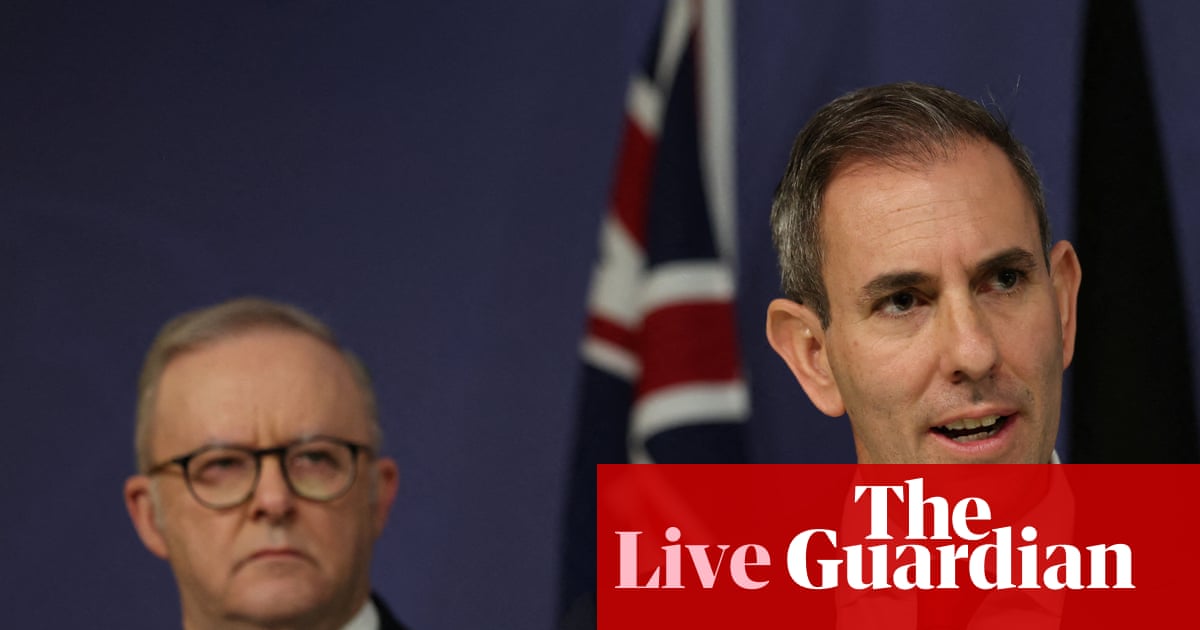
The prime minister, Anthony Albanese, is now addressing reporters at Parliament House with the treasurer, Jim Chalmers, finance minister Katy Gallagher, and NDIS minister Mark Butler.
Albanese says the changes that were announced in the budget (and have since been heavily amended) are important and ambitious.
He also takes a dig at the Liberals, Nationals and One Nation who will oppose it.
double quotation markI expect that just as the three rightwing parties have opposed every tax cut, every pay rise for workers, every cost of living measure, every policy to build more homes and help more people buy their first home, they will oppose these measures and continue in their race to the bottom to see who can be more anti-aspirational, more anti-worker and confirm they are defined purely by what they are against.
Chalmers says today is an “important day for tax reform”, and he, like the PM, is probably breathing a heavy sigh of relief with the changes now guaranteed passage through parliament.
He acknowledges his colleagues for making the deal.
double quotation markEconomic reform is never easy, especially tax reform, but it’s worth it when you are delivering that real change that the prime minister has been referring to. The passage of these bills will mean a fair go for first home buyers, tax cuts for workers and a fairer tax system as well.
Prime minister Anthony Albanese and treasurer Jim Chalmers. Photograph: Lukas Coch/AAPShare
Updated at 21.42 EDT
Key events
Fuel excise extension and NDIS delays will cost budget ‘a few hundred million dollars’
Before the press conference wraps up, the treasurer is asked how much money the fuel excise cut extension (announced last week) and the delay to the NDIS reforms will cost the budget.
The answer: the fuel excise extension will cost around $400m – which Jim Chalmers says the states and territories will chip in for.
On the NDIS changes, Chalmers doesn’t have an exact number, but it’s certainly not chump change.
double quotation markThe NDIS minister, Mark Butler, has indicated the NDIS cost is in the order of a few hundred million dollars.
Share
Updated at 22.21 EDT
Commonwealth working constructively with states on gun buybacks
The government’s promise for a national gun buyback has received a colder response from the states than Labor might have initially anticipated.
But Anthony Albanese says he’s been in direct contact with the NSW police minister and that he’s “confident” the commonwealth will work constructively with states and territories.
double quotation markI’ve had direct contact with the police minister, Yasmin Catley, and I’m confident that we will work through those issues constructively. The gun buyback is important. It is important that as many states as possible participate.
We have been flexible in the framework that has been put forward by Tony Burke in dealing with states and territories, and we’ll work constructively with states and territories, as we always do, we had a very constructive meeting of the national cabinet yesterday.
Share
Updated at 22.21 EDT
Albanese calls Hanson’s monoculture push a ‘nonsense argument’
Jumping back into the prime minister’s press conference, Anthony Albanese is asked about Pauline Hanson’s comments that Australia should be “monocultural” not multicultural.
The PM calls it a “nonsense argument” and says that from the first fleet to our Socceroos team (who we will all be watching at 12pm AEST on Friday), Australia has always been multicultural.
double quotation markWe had from the arrival of the first fleet, not everyone was one [culture].
When we look at the Socceroos, we see examples of that rich culture, people who are proud of their ethnicity, of who they are, but also who are proud Australians in representing our great nation and the whole country will be cheering them on on Friday at 12 o’clock, and I hope that the country stops for a little bit during that time.
It’s who we are, so it’s really a nonsense argument to go back to something that was actually never there.
Anthony Albanese speaks to the media in Canberra on Tuesday. Photograph: Lukas Coch/AAPShare
Updated at 22.12 EDT
Controversial herbicide paraquat to remain legal in Australia despite Parkinson’s concerns
Anne Davies
The herbicide paraquat, banned in over 70 countries, will remain legal in Australia despite Parkinson’s disease groups, scientists and neurologists arguing there is a strong correlation between exposure and the incidence of the disease.
The Australian Pesticides and Veterinary Medicines Authority (APVMA) gazetted a final regulatory decision on Tuesday following the reconsideration of both paraquat and a related chemical, diquat.
The APVMA CEO, Scott Hansen, said the reviews applied contemporary risk management frameworks to rigorous scientific investigation of the impacts of paraquat and diquat on human health and the environment. Hansen said:
double quotation markBoth chemicals remain available for use with significant new restrictions on application rates and permitted uses.
To protect users from acute exposure, new restrictions will phase out backpack sprayers and require enclosed mixing and loading systems for all uses, and enhanced personal protection equipment.
Overall, the maximum rate of application on paraquat and diquat will be 231grams per hectare, when it was previously 1,150 grams per hectare.
During the review process, the APVMA received 171 submissions from scientists, doctors, the agricultural industry and other interested parties.
In making its decision, the authority said it “found the weight of evidence did not show that paraquat exposure through approved uses increases the risk of developing Parkinson’s disease”.
The Parkinson’s Australia chief executive, Olivia Nassaris, said she was deeply disappointed in the review outcome.
“Seventy countries have banned the use of paraquat. Are the lives of Australians less valuable?” she said on Tuesday.
Scientists and neurologists say there is a strong correlation between exposure of herbicide paraquat and the incidence of Parkinson’s disease. Photograph: Leonid Eremeychuk/Getty Images/iStockphotoShare
Updated at 22.15 EDT
Is a $1m home affordable for young people?
Reporter Evelyn Manfield asks the prime minister whether he believes that $1m, the typical price for an apartment in the suburb of Marrickville, in the PM’s electorate of Grayndler, is “affordable” for young people.
As a former Sydneysider myself, for those unfamiliar with that particular terrain, Marrickville is what I would describe as an industrial-chic suburb with lots of bars, micro-brewries, cafes and lots of young people who really want to live there (many of them rent).
The PM can’t really answer the question:
double quotation markWell, it depends on what their income is. It depends on all of their status, which is there. So people are, you know, we want to give young people a fair crack at owning their own home, that is what these are aimed at doing.
Jim Chalmers then gets a follow-up question on whether older people looking to sell their homes should be concerned that prices in some areas are falling.
He says that prices were falling before the budget was released.
double quotation markWhether you’re talking about house prices or about auction clearance rates, we were seeing some of them begin to soften even before the budget, and that’s because there are a number of factors at play when it comes to auctions and when it comes to house prices, including movements in interest rates, global and domestic economic conditions, and also tax settings.
Share
Updated at 22.10 EDT
Butler ‘utterly convinced’ his NDIS reforms are the right package
My colleague, Josh Butler, follows up and asks Mark Butler – the health and NDIS minister – whether the eight-week extension will see any further changes to the package, or if the government will spend the entire time trying to sell those changes to the public and people with a disability.
Butler doubles down and says he still believes these reforms are the right way to go.
He says he gets it’s a hard change but the government’s job is to “clarify exactly what that impact will be”.
double quotation markI’m convinced is the right package of reforms. I mean, there are some minor changes at the edges that we’ve already announced over the course of this morning to particularly clarify our intention and to provide reassurance to people about what is going to change and what is not going to change, but I’m utterly convinced that the package of reform that we worked on for months, frankly … is the right package of changes.
Asked about concerns over automated decision-making included in the NDIS reforms, Butler says the government is “treading very carefully”.
double quotation markWe are treading very carefully into any use of automated decision-making … obviously, we’re taking advice from a range of bodies like the one that you’ve mentioned. I’ve made it very clear that any use of ADM would be simply about administrative processes, certainly not about anything more substantive than that.
Share
Updated at 21.54 EDT
PM and Butler stand firm against changes to NDIS reforms
Anthony Albanese is asked whether, after the longer inquiry process, Labor would be open to more changes to the NDIS reforms.
The prime minister says that when Labor was first elected into office, the disability insurance scheme was growing at 22% per year which was unsustainable, and that the reforms need to be made.
double quotation markWhat we want to make sure is that reform occurs, so that everyone who needs the support at the NDIS with a disability receives the support that they need, but so that we get rid of and deal with some of the waste and anomalies, which are there, which don’t assist people with disabilities.
Neither he nor Mark Butler indicate that they will make other changes. Butler says that the extra time will help the government communicate the changes better to the disability community.
double quotation markI, and many members of government are obviously engaging with people with disability to help to explain the government’s reasoning behind this package and to dispel some of the misapprehensions about what it’s going to mean for participants, and the extra eight weeks of the hearing will provide us with more opportunity to do that.
Butler adds the government is working with the states, who need to be on board for the changes to actually work.
Share
Updated at 21.52 EDT
Six-month delay on NDIS bill would have cost billions, Butler says
The health and NDIS minister, Mark Butler, who was also sitting at the negotiating table to land a deal with the Greens, confirms that there will be an eight-week extension to the NDIS inquiry process.
But Butler says he still believes that the changes are “absolutely the right package for the NDIS”.
He says the extension will allow the government to provide more assurances around the bill, as opposed to a six-month delay which was proposed by the Coalition which would have cost billions.
double quotation markA six-month extension would cost the budget billions of dollars, but would also delay our ability to get those cost blowouts under control, to clear up eligibility rules, and to crack down on the fraud and the integrity issues that the community knows are there with the NDIS, and that is why we have agreed to an extension of this inquiry …
This is another opportunity for us to provide ongoing reassurances about our intentions around this package, and the degree to which this is an important reform to secure the long-term future of this important social program.
Health and NDIS minister Mark Butler. Photograph: Mick Tsikas/AAPShare
Updated at 21.44 EDT
‘Important day for tax reform’: government hails deal with Greens
The prime minister, Anthony Albanese, is now addressing reporters at Parliament House with the treasurer, Jim Chalmers, finance minister Katy Gallagher, and NDIS minister Mark Butler.
Albanese says the changes that were announced in the budget (and have since been heavily amended) are important and ambitious.
He also takes a dig at the Liberals, Nationals and One Nation who will oppose it.
double quotation markI expect that just as the three rightwing parties have opposed every tax cut, every pay rise for workers, every cost of living measure, every policy to build more homes and help more people buy their first home, they will oppose these measures and continue in their race to the bottom to see who can be more anti-aspirational, more anti-worker and confirm they are defined purely by what they are against.
Chalmers says today is an “important day for tax reform”, and he, like the PM, is probably breathing a heavy sigh of relief with the changes now guaranteed passage through parliament.
He acknowledges his colleagues for making the deal.
double quotation markEconomic reform is never easy, especially tax reform, but it’s worth it when you are delivering that real change that the prime minister has been referring to. The passage of these bills will mean a fair go for first home buyers, tax cuts for workers and a fairer tax system as well.
Prime minister Anthony Albanese and treasurer Jim Chalmers. Photograph: Lukas Coch/AAPShare
Updated at 21.42 EDT
KPMG chair and audit partners resign amid alleged leaking scandal
Catie McLeod
Leaving that press conference for a moment, the chair of the Australian arm of global accounting firm KPMG and two partners have resigned amid a growing scandal over alleged leaks of clients’ confidential information.
KPMG announced earlier today that national chair, Martin Sheppard, and audit partners Paul Rogers and Eileen Hoggett would leave the firm.
They will follow KPMG’s Australian chief executive, Andrew Yates, and the national managing partner of audit and assurance, Julian McPherson, out the door.
In addition to the new leadership changes, KPMG has also announced “a governance overhaul and a comprehensive action plan to address integrity issues and strengthen accountability across the firm”.
We’ll bring you more details shortly.
Martin Sheppard speaks during an inquiry hearing into corporations and financial services on 19 June. Photograph: Lukas Coch/AAPShare
Updated at 21.37 EDT
NDIS changes still ‘clear and present danger to the life and liberties of disabled people’, Steele-John says
Jordon Steele-John, the Greens NDIS spokesperson, says no matter what his party will not pass the NDIS bill, but they have secured some changes to it.
He says under the original reforms, the government could force people to undergo medical interventions before accessing the NDIS.
double quotation markThe protections that the Greens have secured ensure that these interventions cannot be restrictive practices, such as forced medication, and that they must be available through the public health system.
I am confident that these amendments will provide and have secured additional protections from what is in the legislation currently. Let me be clear, however, this legislation, while improved by these protections, still represents a clear and present danger to the life and liberties of disabled people.
Greens senator Jordon Steele-John. Photograph: Mick Tsikas/AAPShare
Updated at 21.28 EDT