
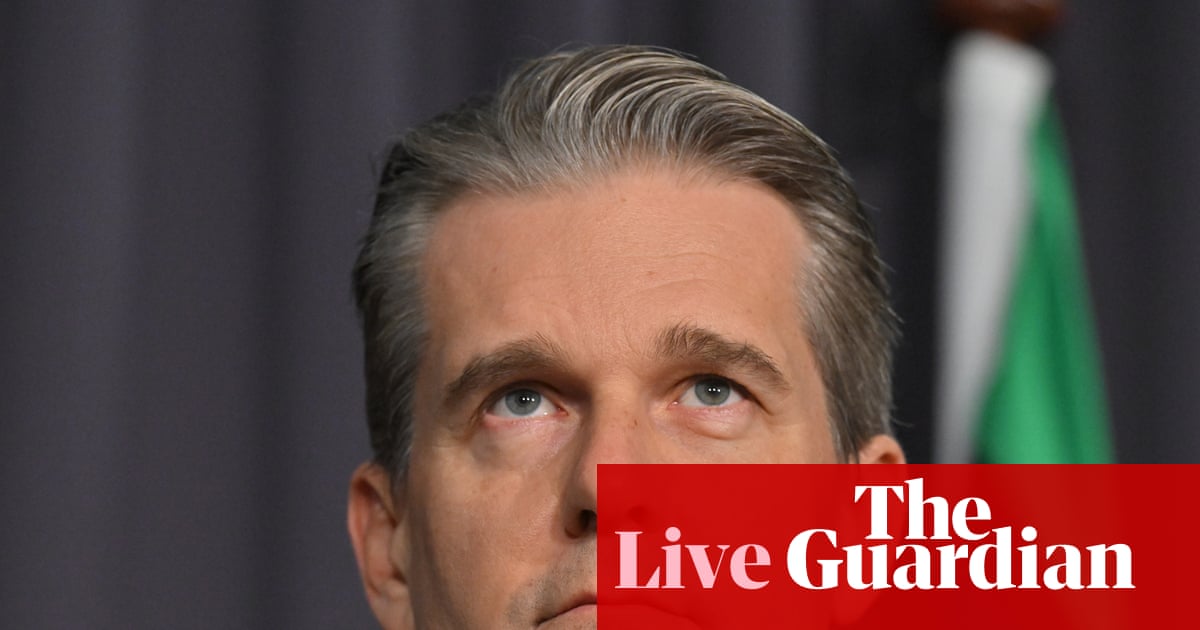
Datacentres ‘most contested pieces of infrastructure’, Charlton says
Josh Taylor
The assistant minister for the digital economy, Andrew Charlton, said in the past two years, datacentres have become “one of the most contested pieces of infrastructure in the world”, with advocates saying it could bring a new wave of economic value, while critics say they are “giant sheds … creating few jobs and risking some of the same mistakes we made in the resources boom”.
In a speech to the Sydney Institute last night, Charlton said both sides contain important truths, but he said the boom was happening. He said:
double quotation markIt’s accelerating. And it’s likely to be larger and more consequential than anything we’ve lived through in recent decades.
The real question – which I will return to many times – is simpler: do we shape the boom before it arrives – or do we react after it’s here?
Charlton said the datacentre boom will be more profound than the resources boom, and Australia was an attractive location for the new centres.
He added concerns around energy use, water use and locations of the centres were legitimate, as well as ensuring Australia earns its fair share.
MP Andrew Charlton. Photograph: Jeremy Ng/AAPShare
Updated at 19.28 EDT
Key events
Catie McLeod
Continuing on our from last post …
There were sales of 11 of the products during the relevant period, while six products did not sell.
The ACCC said the it had decided to resolve the matter “administratively” without taking further formal enforcement action, because:
double quotation markThe allegedly misleading “was” prices were largely due to system errors or human error, some of which JB Hi-Fi proactively took action on prior to the ACCC’s investigation.
JB Hi-Fi also cooperated with the ACCC’s investigation and has taken steps to prevent similar issues in the future.
The ACCC noted JB Hi-Fi had offered compensation to affected consumers, and that the number of affected products was “small”.
JB Hi-Fi has been contacted for comment.
You can read more about how other major retailers (Woolworths and Coles) have used “Was/Is” comparative pricing, here:
ShareCatie McLeod
ACCC announces JB Hi-Fi to refund customers $250,000 over allegedly misleading ‘Was/Is’ pricing
The consumer watchdog says JB Hi-Fi will refund customers more than $250,000 after the electronics retailer allegedly offered misleading discounts on products including laptops and a VR headset.
In a statement this morning, the Australian Competition and Consumer Commission announced JB Hi-Fi had agreed to the refunds after it raised concerns the retailer may have misled consumers.
The ACCC said it discovered the allegedly misleading use of “was/is” comparative pricing during an investigation that monitored JB Hi-Fi’s online product pricing from March to September last year.
The regulator alleges JB Hi-Fi promoted 17 products as discounted from a previous higher price, when the products were either never offered for sale at the higher price, or only offered at the higher price for a short period, or only offered at the higher price long before the promotion.
In total, 206 consumers bought one of the products when they were advertised with an allegedly misleading “was” price.
Photograph: Speed Media/Rex/ShutterstockShare
Updated at 19.59 EDT
Brittany Higgins has a new job fighting ‘rise of misogyny’ and far-right politics in Australia
Brittany Higgins has been appointed as the executive director of the Vida Fund, with her role focused on “countering the rise of misogyny and far-right political movements in Australia”.
The role will see Higgins lead an effort to put gender equality “firmly on the electoral agenda” and support “values-aligned” independent female candidates in upcoming elections, both statewide and federally.
She said in a statement:
double quotation markVida Fund was created to ensure gender equity remains a defining political issue in Australia, not just a one-off moment. We are entering a period where misogyny, extremism are becoming increasingly organised and visible. Vida intends to meet that moment with evidence-based advocacy, strategic campaigning and community-backed action.
The Vida Fund will also undertake new research into the role of gender in the rise of far-right political movements.
Brittany Higgins. Photograph: Dan Himbrechts/AAPShare
Updated at 19.52 EDT
Seven owner announces job cuts and restructuring
Amanda Meade
Seven’s owners, Southern Cross Media, have announced a $150m cost-reduction program, including significant job losses and a restructure of its newspaper, radio and TV businesses.
SCM’s new managing director and chief executive officer, Rohan Lund, has told staff this morning the company’s business is “under immense pressure”.
“We will be saying goodbye to many smart, talented, and hard-working colleagues who have played a vital role in building both businesses,” Lund said in an email sent to staff.
According to an official ASX announcement, the cost-reduction program will lead to 250 to 300 people leaving the group before the end of this month.
Lund blamed the cuts on a tightening advertising sector and global macroeconomic pressures.
Seven told the ASX this morning market conditions “have deteriorated materially more than anticipated” and revenue for the 2026 financial year is lower than expected: falling from previous guidance of $1,910m to $1,920m to $1,860m to $1,870m.
Seven West Media’s print and digital mastheads include the West Australian, the Sunday Times and the Nightly.
Share
Updated at 19.36 EDT
Krishani Dhanji
Breast cancer and endometriosis drug Zoladex is being pulled from Australia. How will women be affected?
Thousands of women could be left without vital breast cancer and endometriosis medicine when AstraZeneca removes its treatment from the Pharmaceutical Benefits Scheme (PBS) and the private market, experts warn.
Zoladex will no longer be available in Australia from November, as the ABC first reported, but some existing patients will still be able to access it for an additional six months.
Breast Cancer Network Australia also says there have been increasing delays to list other critical breast cancer drugs on the PBS, which they fear is due to policy changes in the US and global uncertainty.
What will this mean for women who use Zoladex, and what happens next?
ShareJosh Taylor
Charlton says Australia should learn lessons from resources boom for AI
In an apparent nod to comments made by independent senator David Pocock this week, the assistant minister for the digital economy, Andrew Charlton, said some of the response to the datacentre boom is “rightly or wrongly” shaped by the resources boom, in particular gas.
He said:
double quotation markWe had abundance – but we didn’t lock in our advantage early enough. We built for export before securing supply at home. We became one of the largest gas exporters on Earth and then watched households and factories pay more for gas dug up beneath their feet.
He said the boom set the terms, not the country, and it is important that Australia set the rules for datacentres now.
He said that is what the government is learning from experiences of backlash over new datacentres bringing higher electricity prices in places like the United States and that led to the so-called “triple lock” policy in Australia where datacentres are expected to cover their own electricity costs, have flexible demand and bring new energy supply.
Share
Updated at 19.12 EDT
Datacentres ‘most contested pieces of infrastructure’, Charlton says
Josh Taylor
The assistant minister for the digital economy, Andrew Charlton, said in the past two years, datacentres have become “one of the most contested pieces of infrastructure in the world”, with advocates saying it could bring a new wave of economic value, while critics say they are “giant sheds … creating few jobs and risking some of the same mistakes we made in the resources boom”.
In a speech to the Sydney Institute last night, Charlton said both sides contain important truths, but he said the boom was happening. He said:
double quotation markIt’s accelerating. And it’s likely to be larger and more consequential than anything we’ve lived through in recent decades.
The real question – which I will return to many times – is simpler: do we shape the boom before it arrives – or do we react after it’s here?
Charlton said the datacentre boom will be more profound than the resources boom, and Australia was an attractive location for the new centres.
He added concerns around energy use, water use and locations of the centres were legitimate, as well as ensuring Australia earns its fair share.
MP Andrew Charlton. Photograph: Jeremy Ng/AAPShare
Updated at 19.28 EDT
Convicted gang rapist Mohammed Skaf arrested and charged with nearly two dozen drug charges
Mohammed Skaf, a notorious gang rapist, was arrested and charged with nearly two dozen drug charges on Wednesday night.
NSW police said this morning two men and a woman will face court over their alleged involvement in a large-scale drug supply scheme after search warrants were executed in Sydney’s south-west overnight.
Police said they had allegedly seized large quantities of drugs, including cocaine, around $245,000 in cash, a vehicle and other items during searches in Greenacre.
Mohammed Skaf (centre), seen in 2021. Photograph: Dan Himbrechts/AAP
Skaf, 42, has been charged with 24 offences, including 22 charges of supplying a prohibited drug. He has also been charged with knowingly dealing with the proceeds of crime and knowingly directing activities of a criminal group.
He has been refused bail and will appear before Bankstown local court later today. Investigations are ongoing.
Skaf was convicted in 2000 for his involvement in the gang rapes of at least six schoolgirls in Sydney alongside his brother, Bilal Skaf, and sentenced to 23 years in jail. He was released on parole in 2021, which expired in 2024 at the end of his sentence.
Share
Updated at 18.37 EDT
James Paterson says any discussions about deals with One Nation ‘premature’
James Paterson, the shadow defence minister, said any chatter about preference deals with One Nation are “premature”.
Paterson spoke to RN Breakfast, saying the Coalition would need to make a final decision down the road when candidates are put forward at the next election. He said:
double quotation markYou cannot make a final decision about which candidates you’ll preference in each seat until you know who each of those candidates are, because some political parties, like One Nation, have demonstrated great difficulty in choosing appropriate candidates for public office in the past …
Paterson added the Coalition would “never” do deals on a national basis where they guarantee preferences.
double quotation markI think, frankly, One Nation has a lot of work to do to get themselves into a fit state to contest the election.
James Paterson. Photograph: Lukas Coch/AAPShare
Updated at 18.03 EDT
Wong not ‘interested’ in One Nation’s fundraising
Wong says she isn’t concerned about One Nation’s fundraising efforts, but more about their policies. Pauline Hanson’s party says it has raised more than $1.5m in the last day, although those claims are unverified.
The foreign affairs minister said:
double quotation markI’m less interested in what Pauline Hanson fundraises and am more concerned about One Nation’s policies. Just as I am concerned about the fact that the Liberal party and One Nation seem to be working together and that it appears to be very clearly that a vote for One Nation is actually a vote for the Liberal party, and a vote for the Liberal party is actually a vote for One Nation.
Wong went on to say One Nation is “very good at provoking anger” but has “very little to say” about solutions.
Share
Updated at 17.57 EDT
Wong says Australia still working to see ‘negotiated end’ to Middle East conflict
The foreign affairs minister, Penny Wong, said Australia still hopes to see a “negotiated end” to the conflict in the Middle East.
Wong is visiting the UK this week where she will meet with her European counterparts. She told Radio National this morning:
double quotation markWe’ve said for some time it’s obviously a fragile ceasefire, but we’ve also said that what Australia wants is a negotiated end to the war. That’s what we’re calling for, and that’s what we will continue to press for …
We’re not a central player in the Middle East, as we have said. What we can do is add our voice to others who are calling for a negotiated end to the conflict. It’s obviously one of the things we discuss today with the United Kingdom.
The minister for foreign affairs, Penny Wong. Photograph: Kin Cheung/AFP/Getty ImagesShare
Updated at 17.54 EDT
Are you a parent with thoughts on the social media ban? Let us know
The story about the social media ban and the prevalence of cyberbullying comes as the UK government edges towards introducing a similar measure.
If you’re a parent, we’d like to hear from you about whether the ban is working.
Share
Updated at 17.36 EDT
Taylor says ‘no plan’ to carve up seats with One Nation
The opposition leader, Angus Taylor, said there are no plans to carve up seats as part of a negotiation with a surging One Nation.
Taylor spoke to ABC News Breakfast responding to reports in the morning papers:
double quotation markNo, there’s no plan to carve up seats. We won’t be doing that … What we will be doing is focusing on a Labor government that’s taking this country in the wrong direction with higher taxes, with less houses, with immigration that has not been in line with our housing supply and with an energy system that is broken.
And that will be our focus. It won’t be carving up seats.
Liberal leader Angus Taylor. Photograph: Lukas Coch/AAPShare
Updated at 17.36 EDT
Continuing on from last post …
There had been no discernible drop in reports of online harm such as cyberbullying and image-based abuse from under-16s, according to the latest report from eSafety commissioner Julie Inman Grant in March.
Nevertheless, Bianca Quetti, a mother of teenage children, supports the ban.
double quotation markMy kids were 16 already when it came in … I’m not sure what other parents are thinking, but I would presume most would like it.
I mean, there’s probably a way around it, I’m sure they’ve all got a way around it. I think it’s not a bad thing.
Her 16-year-old daughter Taylah narrowly avoided the ban and said there was a lot on the internet she didn’t think young people should be seeing.
But she said not much had changed with the social media accounts of people at her school who should have been impacted by the ban.
“I don’t know if it’s really working that much … most of their accounts didn’t even get banned, so they’re still allowed on there,” she told AAP.
Share
Updated at 17.25 EDT
Jury still out on early impacts of child social media ban
A non-profit organisation that runs a helpline for young people says there is little sign of a dip in cyberbullying or image-based abuse in the six months since teenagers under 16 have been banned from social media, Australian Associated Press reports.
But even without a clear fall in reports of online harm, the early results are not necessarily discouraging, experts say, as the nation remains at the front of efforts to restrict under-16 access to social media.
Call patterns remained largely unchanged since the ban was introduced, a helplines operator said.
Yourtown, a non-profit, operates Kids Helpline and virtual services manager Tony FitzGerald told AAP it was too early to gauge any real difference.
double quotation markFrom speaking to young people, particularly in that 13-16 age group the experience for them has been very inconsistent.
Some of them have had social media cut-off, whereas [some] have not had any impact in terms of their access to those platforms. It’s been a bit messy for that group.
Despite this, young people are moving to other platforms such as WhatsApp, which aren’t subject to the social media ban, to interact.
“We’ve seen young people come to us who would say they’re being cyberbullied on messaging apps,” FitzGerald said.
double quotation markThere’s a whole range of other platforms that are out there that are not subject to the social media minimum age restrictions that young people still are interacting on and they’re still experiencing harm.
It’s six months since the social media ban for children started and it’s unclear how it’s going. Photograph: Andy Rain/EPAShare
Updated at 17.22 EDT
Good morning, it’s Nick Visser back on deck. Let’s get into it.
Share
New federal government funding for medical research
Tom McIlroy
The federal government will spend an extra $100m over 10 years for high-level arthritis research, a condition which affects some 7 million Australians.
Anthony Albanese and the health minister, Mark Butler, will today announce a new arthritis and musculoskeletal conditions research mission, as part of the government’s Medical Research Future Fund.
The plan is designed to bring together key researchers, health professionals, industry and patients to improve prevention, diagnosis and treatment of the debilitating condition.
The prime minister says:
double quotation markFor millions of Australians, living with arthritis isn’t just an ache or pain, it affects their ability to work, to stay active and to enjoy everyday life,
My government is investing in medical research because it is an investment that changes lives and strengthens our nation’s health.
Share
Updated at 17.05 EDT
New TGA crackdown targets illegal peptides
Ima Caldwell
The Therapeutic Goods Administration (TGA) has announced a crackdown on illegal peptides, labelling the unregulated drugs a “priority focus area“ due to a surge in imports and online advertising.
The medicines regulator said on Wednesday that peptides, frequently marketed for performance enhancement or anti-ageing, are increasingly being unlawfully advertised and supplied to Australians, threatening consumer safety.
Other current priority focus areas for the watchdog include melatonin, medicinal cannabis and weight loss medications.
TGA chief, Prof Anthony Lawler, said:
double quotation markAs the availability of unapproved peptide products has increased, so too has evidence of potential risk to consumers.
The TGA’s increased response to the import, supply or manufacture of unlawful peptides will include product seizures, infringement notices, import interventions and legal penalties.
The announcement follows a joint operation in April between the TGA, Australian Border Force and Victoria police, which seized $2 million worth of illegal steroids and peptides.
Despite peptides not being approved for human use, influencers are telling their audiences that injectable peptides are a new “glow up potion” for everything from back pain to chronic UTIs.
You can read more from Natasha May here:
Share
Welcome
Good morning and welcome to our live news blog. I’m Martin Farrer with the top overnight stories and then it will be Nick Visser with the main action.
A non-profit organisation that runs a helpline for young people says there is little sign of a dip in cyberbullying or image-based abuse in the six months since teenagers under 16 have been banned from social media. More coming up.
The Therapeutic Goods Administration (TGA) has announced a crackdown on illegal peptides, labelling the unregulated drugs a “priority focus area” due to a surge in imports and online advertising. More details in a moment.
And the federal government has come up with $100m for more medical research into arthritis, to improve prevention, diagnosis and treatment.
Share


