
The Trump administration’s decision to begin designating certain Muslim Brotherhood (MB) chapters as Foreign Terrorist Organizations (FTOs) has revived a complex diplomatic dilemma: How will the move affect relations with Turkey, a NATO ally whose leadership has become one of the Brotherhood’s most outspoken global patrons?
This is not a new question. The first Trump administration discussed a full designation of the group in 2017, generating immediate worries about complicating ties with Ankara. At the time, Reuters reported concerns that such a move would “complicate relations with Turkey, a key American ally in the fight against Islamic State, and where the Islamist-rooted AKP Party that dominates the Turkish government of President Recep Tayyip Erdogan is in power.” The report added: “Tunisia’s Islamist Ennahda Party has also participated in democratic elections.”
Today, that diplomatic problem is far more acute. Since those initial discussions in 2017, Turkey’s support for the Brotherhood has only deepened, forcing Washington to confront the reality that an FTO designation directly challenges a key strategic partner.
President Erdogan’s ideological affinity for the Muslim Brotherhood is rooted in his political biography, dating back to the 1970s. During this time, he established contacts with MB figures like spokesman Kemal Al-Helbawy at conferences organized by the World Assembly of Muslim Youth (WAMY), a Wahhabi-Salafist organization. In this era, cooperation was primarily on a religious-cultural and intellectual level, constrained by Turkey’s strict secular system.
The critical shift began in the early 2000s, with the co-founding of the Justice and Development Party (AKP) in 2001. Rising to power from 2002 onward, Erdogan’s government gradually dismantled restrictions on religious expression (for example, lifting bans on headscarves), creating a more permissive and attractive environment for global Islamist networks, including those linked to the Brotherhood. The shared ideological leanings and AKP’s democratic legitimacy solidified Turkey as a crucial new base.
Turkish-Brotherhood ties deepened to an unprecedented level after the 2011 Arab Spring and the 2013 military coup in Egypt that toppled the MB-affiliated President Mohamed Morsi. Under Erdogan, Turkey quickly emerged as the movement’s chief international defender.
Istanbul became the new primary hub for the Brotherhood’s global network, offering asylum to thousands of exiled members.
An estimated 1,500 Brotherhood members sought sanctuary in Turkey following Morsi’s 2013 downfall. Days after his ouster in July 2013, Istanbul hosted two international Brotherhood assemblies, during which exiled leaders assessed the prospects of reinstating their leadership. The meetings reportedly included representatives from across the Middle East and North Africa, including Morocco, Malaysia, Mauritania, Libya, Somalia, Syria and Iraq.
President Erdogan has consistently demonstrated deep solidarity with the movement, regardless of the diplomatic costs:
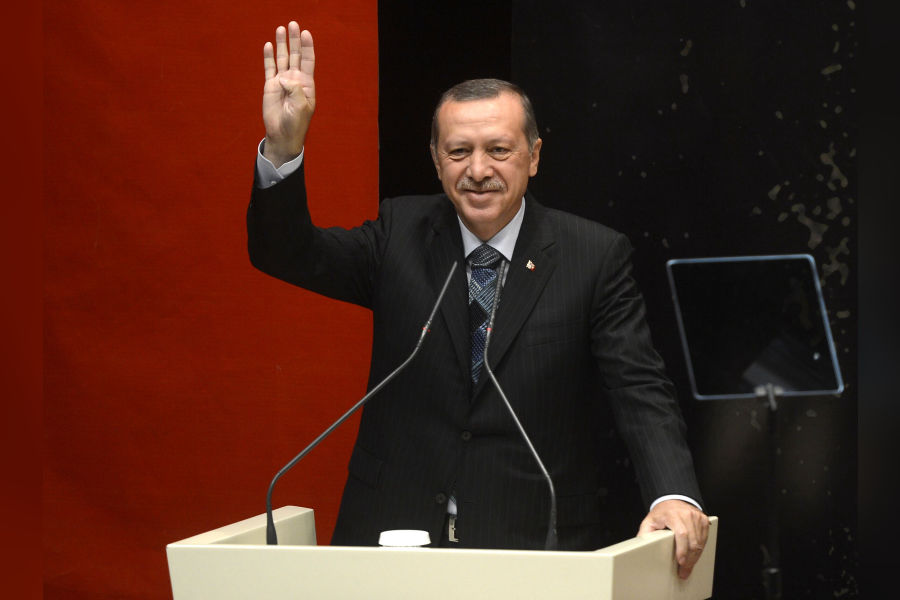
The R4BIA salute: Following the 2013 coup in Egypt, Erdogan publicly adopted the distinctive four-finger R4BIA sign, signaling unambiguous solidarity with the ousted Islamist-leaning government and positioning Turkey as a staunch defender of political Islam abroad.
Ideological defense: Despite international pressure, Erdogan has consistently rejected labeling the Muslim Brotherhood as a terrorist organization. In a February 2017 interview with Al Arabiya, he stated: “It is not an armed group, but…an ideological organization,” adding, “There would be no tolerance for the Muslim Brotherhood in Turkey if they had to do with terrorism, and we have not seen or observed any action [from them] that indicates this.”
Erdogan has also maintained that Morsi is the legitimate leader of Egypt, reaffirming his support as recently as May 2015. This defense was echoed by his party: in April 2019, when U.S. President Donald Trump first announced he was considering designating the Muslims Brotherhood as a terrorist organization, AK Party spokesman Ömer Çelik warned that such a U.S. decision would “undoubtedly yield extremely wrong results regarding stability, human rights, basic rights and freedoms in countries of the Islamic world.”
Media platform: Despite banning and censoring thousands of opposition outlets since assuming the presidency in 2014, Erdogan permits a handful of pro-Brotherhood media to operate in Turkey. Stations such as Rabia TV, al-Sharq and al-Watan, run by exiled Egyptian MB members, often broadcast pro-Islamist messaging, including threats directed at Western-owned companies in Egypt to leave the country.
Alleged material support: Analysts have also suggested that Turkey has supplied weapons and activists to the Muslim Brotherhood for its activities in Egypt. Turkish intelligence officer Irshad Hoz, for example, was arrested by authorities in Egypt in connection to the Brotherhood.
Turkey’s patronage of the Muslim Brotherhood has come at a high diplomatic cost, isolating Ankara from key regional rivals. Saudi Arabia, Egypt and the United Arab Emirates have all designated the Brotherhood as a terrorist organization and view Turkey’s stance as a destabilizing force. When these nations, along with Bahrain, severed diplomatic ties with Qatar in 2017 and demanded the emirate cut its links to the Brotherhood, Turkey firmly sided with Qatar.
The Trump administration’s new push to designate MB chapters has created an unavoidable tension, exposing the limits of its foreign policy principles. This contradiction is highlighted by the personal relationship between the two presidents. During his last visit, President Trump praised Erdogan, noting: “It’s a pleasure to be with President Erdogan of Turkey. And we’ve been friends for a long time, actually — even for four years when I was in exile, unfairly, as it turns out.”
This personal warmth and political debt stand in direct conflict with the administration’s new counter-terrorism policy. The critical question for the U.S. administration is now laid bare:
Will Washington uphold its stated goal of combating groups linked to political extremism, even at the cost of severely rupturing relations with a NATO partner?
Or will it prioritize political expediency and close ties with Erdogan, turning a blind eye to Turkey’s role as the indispensable global patron of an organization the U.S. now partly views as a terrorist threat?


