Since the announcement of the Armenia-Azerbaijan peace process, it has become increasingly difficult to ignore how Armenia’s internal chilling effect plays straight into the hands of the Pan-Turkic revisionist agenda across the border. This repression facilitates the legitimization of an invasion of Armenia if the coercive terms of the agreement aren’t met. In this climate, border communities, notably in Syunik, are often dissuaded from speaking openly about their first-hand experience with the elephant in the room: Armenia’s existential threat. And even when they do speak, the government’s official rhetoric quickly flattens their testimony, insisting that peace has already been “established,” even before any agreement has been signed — a stark oxymoron that conditions the public to equate silence with safety. The only way I could truly get a grasp of what was happening in Syunik was by visiting the southern Armenian province in person, wherever that remained possible.
My first stop was Kornidzor, a border village nestled on the western edge of the Vorotan River gorge overlooking Artsakh. The pristine, renovated road leading there was surrounded by new military positions, standing in stark contrast to rusting rest areas and food courts abandoned mid-construction. Before entering the village, I reached the furthest point possible on that empty road, right where it spirals down towards the Hakari Bridge on the line of contact.
Just two years ago, that same bridge became the only escape route for over 100,000 indigenous Armenian refugees from Artsakh, after enduring a nine-month-long blockade devised by Azerbaijani forces. This exodus was the culmination of what numerous genocide scholars and legal experts recognize as genocide.
As a descendant of Artsakh, I stood there in oppressive silence, feeling it creep into my chest, every breath heavier than the last.
I knew I was being watched, monitored by Azerbaijani soldiers and that any further step could easily be mislabeled as a provocation.
The horrors this place had seen, which at the time I could only witness through my phone, were all coming back to me, in the backdrop of a deserted, occupied landscape. The only movement came from massive Azerbaijani military infrastructure projects underway, their soldiers walking about the bridge and their colossal flag waving relentlessly in the thick air.
Despite the impression that this shifting topography foreshadows a lifeless and desolate reality in the making, I was greeted in Kornidzor with resounding heartiness. It didn’t take long before I found myself seated in front of an abounding dinner table, to feast on the gifts of the local mountains — most notably, a compote made from a distinct variety of mulberry, risky to cultivate given the proximity to the border. Between locals’ stories of war and survival, recounted with unflinching resolve, I glimpsed a less hopeful undertone: the region’s demographic decline and socio-political alienation.
“We are cut off from what happens outside the village, yet we try to live with a vision where the Armenian nation stands strong.
By not abandoning border villages, we preserve Armenia,” shared Karine Ghukasyan, a refugee from Artsakh I had met in the village.
After being forcibly displaced from her native land, she stayed in Kornidzor to be in its proximity: “Artsakh for me is my backbone, my spine, my roots. Just as a tree lives through its roots, today my roots are cut off from my homeland. I don’t think Armenia can survive without Artsakh and Syunik.”
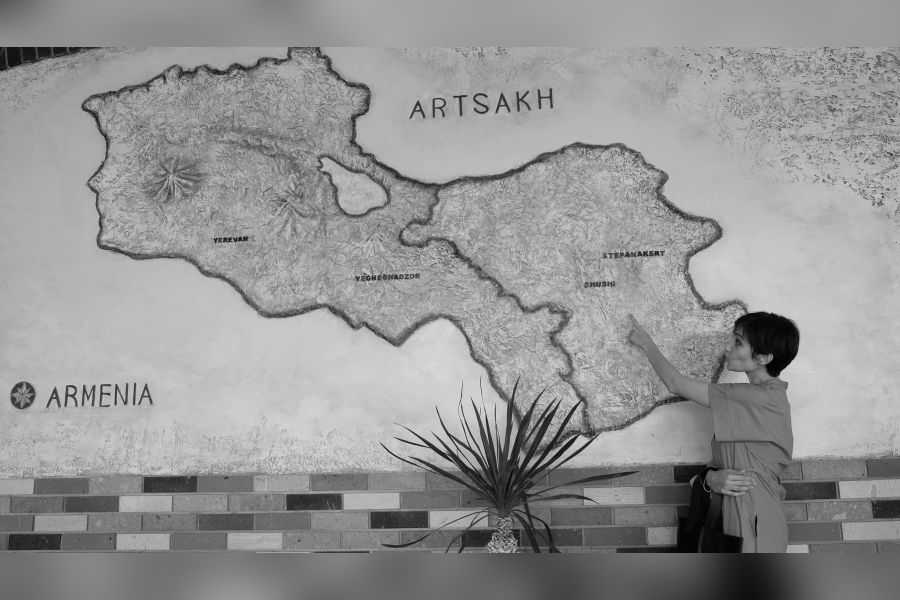
Karine Ghukasyan points toward her homeland, Artsakh: “I satisfy my longing for my roots through the sight of the mountains.”
With an encouraging tone, she called on Armenians living in cities to visit border villages, meet and speak with the locals and learn about village life — especially in remote areas where people still live, work and resist. “Let them see us. And to our diaspora,” she added, “return to the homeland and live here. Armenia will prosper and survive if we all live here.”
In times of war, locals explained that their only shelter were the few remaining medieval cave-dwellings carved into the exposed cliffs on the village’s periphery. But with Azerbaijan’s arsenal rapidly growing — especially with newly acquired Turkish Bayraktar Akinci UCAVs, with a payload nearly 10 times greater than the TB2s that already proved devastating in the 2020 Artsakh war — these old caves could become deadly traps rather than havens. Recognizing the urgency, my team at Aghmoog Collective and I reached out to a local nonprofit committed to border security initiatives in Armenia. Soon after, we launched a fundraiser campaign to support construct one civilian bunker in this sensitive area.
With the help of newly formed alliances, cross-movement solidarity networks worldwide and awareness-building charity events, we successfully reached our budget goal after four months, and the bunker was built. Of course, a single bunker is not enough on its own, but it carries sufficient weight to raise the alarm — potentially prompting other grassroots organizations to look into why we were building a bunker in the first place and to pursue similar protective initiatives.
That small, essential project showed me how civil society, within and beyond Armenia, has the agency to defy Azerbaijan’s territorial expansionism and create tangible impact to protect Armenia.
However, civil society needs to step up, and I am not sure it is happening fast enough.
Surb Hovhannes Church and the ancient cave dwellings to its left, which serve as civilian shelters in Kornidzor.
It is no secret that the Azerbaijani regime has systematically created hostile conditions in border regions to pressure Armenians into relocating to supposedly safer areas — only for those areas to become the next target of coercion. This reflects a dual-layered strategy, both on the ground and across discursive and political planes, ensuring that each concession feeds into the next and Armenia continues to shrink. Knowing that in the past year alone, Azerbaijan has repeatedly opened fire on Armenian border villages, and that their drones are still hovering nightly over my host family’s home, the few nights I stayed in Kornidzor weren’t exactly restful.
I continued my trip towards the city of Kapan, along the H45 highway, which has practically become the only main southern route for tourists, as most other roads are either partially occupied or considered unsafe according to multiple international travel advisories. As I entered the city, a massive Azerbaijani flag greeted me — a symbolic reminder of the encroaching occupation of Armenia, which is currently 241 square kilometers deep. Over the subsequent days, I spent my evenings in the city, and during the daytime, ventured outside the H45, discovering just how constricted Armenia’s southern province really is. In practice, the borders of Syunik proved far narrower than they appear on the map.
One morning, I visited Nerkin Hand, a border village surrounded by three illegal Azerbaijani outposts, linked by a single heavily militarized road. I was there to meet an acquaintance, just a few weeks after Azerbaijani troops had fired directly at one of his neighbor’s roofs. Most of our time was spent inside his home, both to avoid unwanted speculations about my presence in the village and because of the risk of shootings.
We spoke mainly about the socio-economic consequences of Azerbaijan’s partial occupation of the village — including the farmland, church and cemetery — and how it undermines any promise of a future for the younger generation. He also raised suspicion about the peace agreement, which makes the construction of a U.S.-backed Azerbaijani corridor through Syunik conditional, effectively bargaining away Armenia’s sovereignty. After some time, he introduced me to his neighbors, whose hospitality and lightheartedness broke the austere atmosphere, if only for a moment.
Beyond the fact that the occupation of sovereign Armenian territory is itself an undisputed breach of international law, it also entails a range of human rights violations — including access to clean water. Locals reported that Azerbaijani troops occupy the village’s main water source, forcing them to use river water, with higher contamination risks. Some have also shared the fear they’re living with and the difficulty to sleep at night, given that shootings can reignite at any moment and civilian homes are indiscriminately targeted. And yet, despite all these conditions, villagers viewed their presence as a form of resistance and protection of Armenia, like in Kornidzor.
Looking the existential threat in the eye, I could sense my ancestors’ last moments before they were forcibly displaced and killed during the 1915 Armenian Genocide.
If I exist because some of them survived, how can I not resist the same erasure of my people today?
This is not only a moral obligation to fight alongside those on the frontline of our future, but also a way to honor my ancestors who once stood in this very position — whose perseverance made it possible for me to use my voice today without fear of persecution, benefitting from the safety of the diaspora they were forced into.
Reckoning with these thoughts, and hoping to catch a breath of relief, I spent the following days hiking near the Nakhichevan and Iranian borders, naively expecting those areas to be safer — let alone, reachable.
About five kilometers along a clearly designated trail leading to an alpine lake near the Nakhichevan border — exact location withheld for precautionary reasons — I was urged to turn back.
For my own sake, Armenian soldiers approaching from ahead warned me not to continue, citing new movement restrictions in the area and the risk of being detained, or even imprisoned.
As far as I know, this critical security information remains unavailable to the public — it is neither mentioned on any governmental website nor indicated on any signage on the ground. “All that talk about peace is temporary; let that remain in our minds,” shared Razmik Srapyan, a young veteran I spent time evenings with in Kapan.
From my hike in the Zangezur Mountain Range
A similar episode occurred near Shvanidzor, only a few kilometers from the Iranian border. This time, however, I wasn’t as lucky to get a heads-up. On a short hike between Shvanidzor and the nearby village of Alvank, Russian military officers patrolling the area stopped me and forced me to hand them my phone. “What are you doing here?” one of them asked aggressively in Russian. Moments later, I was taken to their military base, arbitrarily detained for about seven hours — likely because they found content on my phone suggesting unfavorable views of their country. Though stationed in Armenia for years, none of them spoke a word of Armenian, so they had to find someone to translate their intimidating interrogation.
A view of Meghri, a town near the Iranian border
This humiliating experience concluded when I was handed over to the Armenian police station in Meghri, which issued a warning for allegedly walking in restricted areas — an obvious cover-up staged by the Russian soldiers. However, when I told the police officers what happened to me at the Russian base, they expressed concern for my rights and advised me to leave the city at the earliest opportunity. Until today, I have found no legal document outlining the scope of Russia’s mandate in the area, nor any confirmation that their soldiers are exempt from Armenian domestic laws. And even if I were walking in restricted areas, how am I supposed to know where they begin and end when, once again, there is no public information readily available?
More broadly, what kind of ‘peace’ is the Armenian government peddling if we do not even know where we can travel within our own borders?
I left Armenia with many questions, all circling back to one: If we bear witness to the erosion of our existence, yet speaking out is framed as a threat to the very future we seek to protect, what freedom do we truly have as Armenians? This conundrum manufactures silence — silence that unveils the writing on the wall for those who care to read it. When I do, the obvious way forward begins with listening to border communities who endure the consequences of inaction firsthand. Their steadfast communal self-reliance can guide external civil society organizations — armed with resources and visibility — on how to strengthen border security to lifesaving ends.
Personally, they redefined my understanding of, and engagement with, Armenian resistance in the aftermath of the Artsakh genocide: not out of chauvinistic nationalism, but out of survival; not as a mythical aspiration for stolen lands, but as an active reclamation of our inherent indigenous rights.
All photos are courtesy of the author unless otherwise noted.