Recently, I had a discussion with one of my friends about Armenian cuisine. My friend, a frequent traveler, declared it boring, saying that it consisted only of khorovadz (barbecue), khash and kebab. The creative Armenian in me took this personally and rebelled against it. I decided to find out for myself: Is Armenian cuisine really boring, or do we simply not know — or present — it well enough?
That summer, I traveled to Dilijan for a tasting experience. This town in the Tavush region is one of Armenia’s most famous tourism centers, and perhaps that’s why new restaurants pop up at every turn.
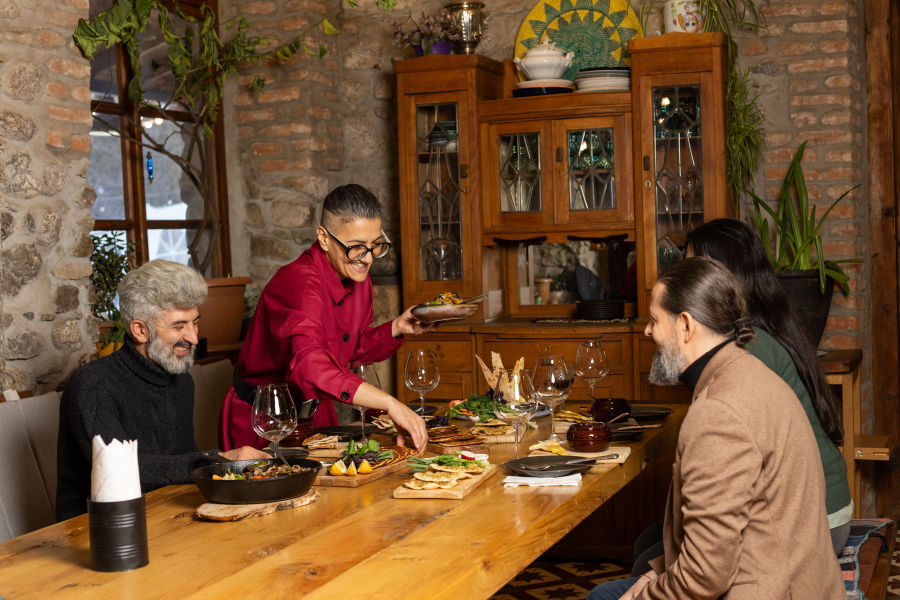
The culinary offerings are diverse, but I explored several places and decided to stop at Tava. Varda Avetisyan, born in Yerevan and having lived abroad for many years, moved to Dilijan, where she now owns several restaurants. What especially surprised me was her fresh, unrecognizable presentation of Armenian dishes.
Avetisyan has revived the Tavush tradition of cooking in a poorr (oven) or tonir (traditional underground oven), and everything at Tava is prepared in it. At a time when many homes in Tavush considered their ovens obsolete and often discarded them, Avetisyan made them trendy again.
The interior of Tava restaurant (Photo courtesy of Avetisyan) Chef Varda Avetisyan creating at Tava restaurant (Photo courtesy of Avetisyan) Dishes being prepared at Tava restaurant (Photo courtesy of Avetisyan)
“When we started cooking in the oven, most people in Dilijan were demolishing theirs. So yes, we’re proud that we encouraged people not to destroy their tonirs,” Avetisyan mentioned.
“This region is characterized by oven culture. Why get rid of it when you can transform it and create something incredibly delicious?”
Everything at Tava is served from the oven: sauces that reflect the shades of Armenian mountains, meat from animals nourished on the fruits of Tavush forests and an abundance of Armenian herbs. Having a sweet tooth, I especially appreciated the Phr-auni, a brownie made with Armenian influences.
Though Armenian cuisine is diverse and varies across regions due to different climate conditions, it is still often overlooked. Each region offers something unique, reflecting its local traditions and character, which is hard to find elsewhere. Fish rule Gegharkunik in all its transformations, while Lori offers an unforgettable tandem of fresh and fried greens.
Preparing dough (Photo courtesy of Avetisyan) Fresh bread, roasted garlic and tomatoes (Photo courtesy of Avetisyan) Preparing the dough for firing (Photo courtesy of Avetisyan) Fresh vegetables paired with sauces and dips (Photo courtesy of Avetisyan)
Avetisyan recalled a recent viral moment at another of her restaurants, Gata. One employee posted a short video on Instagram showing how he sliced cheese gata. The reaction from Armenians surprised her: “What is cheese gata? There’s no such thing. Gata can’t be with cheese.”
“That’s how our people reacted,” she explained. “But Armenian cuisine, like any other, is a living organism. It changes with new elements and modern notes added to the traditional. Cuisine breathes; it cannot stand still.
Our neighbors were all commenting, ‘No, this is ours.’ Even Georgians wrote, ‘This is not gata; this is khachapuri.’”
Avetisyan says that Georgians work hard to promote their cuisine. Georgian food is beloved by its people, who consider it a core part of their identity, and they make great efforts to market it abroad.
“Look how many Georgian restaurants there are in Yerevan, while in Tbilisi, you can count Armenian ones on your fingers,” Avetisyan told the Weekly.
This slideshow requires JavaScript.
Avetisyan has not only opened Tava and Gata in Dilijan, but also Kchuch and Losh. She encourages both locals and visitors to look at Armenian cuisine creatively — not as a fixed set of dishes but as something to revive, reinterpret and refresh. After all, people change, as do nature and mindsets — and cuisine inevitably reflects that evolution.
About 100 kilometers away, in the capital of Yerevan, the number of restaurants serving Armenian cuisine has also grown. Opened in 2018, Chinar features a minimalist interior and soft, soulful Armenian music.
It is one of the few places where, in the evenings, chefs come out to the dining area to talk to guests, give advice and discuss flavors. The restaurant’s chef, Susanna Ghukasyan, who began her professional career at 35, was already known for her dried matsoun (yogurt)-based doughnuts and inventive dishes before moving here.
Chef Susanna Ghukasyan of Chinar restaurant (Photo courtesy of Ghukasyan)
“Any flavor can be presented differently to make it innovative and interesting. That doesn’t mean we should serve khash with lemon or make harissa without grains. In our restaurant’s menu, you’ll find different transformations based on the same foundation,” Ghukasyan explained. “Experiments are not easily accepted; patience and will are needed; sometimes, you have to talk to the guest and explain.”
Ghukasyan stressed the importance of working with the right restaurateur. When business priorities alone drive a restaurant, many experiments remain on paper or in the chef’s imagination. At Chinar, she has the freedom to express herself and bring her ideas to life.
Chef Ghukasyan’s traditional Armenian ghapama (Photo courtesy of Ghukasyan) Chef Ghukasyan poses with fresh tomatoes (Photo courtesy of Ghukasyan) Chef Ghukasyan puts the final touches on a dish (Photo courtesy of Ghukasyan)
According to her, interest in Armenian cuisine is rising, fueled by tourists seeking local flavors. Naturally, when an Italian comes to Armenia, they don’t want to eat pizza; rather, they seek new, local flavors that might seem surprising or unusual — it’s precisely that unusualness that becomes attractive.
During my interview at Chinar, it was around 5 p.m., and, unlike many restaurants, the dining room was almost empty. But after 6 p.m., the flow of visitors increased sharply.
This slideshow requires JavaScript.
People are searching for new, contemporary layers of familiar flavors, and chefs like Ghukasyan are experimenting to meet that curiosity.
Getting to know Armenian cuisine does not mean rejecting others; on the contrary, understanding your own makes you open to accepting, respecting and even experimenting with the cuisines of other nations.
“We have many dishes that are both healthy and delicious; they just need to be adapted for the modern person’s eye and palate. Making innovative dishes with dried matsoun or ghapama doesn’t mean changing the flavors, but simply adding new accents to make them more popular and beloved,” Ghukasyan said.
Armenian cuisine faces many challenges on the path to wider recognition. Still, events that bring people together — not only around food and wine but also around cultural experiences — give hope that Armenia’s flavors will, one day, become so renowned that tourists coming to the region will seek them out specifically.