
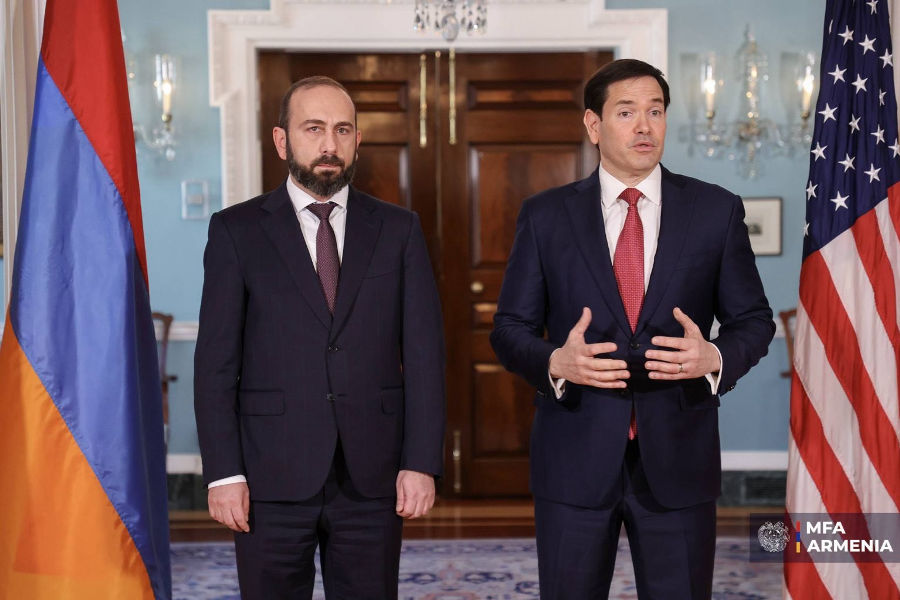
YEREVAN — Armenia and the United States have signed a framework agreement establishing the “Trump Route for International Peace and Prosperity” (TRIPP) project, officials announced following meetings in Washington on Jan. 13–14.
The agreement establishes the TRIPP Development Company, which will manage transit infrastructure through Armenian territory, connecting Azerbaijan with Nakhichevan and linking to the Trans-Caspian Trade Route.
Under the terms of the agreement, the United States will hold a 74% stake in the company in exchange for financial investments, while Armenia will retain a 26% share, contributing development rights and access to infrastructure. After an initial 49-year period, Armenia’s share is expected to increase to 49%.
The project is set to include railway and road networks, energy pipelines and digital systems such as fiber-optic infrastructure. It introduces a “front office-back office” operational model, under which U.S. operators will handle document collection and initial service functions, while Armenian authorities will retain responsibility for customs clearance, security checks, migration control and law enforcement. All taxes and fees generated through TRIPP operations will be paid to the Armenian state budget.
Armenian Foreign Minister Ararat Mirzoyan said the ownership structure reflects the respective contributions of both parties, with the United States providing financial investment and Armenia contributing development rights. He emphasized that Armenia’s sovereignty and jurisdiction over border and customs operations will remain absolute and that security of the route will be fully controlled by Armenian authorities.
Mirzoyan also noted that the participation of Turkey and Russia was not discussed within the framework of TRIPP, though he suggested that broader regional coordination may be required to ensure logistical connectivity, including the Gyumri-Kars road linking goods to European markets.
Prime Minister Nikol Pashinyan described the agreement as a framework defining the operational structure of TRIPP. He noted that bilateral trade between Armenia and Azerbaijan has begun earlier than anticipated and characterized the project as a step toward regional connectivity. Pashinyan also highlighted the role of U.S. President Donald Trump in promoting the initiative.
Ayhan Hajizadeh, spokesperson for the Azerbaijani Foreign Ministry, stated that the framework agreement reflects the United States’ commitment to the Washington summit agreements of Aug. 8. He said ensuring unimpeded communication between Azerbaijan and Nakhichevan remains a priority for Baku and described TRIPP as contributing to the diversification of trade and transport in the wider region while fulfilling obligations previously undertaken by Armenia.
According to the joint statement, the TRIPP Development Company will have an initial 49-year exclusive right to develop the transit corridor, overseeing transport, logistics, energy and digital infrastructure. Private operators from the United States will manage technical services, document collection and payment processing, while Armenian authorities will retain physical presence and oversight over all sovereign functions.
Pilot projects are planned to digitize customs procedures and implement a “single checkpoint” system. Armenian authorities will retain control over all border, customs and security functions, including migration and law enforcement operations.
Despite being framed as a project to enhance regional connectivity, the scale of foreign investment and operational control raises questions about the long-term implications for Armenian sovereignty over transit infrastructure.
The TRIPP agreement has already affected Armenia’s relations with regional neighbors and drawn scrutiny from multiple states. On Jan. 14, Iran’s ambassador to Armenia, Khalil Shirgholami, expressed concern that Armenia is becoming a hub for activities hostile to Tehran.
Speaking at a press conference in Yerevan, Shirgholami said that groups had been allowed to stage protests near the Iranian Embassy for six consecutive evenings, during which “disrespectful and offensive statements” were made. He emphasized that Iran has repeatedly lodged formal complaints with Armenian authorities, but the demonstrations have continued.
Shirgholami warned that some actors are seeking to exploit instability in Iran to encourage separatist movements and fragment the country. He claimed that such efforts were initially planned by external actors, naming Israel, and cautioned that if these attempts succeeded, Armenia “would find itself among the losers.” He added that Iran has historically supported Armenia during difficult periods and said the ongoing protests have left a mark on the historical memory of the Iranian people.
According to Shirgholami, Tehran is concerned that the TRIPP project could be leveraged by the United States within the framework of its security policy. “We have conveyed these concerns to our Armenian counterparts,” the ambassador said. “They have assured us that Armenia will never become a source of threat to Iran. It was agreed that discussions will continue on a regular basis to assess the full scope of this project.”
The comments come amid widespread unrest in Iran, where preliminary reports indicate that more than 2,000 people, including security personnel, have been killed during protests. Iranian Foreign Minister Abbas Araghchi told Al Jazeera that terrorist groups were responsible for both civilian and security force casualties, and Tehran has threatened death penalties for those damaging state property or confronting law enforcement.
Meanwhile, Russia has also voiced concerns. Russian media host Vladimir Solovyov suggested publicly that Armenia’s role in TRIPP could conflict with Russian interests, implying that military measures might be justified in areas within Russia’s perceived sphere of influence. His remarks were widely criticized by Armenian officials as interference in Armenia’s sovereignty.
Turkey has likewise signaled its strategic interest in the project, framing the Kars–Iğdır–Aralık–Dilucu railway as critical for the so-called “Zangezur Corridor.” Turkish Minister of Transport and Infrastructure Abdulkadir Uraloğlu emphasized the corridor’s importance and noted that Azerbaijan continues work on the route, including unfinished sections in Nakhichevan expected to begin this year. He also highlighted U.S. involvement in the corridor’s construction and projected that it could become operational by 2030.
Republican Party Vice President Armen Ashotyan sharply criticized the recent TRIPP-related statements by the government, in which Pashinyan reportedly framed the initiative as a diplomatic success, calling the agreement “unprecedented” in its implications.
Ashotyan argued that the document, while legally non-binding, carries long-term consequences for Armenia’s geopolitical position and represents what he described as a “geopolitical gamble.”
He compared it to historical projects such as the Panama and Suez Canals and strategic Black Sea straits, arguing that any foreign control over infrastructure of geopolitical significance undermines national sovereignty.
He further stated that the TRIPP framework risks turning Armenia’s logistical potential into a tool serving Turkish and Azerbaijani strategic interests, rather than national priorities. According to Ashotyan, the agreement effectively ensures unhindered connectivity between Azerbaijan’s main territory and Nakhichevan, while Armenia receives only conditional, long-term promises of “mutual benefit.” This, he said, allows Azerbaijan to achieve immediate strategic gains, leaving Armenia dependent on future reforms and bilateral relations.
Ashotyan also criticized the operational model outlined in the TRIPP statement, saying it would leave customs and security decisions formally under Armenian authority while placing operational flows, data collection and logistics under the control of foreign capital through private operators. He argued that this separation between formal sovereignty and practical authority threatens the state’s ability to function independently within its territory.
He concluded that references to “full sovereignty” in the framework are inconsistent with its operational design, and warned that the government’s policies continue to impose growing risks on Armenia’s future.


