The Armenian Volunteer Network (AMVN) is a U.S. and Yerevan-based organization that promotes the exchange of knowledge, ideas and learning between professionals and students in Armenia and in other countries. It’s a simple proposition: volunteers abroad and in Armenia share their skills with those who seek them.
U.S.-based AMVN volunteer Susan Pogharian spoke with long-time Armenia-based volunteer Emma Temrazyan, an award-winning educator working in the Tavush region. Tamrazyan shares her background, involvement with AMVN and hopes for its future.
This interview has been edited for length and clarity.
Susan Pogharian (S.P.): What is your background, and how have your relationships and collaborations enhanced your professional life?
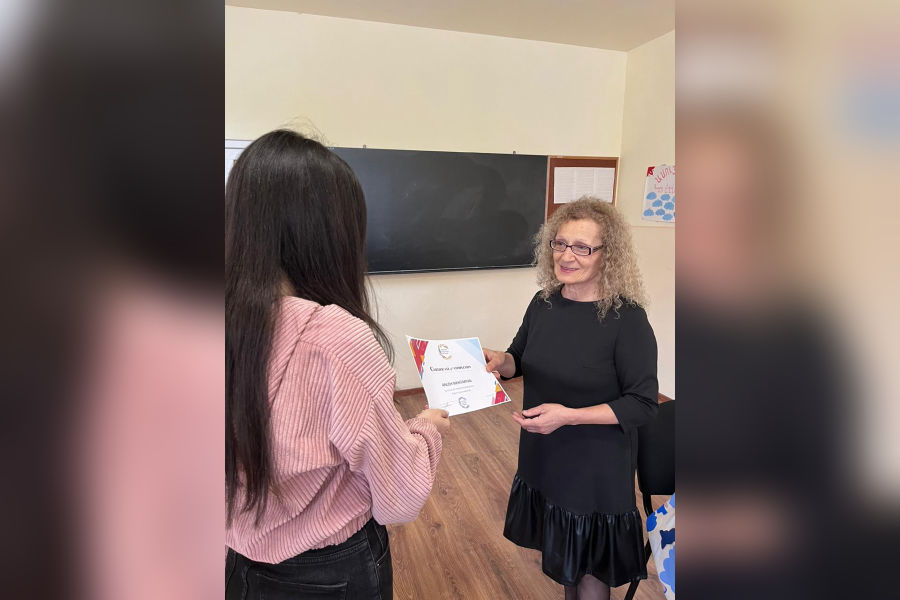
Emma Temrazyan (E.T.): After earning degrees in English and German from Yerevan State University (YSU), I have been teaching English for 44 years at different schools in the Tavush province. I have won teaching awards from the British Council, the U.S. Peace Corps and Armenia’s Ministry of Education and Sciences.
Working with international instructors and teachers who have come to Armenia has helped me become a better teacher. I have worked with professionals in the U.S. Peace Corps at the office in Yerevan, as well as with TEFL (Teaching English as a Foreign Language) instructors and business volunteers.
This exposure allowed me to improve my English by listening to American, Canadian and Australian speakers. These generous teachers taught me another way of thinking, a different approach and perspective to teaching and learning. Knowing English gives us a larger view. When you know a foreign language, you are often able to think more broadly and with more understanding of the world.
S.P.: How did you first become involved with AMVN?
E.T.: I had been teaching English at YSU for 12 years when COVID hit in 2020. Our Peace Corps volunteer was sent home, and like many other schools, we switched to online teaching. One of our teachers knew of the Armenian Volunteer Network (AMVN). We applied, explaining our great need for a replacement English tutor. Kristina Terian, one of AMVN’s founders, provided us with native-speaking volunteers, not only in English, but also in French and Russian.
This collaboration came full circle when Kristina asked our students to volunteer, share their skills and teach Armenian to people in the diaspora. A student volunteered, but her English wasn’t quite strong enough to teach others. So, I took over the role and agreed to volunteer — to return the favor, since AMVN did so much for Yerevan State. Plus, I wished to be a good role model for my students, to show them that their instructors also give back. Showing is always better than telling.
S.P.: Can you tell us a story that stands out to you from your experience teaching AMVN students?
E.T.: One of my students from this Zoom class was half French and half Armenian. Her dream was to learn to read and write in Armenian. The only people who could speak with her — her mother, aunt and grandmother — had all passed away. How could I say no? As an Armenian woman and educator, I felt moved to teach her. Corinne and I still meet every Sunday evening, and have developed a great relationship, which has grown beyond that of a teacher and student. We share our experiences and knowledge, not just taking from the diaspora but also giving back. Now, I look forward to our meetings every Sunday; we have much in common and discuss different topics. Corinne’s involvement with AMVN also extended to her husband, who taught our French students through AMVN.
This slideshow requires JavaScript.
S.P.: What has the reaction been to your volunteer work?
E.T.: I have watched AMVN evolve and help our students in many ways. At first, students were bewildered and couldn’t believe people from across the ocean could help them without demanding money. It was such an unusual offer, a novelty that strangers would give their time without payment. But once the students understood, they happily accepted the help. The greatest achievement is that now, whatever their specialty, many of our students also wish to become AMVN volunteers. Kristina, AMVN’s founder, has helped our students bring the knowledge they’ve gained from the university back to their schools and communities. Again, when I contacted school principals and directors to explain our students’ desire to help, they wondered why no payment was needed. But our students’ desire to give back to their communities was payment enough.
S.P.: Can only students studying a foreign language benefit from AMVN?
E.T.: Beyond the language majors, any student can learn. Many times, students cross departments; for example, an English major may help an art student. It changes students’ mindsets so they can positively affect others’ lives with very little time investment. Both “teachers” and “students” are the same age and become friends; AMVN simply brings them together.
There is a beautiful story about one of our first-year students, Gariné. She was an English major who participated in English language training. First, she was a participant in an AMVN class; then she became a volunteer, teaching English to Armenian school children online. Gariné continues to inspire other students in the university to become volunteers, as well. She became a leader of AMVN in Ijevan, taking over a small corner of the library and ensuring that AMVN activities continued there. Anyone who wishes to volunteer works through her.
S.P.: What do you see as the strengths of AMVN?
E.T.: The biggest strength is that the spirit of volunteerism is alive and well and that much can be accomplished without money. Relationships among people are the biggest currency. If we can expand our AMVN family and participants, the more people will share in this thinking. Investing in others — not keeping knowledge to yourself — is the best thing because everyone benefits.
S.P.: It’s obvious AMVN is close to your heart. What do you wish for its future?
E.T.: If I could wave a magic wand, I would wish for many things for AMVN. While our knowledge is shared without currency, donations could help the organization in many ways. Funding could help volunteers visit Armenia and teach, not only online, but also in person.
We had an AMVN volunteer, Asdghig, from Canada, who visited Armenia and taught our university instructors and English major graduates how to improve their teaching skills. She provided her own accommodations, but funding would help others come and stay for a few weeks or a month to further teach the teachers. Plus, they can experience Armenia. Asdghig’s teaching helped sway one student’s career choice, influencing her to become an English language teacher. This student applied to AUA (American University of Armenia) and is now a first-year master’s student in English methodology. Outsiders can have a positive influence on our students if more are financially able to travel to Armenia.
Beyond funding, I hope that AMVN founders Kristina, Seroj and Hasmig can continue their amazing work. Perhaps someday AMVN will not be their side ‘job’ but instead become their full-time focus to bring even more volunteers and students together. That would be the biggest gift!
S.P.: How would you sum up your experience with AMVN?
E.T.: The beauty of AMVN is that it brings together like-minded volunteers. We all have a lot of experience and knowledge to share. When you share and give from the heart, it is not just work; it’s a pleasure because everyone benefits.
It has been a joy to be part of the AMVN family. It is not just an NGO; it’s a family that values education, because educated individuals can do more working together.
Want to learn more? Volunteer or donate at AMVN.org