
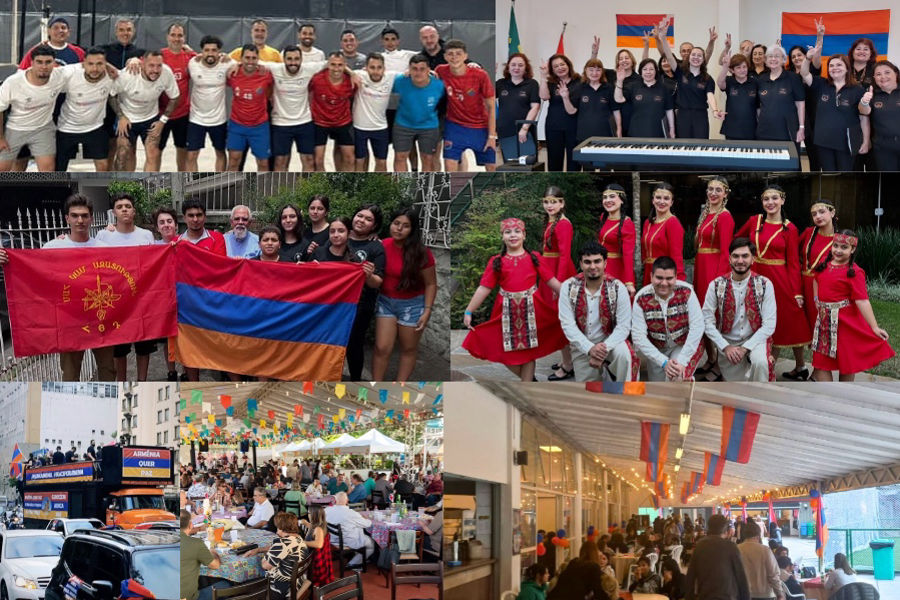
Every Saturday in São Paulo, a quiet yet meaningful rhythm takes shape in the Armenian community. From youth football (soccer) training and cultural performances to language classes and public commemorations, community institutions are working to reconnect a new generation with its heritage.
“Every weekend, people gather at the Armenian church and, from there, many activities happen,” explains Vartine Bohjalian Kalaydjian, producer of the TV program Conexão Armênia and member of Hamazkayin Brasil. “On Saturdays, the youth go to the club for football training, and then after that, they join our dance group classes,” she tells the Weekly.
Brazil is home to one of Latin America’s largest Armenian diasporas, with estimates ranging from 40,000 to 100,000 people of Armenian descent. The first arrivals came in the 1920s as genocide survivors, settling mainly in São Paulo. They founded churches, a school and cultural clubs that formed the community’s backbone for decades. Over time, however, assimilation and urban migration weakened participation.
“When I started attending the Armenian community 20 years ago, it was in a very big crisis,” recalls historian Heitor Loureiro, speaking to the Weekly. “The school almost ended up without Armenians. The church was always empty; the Armenian Club had almost no activity when I arrived.”
But Loureiro has seen a notable shift. “The Armenian community is more dynamic today than it was,” he says. Social media, WhatsApp groups and digital platforms now complement traditional structures. Independent films, book launches and cultural events on Armenian themes have increased, often led by younger members. “There are many more films, plays and books being released, and all of this generates events,” he adds.
This slideshow requires JavaScript.
For Loureiro, this decentralized energy represents “the rebirth of this collectivity,” with cultural and academic activity increasingly emerging beyond institutional walls.
James Onnig Tamdjian, a professor of international relations at Campinas College (FACAMP), echoes this sentiment: “It may seem that numerically people don’t attend, but those who are attending are maintaining the tradition,” he explains. According to him, many are reconnecting with their heritage for the first time. “A youth has emerged that had never had contact with Armenian culture, and thanks to the internet and the work of the organizations, they have reclaimed their identity.” A few have even repatriated to Armenia, he added.
Tamdjian also highlights the reactivation of smaller communities. In Rio de Janeiro, for instance, the Armenian Association has recently reorganized, celebrating Mass and hosting public events. Families from distant regions like Mato Grosso, Rio Grande do Sul or Ceará are also reconnecting. “They are reclaiming a bit of their Armenian heritage,” he says.
Archavir Donelian, a longtime member of the Armenian Club (SAMA) and a representative to the State Parliamentary Council of Communities (CONSCRE), adds that this civic and cultural renewal is supported by a broad institutional ecosystem. Religious services, cultural activities and commemorations such as April 24 take place regularly, supported by the Armenian churches, AGBU, Hamazkayin and SAMA. The Vahakn Minassian Choir and Kilikia Dance Group remain active, while events like the Pan-Armenian Games and academic seminars have further energized participation.
Yet, Donelian also recognizes a generational shift: “With Armenia’s independence in 1991, a process of redirecting the focus of community members, especially younger ones, toward Armenia began.” Today, many are more invested in volunteer work, cultural exchange and residency in Armenia itself, but Donelian warns this evolution could leave traditional institutions without successors, unless they adapt: “Strengthening local Armenian entities is very important because it allows members of the communities to connect with each other and with Armenia.”
This rising interest in the homeland is evident in projects like Conexão Armênia, which promotes Armenian culture and highlights tourism, travel and professional opportunities in Armenia.
“People spend $5,000 to go to Cappadocia. Why not spend that to go to Armenia?” asks Kalaydjian.
Young diaspora members have participated in sports tournaments, study visits and volunteer initiatives, all of which deepen their connection to Armenia.
Back in São Paulo, the community calendar remains full. Independence days, Navasartian festivals and the April 24 commemorations are held each year. The June festivals (Festas Juninas) at the Armenian Club regularly draw over a thousand people, blending Brazilian customs with Armenian culture. In Osasco, the Armenian parish organizes an annual Madagh that gathers families from across the region.
Youth engagement today is particularly strong in sports and performing arts. SAMA, Osasco’s Armenian Association and AGBU have formed a unified football team to compete in the next Pan-Armenian Games. These practices serve both as training and social integration for teenagers from across the community.
On the cultural side, the Vahakn Minassian Choir, which is nearing its 100th anniversary, continues to rehearse Armenian songs weekly. The Hamazkayin “Kilikia” Dance Group and its junior division “Arevik” regularly perform at multicultural festivals. “We always represent Armenian culture on the biggest stages of São Paulo,” says Kalaydjian.
Language remains one of the community’s greatest challenges. Few young Armenian-Brazilians today speak Armenian fluently. “Unfortunately, most do not speak Armenian: my generation and below, they do not,” Kalaydjian notes. The Armenian school, Colégio Armênio, now serves mostly non-Armenian children. Still, Armenian lessons are offered weekly at SAMA, and youth groups include language learning into their activities.
Kalaydjian’s own family is an exception. Her two teenage sons are fluent in Armenian and teach dance to younger children. “I always dreamt of having an Armenian family, sitting around the table speaking Armenian, making toasts, eating Armenian food… doing everything just like we were born to be,” she says. “It’s a big pride that I was able to carry on my father’s legacy.”
This slideshow requires JavaScript.
Denis Tchobnian, coordinator of the Badanegan Miutiun Serop Aghpyur, the youth organization of the Armenian Revolutionary Federation (ARF), sees a more sobering picture: “These young people, for the most part, have no contact whatsoever with the Armenian language.” Twice a month, he leads sessions on Armenian history and culture for a small group of youths ages 11 to 17. Engagement, he says, is sporadic and often limited to major annual events. “The young ones don’t participate much in community life, except for a party, a dance, something very specific,” he observes.
The 2020 Artsakh (Nagorno-Karabakh) war served as a wake-up call for many in the community.
“The new generation saw the threat, and they felt on their skin the fear of just walking outside simply for being Armenian,” recalls Kalaydjian.
In response, youth organized rallies and launched social media campaigns. Some began studying law or advocacy, hoping to work on Armenian issues. “We see a lot of young girls writing essays, representing us in seminars that talk about the genocide,” she says.
As head of the Armenian National Committee (Hai Tahd) in Brazil, Kalaydjian continues to push for government recognition of the Armenian Genocide. While the Federal Senate passed a symbolic motion in 2015, an official executive proclamation remains elusive. “There is much work to be done in this direction,” she reflected.
“Historically, the community has fulfilled its role and continues to,” Tamdjian says. Despite hurdles, the institutions, volunteers and new generations are keeping Armenian culture alive in Brazil. As Kalaydjian puts it, “I see the community now as reawakening.” To preserve Armenian identity, she insists, “you must want it.” And many clearly do.


