
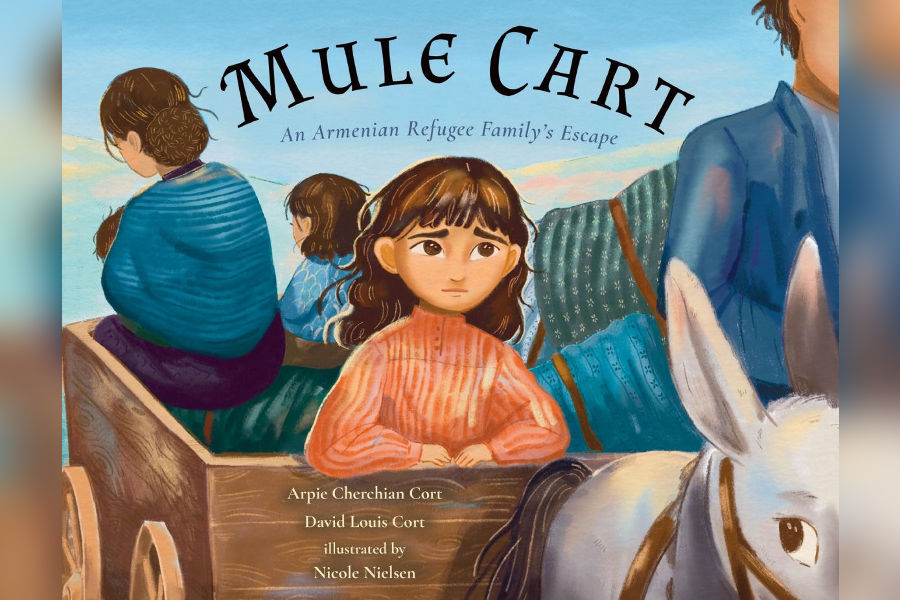
Mule Cart, An Armenian Refugee Family’s Escape
By Arpie Cherchian Cort and David Louis Cort
Illustrated by Nicole Nielsen
Published by Fig Mint Press, 2025
Audience: Ages 6-11, Grades 1-6
Available in hardcover, paperback and ebook
Growing up in the diaspora, I vividly remember attending the annual Genocide commemoration at my Armenian middle school when the entire student body would assemble in the large auditorium to watch a long black-and-white documentary on the event. I recall deliberately closing my eyes to avoid images of hanging bodies, severed corpses and mountains of skulls, asking my friend to tell me when it was safe to open them. I knew that seeing them would haunt me, long after the lights came back on. Intrusive thoughts would always follow, of yet another impending genocide, of what might happen if the same unfolded in Iran and of whether we could trust our neighbors or find safe places to escape. Three decades later, the dissolution of the Republic of Artsakh and the forced displacement of Armenians reawakened in me the same trauma, now compounded by rage and despair, sentiments I often wonder have become woven into the fabric of our Armenian identity.
How, then, can genocide education be thoughtfully and conscientiously approached for Armenian children whose family histories are shaped by intergenerational? What is the responsible end goal: teaching history, raising awareness, combating genocide denial or building the foundations of an Armenian identity?
How can such an effort be free from the accumulation of fear, resentment and generational trauma and instead be grounded in empowerment, compassion and hope?
A newly published children’s picture book seeks to take on this challenging task. The Mule Cart: An Armenian Refugee Family’s Escape, by Arpie Cherchian Cort and David Louis Cort, with illustrations by Nicole Nielsen, follows the story of Anoosh, a young Armenian child who flees the Armenian Genocide with her mother and younger siblings as part of a caravan of refugees traveling by mule cart. As the cart travels from Aintab to Aleppo, Anoosh chronicles the treacherous journey, leaving behind the rubble of cannon fire and crossing dangerous roads, storms and hunger.
Strikingly, we do not see death or violence but feel, alongside little Anoosh, the affective experience of it: fear, despair and uncertainty but also moments of comfort in the mother’s song, the warmth of a sibling’s embrace and the reassuring aroma of the Armenian coffee. It is here that the book successfully translates the lived experience of displacement and resettlement onto the page. The illustrations follow the same trajectory. Somber grays, blues and browns gradually give way to warm earth tones, reds and greens that signal safety culminating in a closing note of hope and a celebration of survival. There is an abundance of cultural and symbolic imagery, from the mother’s hair braided in the form of a Choreg to apricot and pomegranate trees, Armenian words, coffee reading and folk lullabies.
What makes this intimate retelling of the Armenian Genocide especially worthwhile is the accompanying educational material that follows the story, including a brief account of the Genocide; a glossary of Western Armenian words; a short excerpt on the Armenian coffee-drinking and cup-reading tradition; a map tracing the family’s escape; and the lyrics and musical notes to the Armenian song “Coming of the Swallow” by Ghazaros Aghayan.
The book is the author Arpie Cherchian Cort’s personal commitment to preserving her ancestors’ story, undertaken with the utmost care, knowledge and generosity. As an experienced educator, Cherchian approaches this deeply personal narrative with a pedagogical awareness of trauma-informed practice, while maintaining historical responsibility and age-appropriate accessibility for young readers.
Storytelling remains a powerful tool in genocide education, specifically for younger audiences. With the recent passing of the Armenian Genocide Education Act in California, as well as the Genocide Education Project, the prospects in genocide education in the United States are promising. The remaining challenge lies in developing innovative approaches that not only teach younger generations about the past, but also foster empowerment, resilience and a celebration of identity, while cultivating empathy and the capacity to recognize and condemn violence on a personal and emotional level.
When I shared the book with Monte, the first-grade son of a close friend — the same friend who once sat beside me in the school auditorium — he, though not yet fully aware of the Armenian Genocide, recognized the story as one of Artsakh.
The responsibility of raising culturally aware children in the diaspora has never been more significant and stories such as these play a vital role in sustaining historical memory, cultural identity and intergenerational understanding. Trauma-informed picture books, when thoughtfully designed for specific age groups, can have a powerful impact on all children and empower educators to introduce the topic in their classrooms. The Mule Cart: An Armenian Refugee Family’s Escape is a valuable resource for school and community libraries, as well as for personal home collections.


