
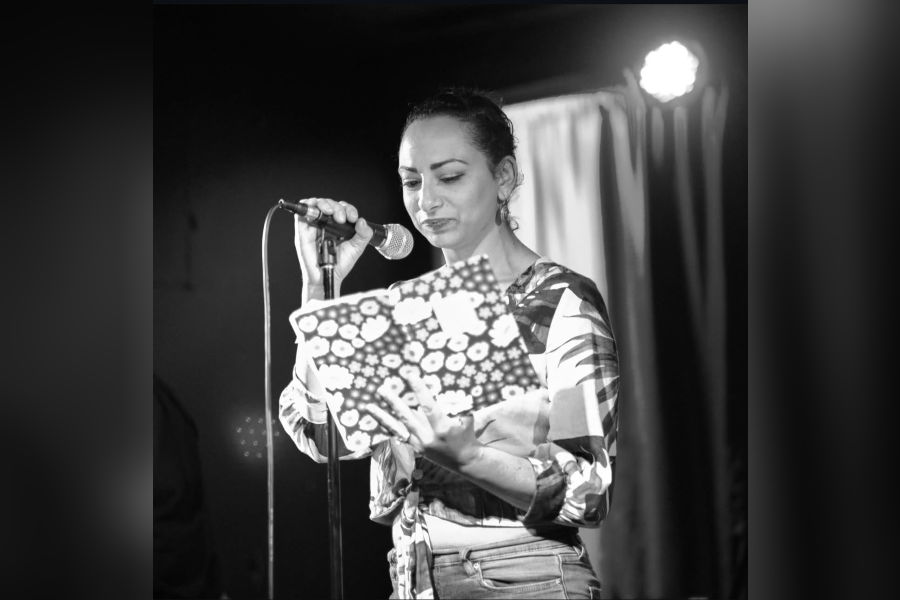
Melineh and I are lifelong friends, bound early on by a shared and abiding love for literature. Some of my most vivid memories of her as a child are of the intensity with which she recounted the stories she read — already attuned to language, rhythm and feeling. As an educator, I found that early devotion deeply moving. Today, our connection has evolved into one rooted in what we both hold sacred: the art of writing itself.
Melineh Ani Merdjanian Yemenidjian is a special needs instructional aide based in Los Angeles, where she lives with her husband, Christopher, and their two sons, Norayr and John, both students at her alma mater, Ari Guiragos Minassian Armenian School. A great-grandchild of Armenian Genocide survivors, her commitment to safeguarding her heritage is deeply personal.
She is the author of The Split Pomegranate, a poetic memoir. The International Armenian Literary Alliance (IALA) describes the work as an “intimate and fiercely honest collection,” one that follows an Armenian American woman navigating mental health struggles, inherited wounds and “the complicated joys of love and heritage.” Her poem, Krikor Shirozian, published alongside this interview, traces the journey of her great-grandfather, who was orphaned during the mass exodus to the Deir Zor desert.
As someone who has witnessed Melineh’s voice take shape over time, I see The Split Pomegranate as exactly that: a gathering of fragments that stand on their own, yet build toward self-understanding, renewal and an unflinching claim to emotional truth. It is raw without being careless, vulnerable without apology and written with the kind of courage that lingers.
I spoke with Melineh about poetry, process, passion and the slow work of writing oneself whole.
This interview has been edited for length and clarity.
Talar Keoseyan (T.K.): How did your love of poetry come about?
Melineh Yemenidjian (M.Y.): My love of poetry is a cosmic desire. I started writing around age 12, when I experienced bullying at school. I already had a love of books, so it was a natural outlet for escapism, as it is for many people. I mostly journaled, and then some poems emerged. I’ve kept all my journals since I was 7, which have been instrumental in helping me write my book. Writing and journaling have been desires given to me, ever since I needed an outlet. I still have all of them.
T.K.: Tell us about your favorite poems from the book.
M.Y.: The first poem that comes to mind is the final poem of my book, “The Genesis of a Poem.” It captures my experience of writing poetry. It’s also very sensual, in that I give in to the senses. I’ll read a passage:
“You, like the matron of a bordello,
seduce me. You fill coins of gold
in my mouth left on chests by regulars
who cultivate tête-à-têtes
like the Bible swallows myths.”
For me, it is sometimes a forbidden world, because when everything becomes overstimulating — with the news and information around me — I can go into this space and color outside the lines of what is expected of a “good Armenian girl” or a mother. It’s my way of deviation without feeling shame.
T.K.: This is a common thread in our culture.
M.Y.: “Dzanur bedk eh mnank.” (We have to hold firm.)
T.K.: Of course; God forbid someone has a different opinion or thought.
M.Y.: Or a flight of fancy. Sometimes, we get swept up in our desires and how we want to feel in the world — how to be.
This poem is my way of being: my way of owning and collecting all the parts of me, all of my history, the things that make me want to live through poetry.
This book is essentially a memoir. It intends to bridge the gaps between my childhood, heritage, struggles with mental health, recovery and self-affirmation. I’ll read the second-to-last stanzas of the poem, because they sum up what the poetic process feels like for me in this regard:
“Then, through the door appears a string
of ex-lovers, a psychiatrist, my husband
pushing our children in a red wheelbarrow,
grandmothers holding pomegranates, bullies,
and my poetic ancestors —
arm in arm.”
T.K.: How did the book come together?
M.Y.: I started compiling the book when I was accepted into the Community Literature Initiative (CLI) program. From September 2024 to June 2025, we met every week for three hours. We unearthed poems already written and generated new ones until we met with a proofreader, a graphic designer and a layout designer to turn the manuscript into a hard copy.
I would say that I’ve been writing this book since 2011, which is when I wrote the earliest poems. It’s as if the book was subconsciously writing itself throughout the years.
T.K.: Any future books in the works or on the mind?
M.Y.: I’m in the exploratory and drafting phase of my first novel, a work of women’s fiction that expands on the themes of The Split Pomegranate.
T.K.: What advice would you give to young Armenian writers and poets?
M.Y.: Don’t try to get published. What I mean by that is, writing solely for the sake of publishing or recognition takes the art out of writing: the human element.
When you’re writing for consumption, to post on social media or to be in the upper echelon — anything other than because you bleed for this art, because you have to do it — you lose something essential. Writing should propel the love for your craft forward.
When you reach a point in your life where you have developed your craft through discipline and dedication, then you may be ready to take it to the next level, to become a professional and elevate your work.
Anyone can write a line. Anyone can post their work and call themselves a published author or go to Kinko’s. But it takes something very special to maintain that fire. Don’t burn it too quickly. Sometimes, a slow burn is more satisfying than a firework.
This slideshow requires JavaScript.
T.K.: Can you tell us about the publishing process, and is there anything else you’d like to share with readers?
M.Y.: The Split Pomegranate was published by Daxson Publishing. They are known for choosing the work of underserved voices and giving it respect and reverence. For writers who are ready to be published, they hold your hand — not as a crutch — but by walking alongside you and providing the care that mainstream publishers may not.
I extend myself to anyone who would like to talk about writing, poetry or publishing, and to be a source of support when voices say you are not enough to call yourself an artist or that you don’t have a place in the community — because if you do, you are.
T.K.: One of the reasons your work resonates with me is that it is raw, substantial and authentic. Your hardships and life experiences enhance your writing and encourage others to come forward with their own stories. It is powerful, and so needed.
M.Y.: Thank you. I love aligning myself with people like you, Talar. We own our stories and aren’t afraid to tell them; we are courageous. We get each other, which is why I asked you to write a blurb for my book. I wholeheartedly thank you for your inspiring words.
Those interested in connecting with Melineh may email her at melineh.poetry@gmail.com or follow her on Instagram at @melinehauthor for updates and upcoming events, including her features on Feb. 12 at Page Against the Machine in Long Beach and March 21 at Lopez Urban Farms in Pomona. She will also hold a reading and book signing on Feb. 20 at Libromobile in Santa Ana.
You may purchase The Split Pomegranate here.


