
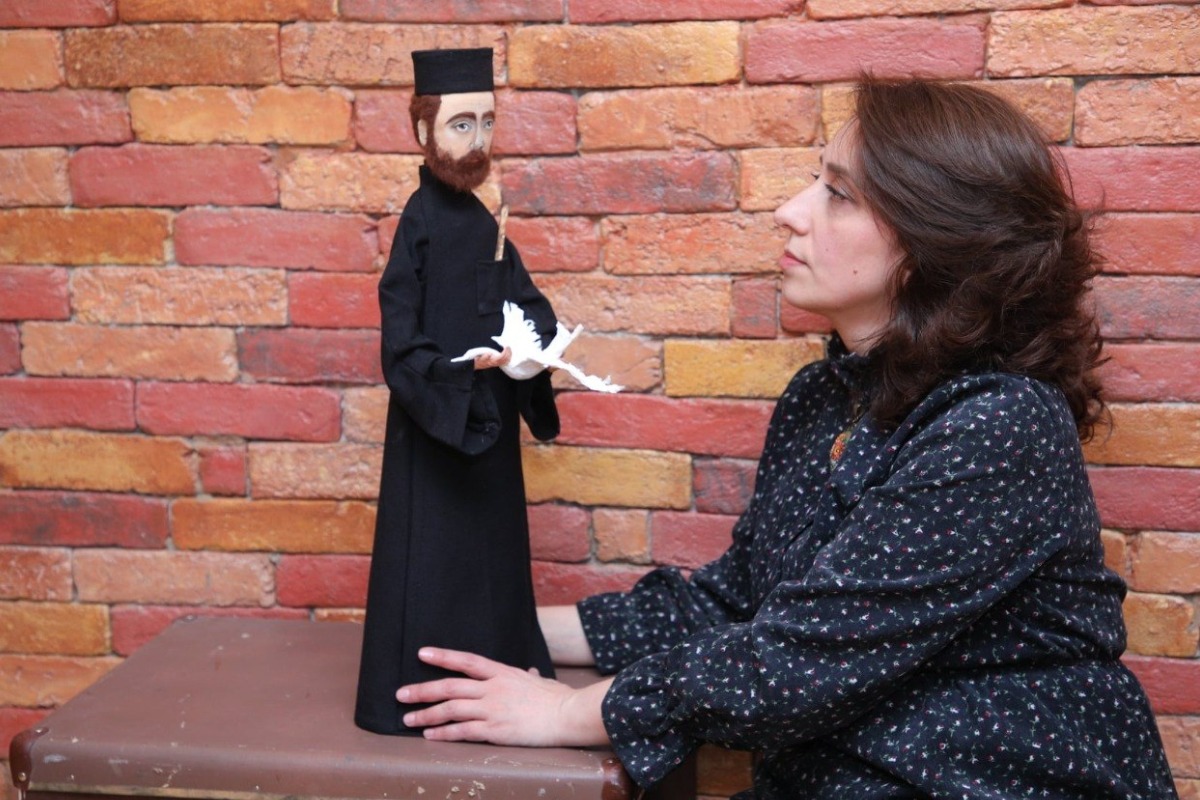
“We all come from our childhood.” For Lusine Santrosyan, deputy principal of Nor Hachn Basic School No. 1 and a recognized folk master, this sentence is not just a poetic phrase but a life formula. Her story is a unique journey marked by creative silence, pedagogical discipline and, ultimately, a spiritual rebirth embodied in her Nazare dolls.
The 7-year-old girl silenced by a teacher’s words
Lusine’s creative roots lie in “paradisiacal Dilijan.” The forest flowers brought by her father and the paints gifted by her mother were inseparable parts of her childhood. She created her own fairy-tale world, painting and crafting her first theatrical dolls so that games with neighborhood friends would be more vivid.
However, Lusine’s creative path was abruptly cut short at the age of 7. While studying at the Dilijan School of Art, a stern sentence from her first teacher — “If you can’t keep up with your schoolwork, don’t come to art class” — proved fateful. For the high-achieving and stubborn girl, it was such a devastating blow that she returned home in tears and never looked back. Even her beloved paints and albums were left behind at the school. From that day on, the dollmaker within her fell silent for decades.
That silence was replaced by a career in pedagogy. Since 1994, Santrosyan has found her place in education. Although she loved her work, there was always an inexplicable void within her.
“It was like a Lego picture where the most important piece is missing. It was a state that felt half-empty, half-happy and fruitless,” she told the Weekly. For years, the school served as a place for self-education and struggle, where she directed plays and brought a creative spirit to everything, but the “missing piece” of her soul remained elusive.
Advertisement
The turning point at 40 and the “spiritual Wi-Fi”
The turning point came at age 40. It wasn’t a planned decision but an internal inevitability: Her hands were searching for materials. Encouraged by her daughter, Santrosyan returned to her childhood, met that 7-year-old girl and started anew. It was then that the “missing Lego piece” finally fell into place.
Thus, the Nazare brand was born. While the name was inspired by a famous Armenian cartoon, the content was much deeper. “To make your dialogue with the universe work, you must first penetrate your own roots. That is the password to our spiritual Wi-Fi,” Santrosyan said. Her dolls are ritualistic, carrying the Armenian genetic code and acting as a bridge between the past and the present.
Arzni regional festival of Armenian and national minority Culture in Armenia and a collection of Nazare dolls.
The doll as penance
For Lusine Santrosyan, dollmaking is not merely a craft; it is a “path of light” and an act of penance. She believes dolls have memories and transmit energy; therefore, she never touches her materials unless she is internally at peace.
The most beloved and weighty moment is crafting the face: “The moment I finish, we smile at each other, and I say, ‘So, this is who you are.’” Although it was difficult to part with her works at first, today she knows that by letting go, she multiplies. Today, her dolls grace the Museum of the History of Yerevan and have flown to various corners of the world.
Showcasing Nazare dolls at the Dilijan art and craft festival.
The war’s interruption and the title of folk master
Santrosyan’s path has also passed through pain. After the 44-day war, the eyes of her dolls turned out so sad that she was forced to take a long break. However, the nature of the creator eventually triumphed over the sadness.
In 2023, she received the title of folk master. She had applied at the last minute, urged on by a friend. But for her, the title was not a destination but a responsibility. “A title is like a university diploma that you put on a shelf, but that internal sense of incompleteness — the feeling that you can always do more — remains. That is what drives you forward. If I stop creating, I will stop breathing spiritually.”
At school, Santrosyan is a demanding deputy principal who teaches her students to live with a “soldier’s mindset.” However, in her studio, she is absolutely free. There is always a large sheet of paper on her desk, where “scribbled” ideas eventually transform into angels. “The first condition for creativity is freedom. How can you soar if you are constrained?”
The final station
When Lusine Santrosyan is asked about her most desired destination, she gives a deeply spiritual answer: “My final station is the station where I meet God.” Until then, her Nazare dolls continue their luminous flight — as small pieces of the master’s essence that will speak for her for years to come.
Nazare dolls by Lusine Santrosyan


