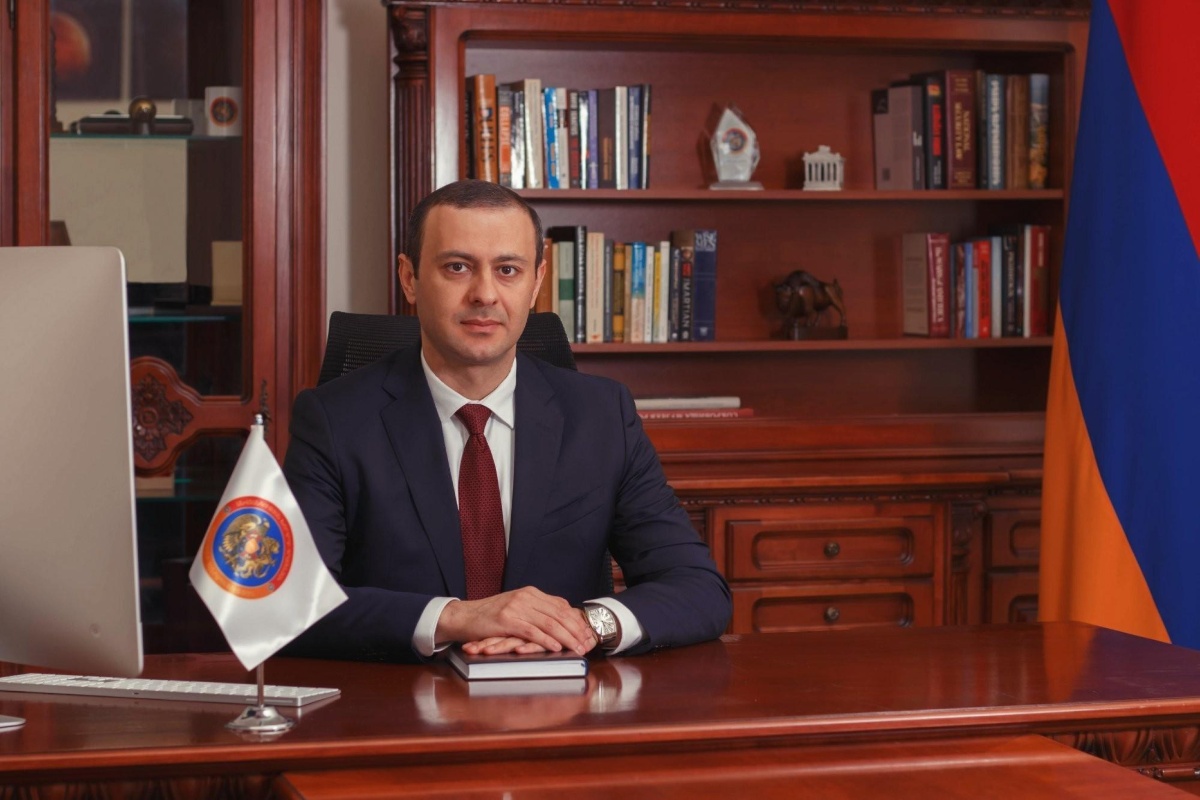
YEREVAN — Former Security Council secretary Armen Grigoryan’s public criticism of Armenia’s European integration policy has prompted a broader debate about the country’s strategic direction and the decisions made during his eight years in government.
In a Nov. 11 article titled “The Illusion of EU Membership,” published by MediaLab, Grigoryan argued that Armenia’s pursuit of European Union membership is unrealistic and could ultimately strengthen the country’s dependence on Russia. In a subsequent Nov. 13 interview with CivilNet, he maintained that he had raised these concerns with Prime Minister Nikol Pashinyan and other senior officials while still serving as Security Council secretary.
His statements come three months after his dismissal in August 2026 and less than two weeks after Pashinyan suggested that Armenia could realistically submit an EU membership application in 2027 or 2028.
Grigoryan’s interview has also drawn attention to previously undisclosed details about Armenian-Azerbaijani tensions in spring 2025, including his assertion that the security situation was serious enough for the U.S. Embassy in Yerevan to discuss evacuation.
A disagreement that predates his dismissal
Grigoryan served as secretary of Armenia’s Security Council from 2018 until Aug. 13, 2026. His dismissal was followed in September by his appointment as a senior adviser at Policy and Management Consulting Group, an international consulting firm involved in assessing the U.S.-backed Trump Route for International Peace and Prosperity (TRIPP).
Advertisement
Grigoryan’s subsequent criticism has prompted speculation about whether his departure from government marked the beginning of a wider political disagreement with Pashinyan.
Ruling-party lawmaker Sona Ghazaryan confirmed that Grigoryan’s position had been known within Civil Contract. Earlier media reports had described internal disagreements over the potential economic consequences of Armenia’s European ambitions.
During his CivilNet interview, Grigoryan said he had tried to persuade the prime minister and other government members not to proceed with the EU membership agenda. Asked why he had not resigned, he defended his decision to remain in office, arguing that he could continue advocating his position from within the government.
The government adopted its law initiating the EU accession process in March 2025, more than a year before he left office. Grigoryan now argues that this legislation exposed Armenia to increased geopolitical pressure and reduced its capacity to pursue an independent foreign policy.
If these concerns were presented internally, their treatment within the government remains unclear. Neither Grigoryan’s article nor the publicly available account of his interview establishes which specific recommendations he submitted, how they were evaluated or whether alternative policies were formally considered.
Spring 2025 revelations
One of the most consequential aspects of Grigoryan’s CivilNet interview concerns the security situation between Armenia and Azerbaijan in March and April 2025.
The former Security Council secretary said he had been negotiating with Azerbaijani presidential adviser Hikmet Hajiyev amid concerns about a possible military escalation.
On March 13, 2025, Armenia and Azerbaijan separately announced that negotiations on the text of their peace agreement had been completed. Armenia’s Foreign Ministry confirmed that Yerevan had accepted Azerbaijan’s proposals concerning the final two unresolved articles. Those provisions concerned the mutual withdrawal of interstate legal claims from international courts and a prohibition on the deployment of third-party forces along the Armenia-Azerbaijan border. The latter was especially sensitive because of the presence of the European Union Mission in Armenia (EUMA) on Armenia’s side of the border.
The agreement on these provisions was presented as an important diplomatic development. Nevertheless, Azerbaijan continues to maintain additional conditions for signing the treaty, including demands concerning Armenia’s Constitution.
Government concessions and Grigoryan’s responsibility
Azerbaijan specialist Tatevik Hayrapetyan has criticized Grigoryan’s revelations, arguing that his remarks expose serious shortcomings in the Armenian government’s approach to negotiations with Azerbaijan.
Hayrapetyan argued that Grigoryan’s disclosure about the threat of military escalation directly challenges the government’s position that concessions and bilateral negotiations were reducing the likelihood of renewed conflict.
She further maintained that U.S. diplomatic intervention had been instrumental in preventing another confrontation, underscoring what she described as Armenia’s inability to deter Azerbaijani aggression without external involvement.
According to Hayrapetyan, the government’s reliance on negotiations without sufficient security guarantees or military preparedness has allowed Azerbaijan to maintain pressure while introducing additional demands. She argued that Baku has benefited from prolonging the negotiating process rather than committing to a final settlement, pointing to the fact that the agreement, initialed under US mediation in August 2025, remains unsigned.
Her criticism also extended to Grigoryan personally. Hayrapetyan emphasized that the former Security Council secretary had participated in and supported the government’s security policy throughout his tenure and could not distance himself from its consequences simply because he had been dismissed.
European integration and dependence on Russia
Grigoryan’s central argument is that Armenia’s declared pursuit of EU membership may produce the opposite of its intended effect. He contends that attempts to move closer to Western institutions have historically triggered Russian retaliation, ultimately reinforcing Moscow’s influence over Armenian political and economic affairs. His article refers to Armenia’s 2013 decision to abandon a planned Association Agreement with the EU and instead join the Russian-led Customs Union, a process that subsequently led to membership in the Eurasian Economic Union (EAEU).
Grigoryan believes a similar pattern could emerge today. His proposed alternative is a foreign policy based on broader diversification, including cooperation with the EU, the United States, India, China, Iran and other partners, without treating formal EU membership as an overriding objective.
Armenia has expanded cooperation with Western countries without becoming an EU candidate state. The withdrawal of Russian personnel from Zvartnots Airport, the deployment of EU civilian monitors, military cooperation with European states and the development of closer relations with Washington demonstrate that diplomatic diversification does not necessarily require a formal accession process.
Grigoryan cites many of these developments as evidence that Armenia could reduce its dependence on Russia before adopting the EU accession law. Among the examples he presents are proposals to establish additional Russian cultural centers, possible Russian involvement in infrastructure projects and a reported increase in electoral support for political forces he characterizes as pro-Russian.
Russia’s gas leverage
The debate over Armenia’s foreign policy direction has acquired immediate economic significance as the country approaches the winter of 2026-27. Russia remains Armenia’s principal supplier of natural gas and exercises considerable influence through Gazprom’s ownership of the country’s gas distribution infrastructure.
According to Armenian energy-sector data, Russia supplied approximately 2.23 billion cubic meters of natural gas in 2025, while Iran provided approximately 476 million cubic meters through the gas-for-electricity arrangement.
In May 2026, Russian officials warned that Moscow could suspend or terminate arrangements providing Armenia with preferential supplies of natural gas and other commodities if Yerevan continued pursuing EU membership.
On Nov. 9, Armenian Territorial Administration and Infrastructure Minister Davit Khudatyan confirmed that correspondence from Russia left open the possibility of a gas-price increase, including for political reasons.
An October assessment prepared by the four other EAEU member states estimated that suspension of Armenia’s participation in the bloc could increase the calculated import price of Russian gas from approximately $177.50 to $300 per thousand cubic meters, an increase of around 69%. The report also projected substantial declines in trade and economic output. Increased import prices could raise production expenses for Armenian businesses and eventually affect consumer prices.
A complete interruption of Russian gas supplies would create a more serious challenge. Armenia has limited capacity to replace Russian volumes quickly, especially during winter, when heating demand rises. The country’s dependence on imported gas extends beyond residential consumption to electricity production and industrial activity.
Iran’s expression of willingness to supply liquefied petroleum gas and participate in constructing an Armenian oil refinery represents another potential area of cooperation, but neither proposal constitutes an immediate replacement for the natural gas volumes supplied by Russia.
The constitutional debate
Grigoryan said discussions about including EU membership in Armenia’s proposed new Constitution were the reason he decided to speak publicly. The initiative was advanced by Aram Sargsyan’s Republic Party, which proposed establishing European integration as a constitutional objective.
Grigoryan argued that including EU membership in Armenia’s Constitution could effectively constrain future governments, as joining the EU requires approval from all member states.
European Commissioner for Enlargement Marta Kos reiterated that Armenia’s government must decide whether to submit an application, while the EU’s member states would determine how to respond. Consequently, the political debate is taking place before Armenia has entered the formal accession process.
Grigoryan argues that progress following the 2018 Velvet Revolution has slowed and that elements of democratic stagnation or regression have become increasingly apparent. He further suggests that Armenia’s European ambitions can create an environment in which government shortcomings receive less scrutiny because criticism is perceived as undermining a larger geopolitical objective.