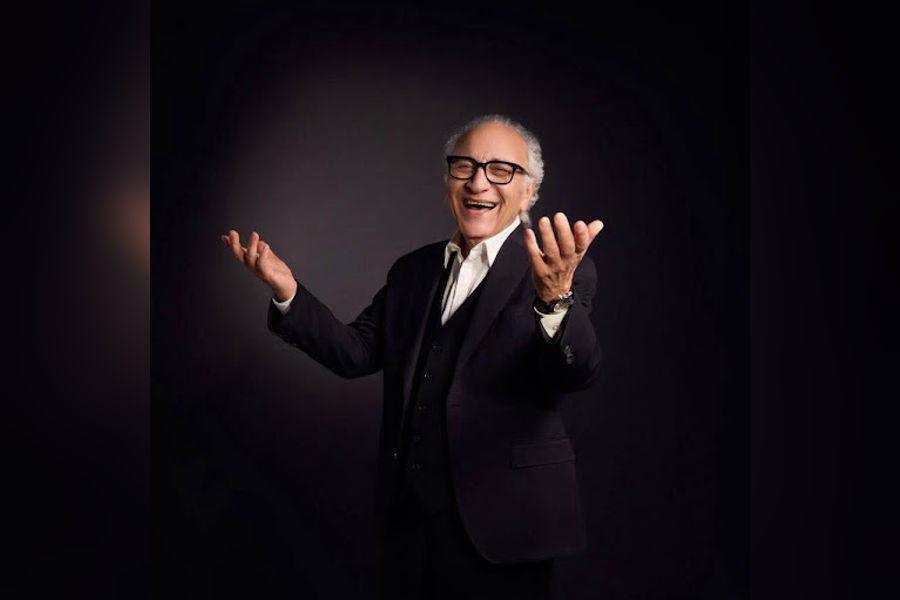
Beloved by Iranian and Armenian fans worldwide, Martik Kanian, popularly known as Martik, is truly a musical icon.
With his velvet voice (or “makhmali”), he blends poetic ballads, romantic guitar melodies and high-energy dance beats across a variety of styles and genres.
Recently, Martik has delighted fans with new music, such as singles “In Che Haleh” and “Tahammolam Kon,” and is currently on an eight-city North American tour, offering audiences the chance to sing and dance to his biggest hits!
The Weekly caught up with Martik ahead of his New York concert to talk about his new music, legendary career and current tour.
This interview has been edited for length and clarity.
Rosie Nisanyan (R.N.): How did you get started in music?
Martik Kanian (M.K.): I was born in Abadan, in southern Iran. My family was Armenian, and they were very musical. My dad was a singer, my grandfather was a singer, my sisters sang. When I was a little kid, they would sing Armenian folk songs for me. But at five years old, I didn’t like anything but American rock and roll. I saw the movie “Rock Around the Clock” and fell in love with that culture — Bill Haley, Elvis, Little Richard; all of them. When I was 15, my dad retired from the British oil company and we went to the capital city, Tehran. That’s when I started to sing and play Farsi songs.
R.N.: Where do you find inspiration for your music, like your most popular song, “Parandeh”?
M.K.: “Parandeh” is over 35 years old now. I wrote that song when I was in Los Angeles, in Glendale. It was one of the first of my songs to become a hit, and after that, there was “Agheh Bargardi.”
I also sang songs by Persian composers, like Jahanbakhsh Pazooki, one of the greatest Iranian composers — I have an album of his songs. Also, Sadegh Nojouki, who’s a well-known Iranian composer — I sang a couple of his songs, too. They all helped my career.
I still hear the old songs I wrote in Iran, even after 50 years. This second generation is singing and playing my songs in Iran. A lot of musicians in Iran appreciate my music, and I am really thankful — that’s why I’m still in business.
R.N.: Do you have a favorite song to perform at concerts? Either one that everyone sings along to, like “Bahar,” or maybe one you personally prefer?
M.K.: There are so many; they’re like my kids! I love all of my kids! All the songs I perform at concerts are popular, and people truly love them. The audience gets a lot of good energy from the upbeat songs, which also have musicality. The beautiful lyrics are from Iranian lyricists like Masoud Fardmanesh, Zoya Zakarian and Jahanbakhsh Pazooki, who is a lyricist and composer. I’ve been very blessed that all these people still love me, we’re still friends, I’m still working and I’m so happy!
When I go to a concert and find an Armenian audience that may not understand Farsi, I play at least one Armenian song dedicated to my Armenian listeners.
Armenian songs are very close to Persian and Azeri songs, so everybody enjoys them.
Even many non-Persian speaking Persian-Armenians love my Persian songs. There were a couple of songs written by very big Persian composers, like “Gole Sangam.” Armenians who don’t speak Farsi still sing it.
I also sing American, Italian and Spanish songs. When I was a little boy, I would hear nice, romantic Italian or Spanish songs. I don’t understand the words, except “amor, amor,” but I enjoy it. Music is an international language.
R.N.: You’ve released some new music this year, like “Tahammolam Kon.” It’s a different style than your earlier pop songs — more ballad-like. Tell us about the new music and your creative process these days.
M.K.: The songs are ballads because the lyrics weren’t good for upbeat songs. Before COVID, I had someone taking care of my wife while I was at work, because she wasn’t feeling well. But when COVID started, the caretaker had to leave and I took care of my wife for about a year and a half. In between, when I had time, I would sit down with my guitar and come up with melodies.
For “Tahammolam Kon,” I decided to put an Argentine tango rhythm with my Farsi lyrics. I think people like it, but they need time to get familiar with it. Right now, people listen to all my oldies; even the second and third generations are still listening.
R.N.: You just kicked off your North American tour in September with performances in Los Angeles, D.C., Montreal and Toronto. And you’ll be in New York on November 15. How has the tour been so far?
M.K.: A good friend of mine who’s also an artist — he sings, plays piano and guitar, produces music — said that he wanted to do this tour with me. We’ve done a few sold-out shows already, and they’ve been very successful.
The crowds have been classy, with many nice people who sing most of my songs.
When I go to these concerts, they’re young people, like 30, 40, 50 years old. They’re all singing along with me — it’s a nice energy. I’m 76 years old, but I don’t feel 76 whatsoever when I go on stage.
My son Artin is also a good singer. Artin did a very classic American pop song during the L.A. concert and people went crazy. He sang “Can’t Take My Eyes Off You” and they loved it so much!
For many years, I did a lot of weddings, engagements, bar mitzvahs and bat mitzvahs for the Persian Jewish community in New York, so I’m excited to be back.
R.N.: How has the Armenian community supported you over the years?
M.K.: In Abadan, Iranian-Armenians were working in the oil company and we had an Armenian society. When I was nine or 10 years old, I started playing guitar and everybody in town knew me. When I was five, I sang Little Richard’s “Tutti Frutti,” and I still have the cassette of the recording. In the community, we were all into American and British music and I was good at that, so I became popular at five years old. Very spoiled! But unfortunately, there wasn’t any YouTube or anything.
When I went from Abadan to Tehran, they very quickly accepted me as an artist. I started singing in Farsi, and then in many other languages, because I love, love, love music!
The Persian, Armenian and Jewish communities — everybody — accepted me and gave me a lot of love and support.
I have maybe a hundred Farsi songs, but I also have an Armenian album. The name is “Hoosa,” which means “have hope.” I sang songs from Komitas, because I was brought up with [his] music. Also, Artur Grigoryan — he’s Armenian, born in Armenia. Unfortunately, he passed away a few years ago. He was a great composer, so I sang some of his songs on that album.
R.N.: Do you have any advice for aspiring musicians?
M.K.: Listen to all the classics; listen to jazz. Listen to good music, not just dance music. Listen to classical music and to beautiful Persian and Armenian folk music. Listening to good music can cure your soul and make you a nice person.
Tickets are available for Martik’s concerts in Vancouver, Canada, on November 9; Boston, Mass., on November 14; Westbury, N.Y., on November 15; and Atlanta, Ga., on November 16. You can listen to his music on Spotify, YouTube and more. Follow Martik on Instagram @MartikMusic and on Facebook @MartikKanian to stay up-to-date on new music and upcoming performances.