The stage was dark. Not the kind of theatrical darkness that suggests mystery, but a heavy one, filled with tension and Soviet gloom, lingering like damp wool.
A single beam of light fell on a door marked 34. For the numerically inclined, 34 is considered unlucky in many Eastern cultures, including Chinese, where the number four (四, sì) sounds like 死 (sǐ), meaning death. The door, central to the play, seemed suitably ominous.
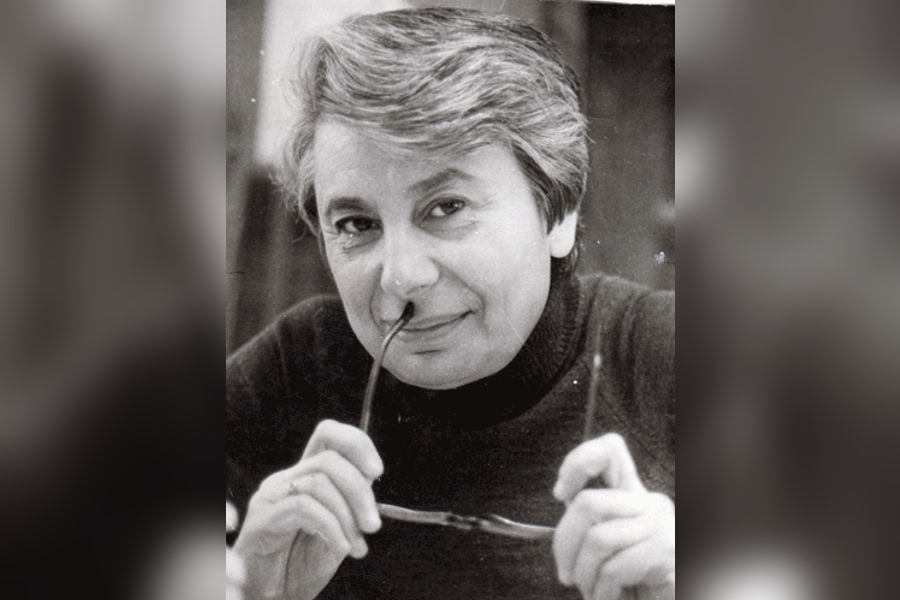
This closed door is the focal point of “Chewing Through Iron,” a documentary-style theatrical play exploring the life of singer-songwriter Elvina Makaryan and her slow erasure. Here, the dreaded number feels more than suitable.
This slideshow requires JavaScript.
Makaryan, a prominent Armenian singer in the late Soviet era, was known for her raspy, charming voice, her daring lyrics and her refusal to conform. Stories abound of her extravagant voice and rare talent; one claims that composer Aram Khachaturian called her a miracle after hearing her perform at the age of 16.
In a society that demanded conformity, being “miraculous” was another form of being “other.” In Soviet Armenia, like elsewhere in the USSR, otherness was tolerated only if it was quiet — and that was something Makaryan could never be.
In late-’80s Armenia — and perhaps even today — standing out could be enough to get one quietly removed.
I sat in complete darkness at the Mher Mkrtchyan Artistic Theater, watching Makaryan’s story unfold…but I could not see her anywhere. Playwright Anahit Ghazaryan and director Nadia Israelyan deliberately created distance between the audience and the singer.
This slideshow requires JavaScript.
Makaryan was nowhere to be found. Instead, another woman appeared on stage, an everyday figure dressed in Soviet vintage, holding an envelope and approaching the mysterious door 34.
She whispered to the locked door — secret advice.
“Just say sorry,” she murmured, as if addressing an untouchable idol. “Come, say that word — sorry,” the woman continued. “Say, ‘Yes, I was wrong,’…Say you’ll keep your mouth shut from now on…”
The play focuses on a vulnerable period in Makaryan’s life, 1987 to 1989, when the Communist Party effectively silenced her. They paid her salary on the condition that she wouldn’t show up for work — no formal charges or dramatic arrests. Her songs were taken off the air and her name was erased from broadcast schedules. She was barred from appearing at Armenian Public Radio, where she worked in the pop-symphonic orchestra. She was condemned to stay home and receive a salary delivered to her.
She was allowed to exist, but not for the public.
“Officially, there was no house arrest,” Ghazaryan told the Weekly. “There was a ban on appearing on the radio, where she worked, and there were threatening calls.”
“Chewing Through Iron” is Ghazaryan’s third theatrical work, created in collaboration with Israelyan and Misha Charkviani. Their documentary-style plays consists of three works so far: “Planned Outage” and “Download | Upload | Loveload.” All of these works, different in form and approach, revolve around Armenia of the late ‘80s and early ‘90s — a period stamped into our collective memory as “Mout ou tsourt tareener” (“the dark and cold years”) — a time that many wish to forget, yet perhaps need to see and feel.
The creative team for “Chewing Through Iron” was joined by producer Edward Mkhitaryan. The production is simple yet monumental: a locked door representing a woman forbidden from being seen, with other characters appearing briefly.
This slideshow requires JavaScript.
Characters parade before door 34 — some are colleagues, some are neighbors. They come to accuse, to provoke, to beg. Their insults are veiled as concern. What they all have in common is a desperate demand: for the woman behind the door to stop being different. But the door remains closed. There’s only one physical link to the woman inside: her mother. She haunts the door with groceries, muttering words of concern or disapproval as she watches others attack her daughter.
“You don’t always have to physically show the character to tell her story,” Ghazaryan explained. “In our case, not showing Elvina on stage helped to show her story, her essence and her path much better than if we’d find someone who’d try to copy her.”
Israelyan’s striking visuals and texts created an aura of disaster that lingered after the play ended. Her use of projections as a door allowed the audience to gaze upon this intimate drama within its socio-political context — further grounding the play in real-life events that some of us still remember vividly.
A scene from the production, “Chewing Through Iron”
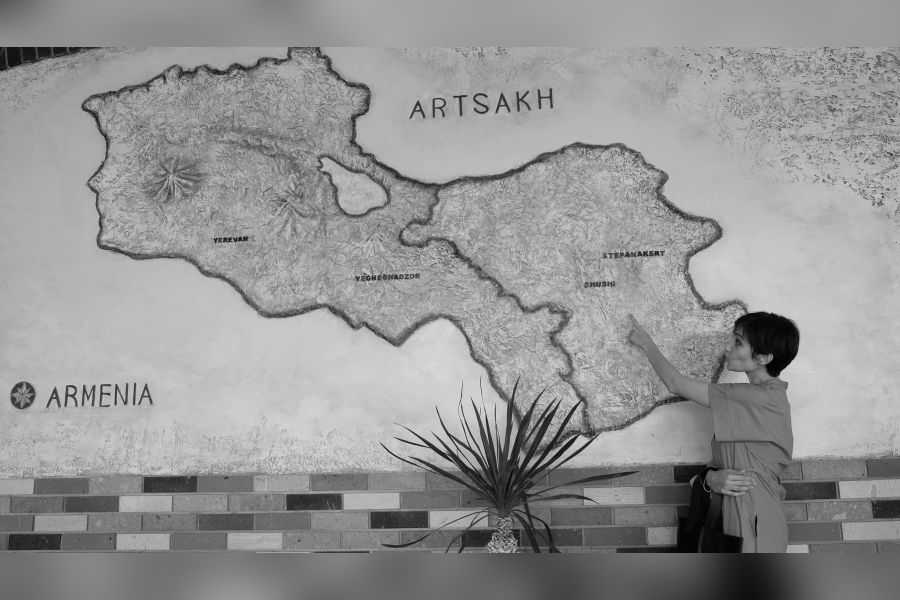
The context situates Makaryan’s life and disappearance within a broader map, to see how it coincided with national upheaval: the 1988 earthquake, the creeping collapse of the Soviet system, the shutdown of the Metsamor nuclear plant and the Artsakh movement.
Her private erasure as an artist mirrored the anxiety of an entire society at the intersection of catastrophe.
The play offers no happy ending. And though I knew it from the start, I still felt sad for the character, who remained behind the locked door while the society that once praised her left her bereft.
All photos are courtesy of Daniil Primak unless otherwise noted.
For more information about “Chewing Through Iron,” including upcoming performances, please visit the following website.