A critical book, “Armenian Historical Heritage of Material and Spiritual Culture of Nakhichevan,” by Argam Ayvazyan, was recently published in Yerevan. The 760-page book with over 1,000 pictures also includes studies by many other researchers and scholars. The benefactor of the publication is Gagik Gerasim Melikyan.
The volume includes the study of documented materials collected by the author from 1965 to 1987, as well as the Armenian heritage and cultural values of Nakhichevan.
The book is intended for specialists interested in Nakhichevan — an integral part of Armenian historical and cultural heritage — as well as broader reading circles.
Nakhichevan is one of the oldest centers of Armenian civilization in the Armenian Highlands, with a history of more than 3,500 years. The earliest references to it date to approximately 1539 B.C.
As a result of deliberate anti-Armenian racist policies of the Republic of Azerbaijan, Nakhichevan expelled the entire native Armenian population and destroyed thousands of Armenian monuments that had miraculously survived in the territory of Nakhichevan centuries of destruction up to the period 1998-2006, including monasteries, churches, cemeteries, inscribed khachkars, tombstones, fortresses, bridges, frescoes, miniatures, landscapes of the highlands, samples of applied art, ethnographic materials, etc. Thus, all vestiges of Armenia’s several millennia long Armenian presence and heritage were erased.
The book covers several themes: a brief historical overview of Nakhichevan, archaeological evidence, fortresses, towns, historical and architectural monuments, bridges, khachkars, miniatures, sculptural art in Nakhichevan’s architectural monuments, frescoes, national costume, carpet weaving, the population of Nakhichevan, its gavars (administrative units) and settlements, etc.
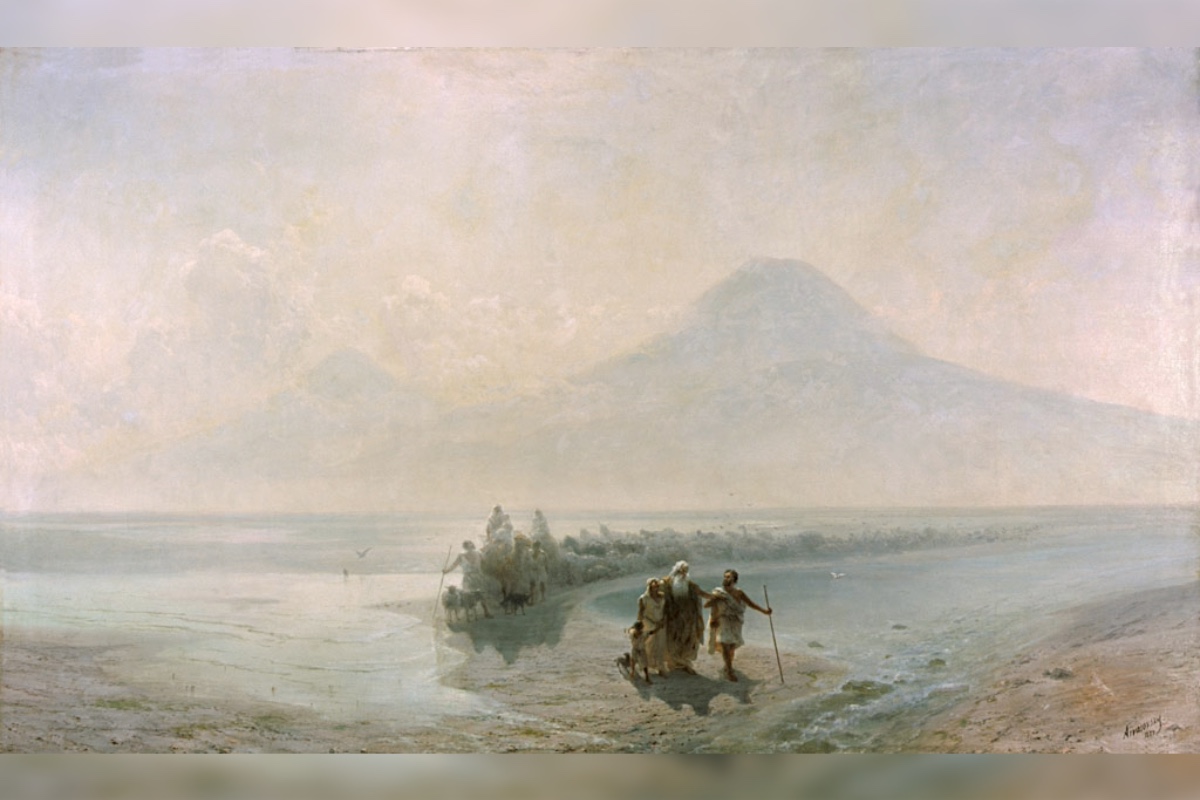
The history of Nakhichevan spans ancient and classical periods. According to tradition, the city was founded by the biblical Noah after the Flood, and the name “Nakhichevan” means “the place of first descent.”
From the second century B.C. to the 11th century A.D., Nakhichevan was an important center of the Armenian Kingdom under the Artashesid, Arsacid and Bagratid dynasties. It is also mentioned in the works of Ptolemy and Josephus Flavius.
Over the centuries, the region came under Arab, Seljuk and Mongol control. In the 12th century, it served as the capital of the Eldiguzid state.
In the 18th century, a semi-independent khanate was formed under Persian suzerainty. After the Russo-Persian War (1826–1828), the Treaty of Turkmenchay transferred the territory to Russia.
The history of Nakhichevan begins in the period immediately following the Great Flood. As early as the first century A.D., the great Jewish historian Flavius Josephus recorded a tradition according to which in line with the account of the biblical Noah’s arrival Nakhichevan is described as the place where Noah, after the receding of the waters, settled with his kin in these parts, founded a city and named it Nakhichevan, meaning “First Refuge”.
Nakhichevan was one of the most important centers of Armenian writing and literature, and the monasteries served as medieval universities. Among them is the school of Gladzor; although the university itself was located in Vayots Dzor, many of its prominent graduates were originally from Nakhichevan. The same applies to manuscripts:
- Saint Mesrop Mashtots: According to tradition, it was in these places that the creator of the Armenian alphabet, Mesrop Mashtots, worked on the Armenian script in 405–406 A.D., which greatly stimulated the development of Armenian culture and has exceptional value and significance.
According to the historian Koryun, Mesrop Mashtots opened a school in the village of Masrevan (Mesropavan) in the province of Goghtan and lived there for several years with his students. For centuries, unique illustrated manuscripts were copied in these places.
- Saint Thomas (Agulis): In the 17th century, the monastery became an educational center where not only clergymen but also merchants received an education, studying languages and philosophy.
The Jugha khachkars of Old Julfa represented the pinnacle of Armenian stone art. Unlike classic Armenian khachkars, the Jugha khachkars were narrower, taller and crowned with “crowns.” In addition to delicate geometric sculpture, they often depicted riders, feast scenes and biblical motifs, which were carved using a “carpetlike” ornamentation technique.
Of the more than 10,000 monument-khachkars recorded at the beginning of the 20th century, none remain in their place today; all have been destroyed, and only a few examples miraculously remain intact thanks to being moved to Holy Etchmiadzin.
It is known from history that in 1605, Safavid Shah Abbas I mass-deported Armenians to Persia, as a result of which approximately 300,000 Armenian residents were forcibly moved from Eastern Armenia, including Nakhichevan, to Iran; this was extremely destructive for the region’s development.
Shah Abbas, by devastating the border zone with the Ottoman Empire, primarily tried to deprive the Turkish army of the opportunity to conduct military operations against Persia. This effectively meant that at that time, Nakhichevan was a security zone for Iran.
At the end of the 18th century and the beginning of the 19th century, Nakhichevan was the capital of the semi-independent Nakhichevan Khanate.
In 1813, by the Treaty of Gulistan, Russia recognized Persia’s sovereignty over that khanate, but later, as a result of the Russo-Persian war, by the Treaty of Turkmenchay signed on Feb. 10, 1828, the territories of the Yerevan and Nakhichevan khanates were ceded by the Shah to the Russian Empire.
After the signing of the Treaty of Turkmenchay, Nakhichevan and the Goghtn districts (Vaspurakan province), Yernjak, Shahaponk, Jahuk (Syunik province), and part of the Sharur district (Ayrarat province) within Greater Armenia became part of the Armenian Oblast created by the Russian Empire, and after its dissolution, from 1849 until 1918, they were within the borders of the Erivan Governorate.
After World War I, in June 1918, Nakhichevan was occupied by Turkish troops, with whose support the pro-Azerbaijani Republic of Aras was proclaimed.
In January 1919, British troops entered Nakhichevan with the goal of ensuring stability in the region until the final resolution of territorial disputes at the Paris Peace Conference. Great Britain supported the creation of a temporary Armenian governor-generalship in Nakhichevan in May 1919 and officially demanded the local Muslim population to submit to the Armenian authorities.
The British command contributed to the dissolution of the pro-Azerbaijani Republic of Aras, facilitating the establishment of the Republic of Armenia’s control over this region in the spring of 1919. However, in the summer of 1919, Great Britain evacuated its troops from Nakhichevan.
Later, in March 1919, when the Turkish army was retreating from the Caucasus, Nakhichevan with its districts became part of the newly created First Republic of Armenia. However, as in 1918, the Musavatists, with the help of Turkey, succeeded at the end of April 1919 in again separating Nakhichevan from the Republic of Armenia.
On Nov. 29, 1920, after the Sovietization of Armenia, the Revolutionary Committee of Azerbaijan, by a special declaration on Dec. 1, 1920, announced that it renounced the disputed territories with Armenia and that “Nagorno-Karabakh, Zangezur, and Nakhichevan are recognized as inseparable parts of Armenia”.
However, historical truth, constitutional and national rights were crudely violated, as happened in 1918-1919. Azerbaijan, failing to fulfill the obligation assumed by the declaration, again as a result of Turkey’s intervention, began to demand the inclusion of Nagorno-Karabakh and Nakhichevan within its composition. Turkey insisted that Nakhichevan not be part of Armenia, viewing the region as a strategic barrier and a “door” to the Turkic world. The Bolsheviks sought to win over Kemalist Turkey to their side in the struggle against the Entente, and the concession on the Nakhichevan issue became part of the compromise to strengthen that alliance.
As a result of the pro-Turkish and pro-Azerbaijani policy of the Soviet government, in accordance with the illegal decisions made during the Soviet-Turkish negotiations and the decision of the Kavburo of July 5, 1921, Nakhichevan and Nagorno-Karabakh were forcibly attached to Azerbaijan.
Thus, based on these anti-historical, anti-constitutional, and anti-national decisions, in February 1923, Nakhichevan was formed as an autonomous region, and a year later, on Feb. 9, 1924, it was included in Azerbaijan as an autonomous republic, with which it has no common borders.
On March 16, 1921, the Treaty of Moscow “on Friendship and Brotherhood” was signed between Russia and Turkey, according to which the Nakhichevan region became an autonomous territory under the protectorate of Azerbaijan.
According to this treaty, Azerbaijan did not have the right to transfer this protectorate to a third state (referring to Armenia).
Later, the provisions of the Treaty of Moscow were confirmed by the Treaty of Kars signed on Oct. 13, 1921, with the participation of the Soviet republics of Transcaucasia — Armenia, Georgia, Azerbaijan — and Turkey. This finally fixed the status of Nakhichevan as an autonomous territory of the Azerbaijan SSR.
In 1921, Armenians still constituted a significant part of the region’s population (about 15-40% in various districts), but during the Soviet period, their numbers continuously decreased due to administrative pressures, the closing of Armenian schools, and economic difficulties, which led to the complete disappearance of the Armenian population by the end of the 1980s.
Until 1932, the Nakhichevan Autonomous Republic bordered only Armenia and Iran, but Turkey always cherished the idea of opening a Turkish corridor to Nakhichevan – later to cross the territory of Armenia through Syunik and establish a direct connection with Azerbaijan and the Turkic states of Central Asia to realize the pan-Turkist idea of Great Turan.
The occasion for this was the events of 1927-1930, when during the uprising by Kurds against Kemalist Turkey, a self-proclaimed Kurdish entity arose, and armed Kurdish detachments began to actively operate on the slopes of Mount Ararat.
In 1930, Turkish troops, pursuing the rebels, entered the territory of Iran in the area of Little Ararat (Sis peak) to, as they declared, ensure the security of their borders and fully control the strategic heights of Ararat, depriving the rebels of the opportunity to use the border as a rear.
Turkey demanded a revision of the border line and began to actively push the idea of an exchange of territories: Kotur Valley in exchange for Little Ararat (Sis peak).
The result of this process was to be the possibility of a direct connection between Turkey and Nakhichevan as a result of the work of the Turkish-Persian demarcation and delimitation commission.
As a result of that work, the Kotur Valley, which previously belonged to Persia and was temporarily occupied by the Turks, was to be returned to Iran. In exchange, Turkey received Little Ararat (Sis peak), including its eastern slope and adjacent territories with an area of about 840 square kilometres, which gave it the opportunity to fully control the Ararat massif and the land corridor to Nakhichevan.
This territorial exchange was fixed by the Border Agreement of Tehran signed on Jan. 23, 1932, between the Republic of Turkey and the Imperial State of Iran, which laid the foundation for the modern borders of the two states.
For Armenians, Mount Sis (Little Ararat, 3,611 meters), which has not only strategic but also sacred significance, ended up in the territory of Turkey not as a result of an equivalent exchange since the Kotur Valley originally belonged to Persia and was already occupied by the Turks but as a result of the short-sighted and wrong policy of the Iranian leadership.
In subsequent years, Azerbaijan pursued a targeted policy aimed at the destruction of Armenian cultural heritage monuments and the displacement of the Armenian population from Nakhichevan, populating that territory with Azerbaijanis.
After the Sumgait genocide of 1988 and the massacres in Baku, Armenians were mass-expelled from Azerbaijan, including Nakhichevan (at that moment, more than 160 villages were still populated by Armenians), and in the following years, all remaining Armenian historical monuments were finally destroyed.
The state policy of falsifying history was purposefully continued by Azerbaijan, and in connection with this, specific mechanisms can be distinguished that Azerbaijan uses for the appropriation of cultural and historical heritage:
- Linguistic manipulation: Azerbaijani historiography tries to separate the name “Nakhichevan” from its Armenian etymological root (connected with Noah and “first descent”), replacing it with Turkic or other interpretations.
- “Albanization” theory: All those Christian monuments that cannot be physically destroyed are declared not Armenian, but “Albanian.” This allows Azerbaijan to present itself as the heir of Caucasian Albania and claim those monuments, while simultaneously accusing Armenians of “Armenianizing” them in later times.
- Physical erasure of traces: As already mentioned, the destruction of thousands of khachkars in Jugha was “necessary” precisely to eliminate the material evidence that testified to the centuries-old presence of Armenians. No monuments — no history.
During the last 30 years, Azerbaijan has carried out the destruction of Armenian spiritual and cultural heritage, especially on the territory of the Nakhichevan Autonomous Republic, where 89 Armenian churches, 20,000 tombstones, and more than 5,000 khachkars were destroyed.
This book presents to the fundamental study authored by Argam Ayvazyan, “Heritage of Armenian Historical Material and Spiritual Culture of Nakhichevan,” concerning the history and architecture of Nakhichevan, which is illustrated with photographs of temples, churches, khachkars and other architectural monuments.
The goal of this research is to present and analyze Nakhichevan’s rich spiritual and cultural heritage in a historical context, which is an inseparable part of Armenia’s spiritual heritage, and to provide the reader with information that is an important source for clarifying many complex pages of the Armenian people’s history.
The materials presented in this study show how the Nakhichevan region has played an exceptional role over centuries in the formation of Armenian statehood, writing and literature, science, culture and art.
The prominent Armenian scientist Argam Ayvazyan has dedicated his entire conscious life to the study of Nakhichevan’s rich and unique Armenian historical-cultural heritage.
It is known that after the establishment of Soviet power, Nakhichevan was included in Azerbaijan as an autonomous region, which for decades pursued a state-targeted policy of destroying the Armenian cultural heritage of this region.
For Soviet Armenian scientists and intelligentsia, visiting Nakhichevan was inaccessible; moreover, the life and future of the local Armenian population were under constant danger, while numerous cultural values stood constantly on the edge of destruction.
Argam Ayvazyan, being a native of Nakhichevan, has occupied all his life with the study of his homeland’s historical-cultural heritage. Ignoring various obstacles created by Azerbaijan, the scientist recorded not only the destroyed but also the partially preserved monuments of monumental architecture and art — khachkars, bas-reliefs and sculptures — the monuments on-site.
Ayvazyan performed a colossal scientific work: he prepared and published fundamental works dedicated to the history, culture, architecture, mural painting, Jugha khachkars and manuscripts of various historical periods of Nakhichevan.
The scientist’s special merit is the collection and publication of the region’s epigraphic heritage in the book “Epigraphic Heritage of Nakhichevan.” It should be noted that this monumental work, consisting of six volumes, contains more than 4,000 lithic inscriptions dated from the ninth to 19th centuries, around 5,800 illustrations, drawings, maps and other materials. Being a scientist of wide interests, he also published a fundamental study in the field of Armenian dialectology titled “Relics of the Agulis Dialect”.
Argam Ayvazyan also compiled large-scale maps that record and locate the monuments of Nakhichevan’s Armenian culture: “Nakhichevan: Historical Testimonies (Map-Guide of Monuments)”.
Ayvazyan’s popular science film “Broken Melody: Jugha” (2003), which is dedicated to Jugha and its unique art of khachkar-making, acquires special significance. This refers to the unique 4,500 khachkars of Jugha, about 800 of them are presented in the film, which Azerbaijan destroyed with bulldozers, leveling the ancient Armenian cemetery to the ground.
On the topic of Nakhichevan alone, Ayvazyan is the author of 48 books — monographs, catalogs and collections — two ethno-cultural maps, and more than 300 scientific, encyclopedic and popular science articles.
The book substantiates the necessity of recording the region’s Armenian heritage under conditions of systematic destruction.
The author systematizes information especially about the churches and khachkars of the Jugha cemetery, describing the lost monuments through archival materials and photographs. The book has the structure of a scientific catalog; it includes the region’s history, architectural monuments and visual testimonies of the cultural landscape, serving as a tool for studying the destroyed heritage.
Historical continuity: Nakhichevan is viewed as one of the cradles of Armenian civilization, whose history is traced from the times of the Kingdom of Van (Urartu) until the late Middle Ages.
Architectural uniqueness: The uniqueness of the local architectural school is emphasized, including the famous khachkars of Jugha, monasteries, and churches, which for centuries formed the region’s image.
The problem of heritage preservation: The tragic fate of the monuments is also an important theme. The author points out the systematic destruction of the Armenian cultural layer in the region, which makes the book not only a scientific work but also a documentary study documenting and recording the lost spiritual and cultural heritage.
Argam Ayvazyan’s book “Heritage of Armenian Historical Material and Spiritual Culture of Nakhichevan” is extremely important not only from a scientific but also from a political and source-study perspective. Besides the purely scientific goal, it also has a cognitive significance and acquires exceptional value, especially in the context of Azerbaijan’s state-level policy of denying the Armenian origins of Nakhichevan’s historical and cultural monuments.