Western Thrace — or Greek Thrace. The very name suggests that a visit there can feel like a journey into the past. I had come to this region for five days as part of a project aimed at digitizing archival materials related to the history of Armenians in Greece. A few years earlier, the Berlin-based Houshamadyan organization, in collaboration with the Armenika association in Athens, had received a grant from the British Library to carry out this project. After successfully completing the work in Athens, Kokkinia and Thessaloniki, our team had now arrived in Western Thrace to locate and digitize Armenian written traces here as well.
Members of the Athens team — Mike, Anaïs, and Reverend Vicken Cholakian — had already been in the region for a week, working on the digitization of Armenian communal materials preserved in various cities of Western Thrace. These included, in particular, refugee registers compiled by local Armenian community councils from the 1920s onward, containing detailed information on newly arrived individuals. There were also minutes of council meetings, correspondence — often dating back to the 19th century — and archives of other Armenian organizations, including charitable, athletic, cultural and educational associations. In addition, lists of Armenians who emigrated to Soviet Armenia in the 1940s, along with related correspondence, were also found.
Most of these materials are housed in Armenian church archives in Alexandroupoli, Kavala, Xanthi and Komotini. These archives are not preserved under optimal conditions, which explains why the British Library’s program is aptly titled “Endangered Archives.” Our presence in these locations aimed to digitize these materials in order to prevent their deterioration or disappearance and to ensure their preservation in digital form.
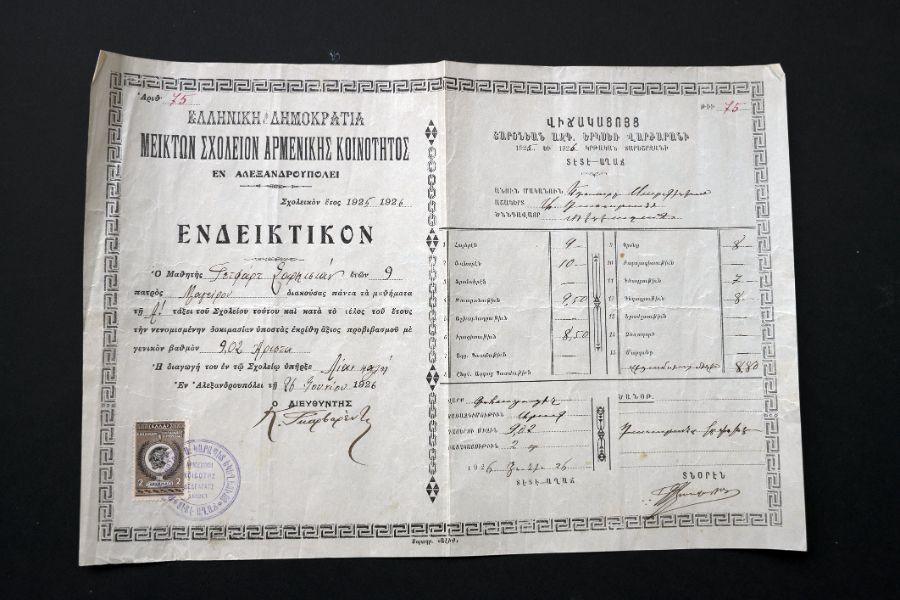
My task, together with Ani from Athens, was to conduct interviews with Armenian families living in the region, digitize historical materials in their possession — including photographs, documents and memorabilia — and trace their family trajectories. Many of these stories date back to the time before the mass arrival of Armenian refugees in Greece after 1922.
Thus, in Alexandroupoli, I met Lucy Sarkissian. She feels a slight apprehension when she learns that I will conduct the interview in Armenian. Lucy’s father is Armenian and her mother Greek, but it quickly becomes clear that she can express herself in Armenian with considerable ease.
Advertisement
Lucy Sarkissian
Lucy’s ancestors came from villages in Mush and arrived in Alexandroupoli in the 1870s, when the city was still in its early stages of development, at a time when it formed part of the Ottoman Empire and was known as Dedeagach. At first, only men from Mush came, working as laborers on the railway line that passed through the city. It is believed that these migrants from Mush were among the first Armenians to settle there, and their traces remain visible to this day. The Armenian church is called Surp Garabed, founded in 1875 in memory of the famous Surp Garabed monastery of Mush. For decades, the local Armenian school, Daronian, operated next to the church, named after the Daron region, the homeland of the people of Mush. Lucy vividly recalls expressions in the Mush dialect that she heard within her family, such as ch’m kina (“I do not know”) and ch’m ouzi (“I do not want”).
Alexandroupoli was our first stop. In the days that followed, our team visited Xanthi, Orestiada, Didymoteicho, and Komotini. In each of these places, we met Armenian families and conducted interviews with them. Throughout Western Thrace, one has the sense of being in a place quite different from the Greece of seas, islands, and ubiquitous tourists. The region feels more like a continuation of the Balkans, and despite the wars and conflicts of the past century, its population remains diverse. The Christian Bulgarians and the Jews have disappeared entirely, but alongside the Greek Orthodox population there still live Turks, Pomaks (Muslim Bulgarians) and Muslim Roma. Mosques are a common presence in both urban and rural landscapes. Armenians, too, are part of this mosaic, and it was for them that our team had come to Western Thrace.
Akis Dagazian was born in Komotini and now lives in Thessaloniki. He is deeply familiar with the history of his family and of the Armenians of Komotini.
“Until 1912, Komotini, then known as Gümülcine, and all of Western Thrace formed part of the Ottoman Empire. The city’s last Ottoman governor was the Armenian Mgrdich Efendi Tabakian, a well-known tobacco merchant. The family’s shop still exists today, and on its façade there remains an Armenian inscription from that time bearing the name Hagop Tabakian,” Akis explains.
In 1912, following the First Balkan War, the region passed under Bulgarian rule. It was only in 1920 that Komotini and the surrounding area were incorporated into Greece.
There is evidence of Armenian communal life in Komotini from the mid-18th century onward. The Armenian church, Surp Krikor Lusavorich, was built in 1834 and is located in the area historically known as the “Armenian quarter.” Akis notes that, at one time, all Armenians lived in this neighborhood. The current street names still bear witness to the former Armenian presence in this part of the city, including Ioannou Tsimiski (John Tzimiskes), the Byzantine emperor of Armenian origin; Leoforos Armeniou (Armenian Street); and Rupen Kevorkian, a member of the Komotini administrative council who, in 1920, played a decisive role through his vote in the efforts to attach the region to Greece. Komotini is also home to the current spiritual pastor of the Armenian Church of Western Thrace, Fr. Daniel Kaloghlian, who belongs to the Catholicosate of the Great House of Cilicia. It was in the hall adjacent to the Komotini church that, over nearly two weeks, the team from Athens was hosted, while the community council provided optimal conditions for the digitization of the archival materials collected in Western Thrace, amounting to approximately 7,000 pages.
This slideshow requires JavaScript.
Akis points out that today only two Armenian families remain in this historic Armenian quarter of Komotini. Armenian communal life here, and in Western Thrace more generally, was at its most vibrant in the 1920s and 1930s. It suffered its heaviest blow in the years following World War II. Between 1941 and 1944, Western Thrace once again came under Bulgarian rule, as Bulgaria was an ally of Nazi Germany. These were difficult years, during which the Jewish population was entirely deported, and the new authorities compelled inhabitants to renounce Greek citizenship and adopt Bulgarian citizenship instead. Bulgarian became the official language of the region, among other changes. None of this passed without consequence. When the Bulgarians withdrew and the Greek authorities returned, acts of revenge followed immediately. In such conditions, vulnerable minorities became the first targets, and Armenians were among them. Trials were launched against Armenians, often based on unfounded accusations, and various forms of pressure were exerted upon them.
Kohar Kurkjian (née Nazarian), from Xanthi, recounts that during those years her aunt Araksi was also imprisoned for six months on similar false accusations. This oppressive atmosphere became one of the main causes of Armenian emigration from Western Thrace. Many left for France, the United States and Latin America, but the majority migrated to Soviet Armenia, following the “repatriation” campaign launched by the Soviet authorities after World War II. Zabel Papazian, from Orestiada, recalls that her family had also planned to leave for Soviet Armenia. Everything was ready, and only the sale of their properties remained. Zabel’s father had two brothers, one of whom had also decided to emigrate. However, the third brother, who remained in Orestiada, opposed the sale and refused to allow the family’s properties to be sold to outsiders, while he himself lacked the means to purchase them. As a result of this disagreement, all three brothers ultimately remained in Orestiada.
Yet many did leave during those years. The mass emigration of Armenians from Western Thrace led to the closure of Armenian schools and the gradual fading of what had once been a vibrant communal life.
Unexpectedly, however, these communities experienced a new turn. About 50 years later, in the early 1990s, Armenian migrants began arriving from Armenia and other former Soviet republics. They brought renewed vitality, and communal life gradually revived. In this sense, those years marked the beginning of a new chapter in the Armenian life of Western Thrace.
A striking example of the coexistence of old and new community life was our team’s visit to Didymoteicho, known in Armenian sources as Dimotika. We were at the border with Turkey; to the east flowed the Maritsa River (Evros in Greek, Meriç in Turkish), forming a natural frontier. In the distance, one could see the massive barriers erected in recent years along the Greek border to prevent the passage of refugees. In Didymoteicho, on a hill, stands the Armenian church of Surp Kevork. There we met Zabel, Sonia and Boris, an Armenian migrant from Russia who in recent years has become the devoted caretaker of the church. As we were taking leave, Zabel said to us: “Do not forget us; we too are an Armenian community here.”
On our way back, Mike had the wonderful idea of organizing an annual group trip from Athens to this region. Participants would visit the places we had explored, experience the beauty of Western Thrace and become acquainted with both its past and present Armenian life.
This slideshow requires JavaScript.
For the history of the Armenians of Western Thrace, see the following works:
- Asadour H. Magarian, Memory Book of the Armenian Communities of Thrace and Macedonia, Thessaloniki, Horizon Daily Press, 1929, 640 pp. (in Armenian); Greek translation: Η Ιστορία των Αρμενικών Κοινοτήτων Θράκης και Μακεδονίας, Athens, Stamoulis, 2025).
- Tzeni Kasapian and Konstantinos Hatzopoulos, The Armenians of Komotini, Komotini, 2009, 544 pp. (trilingual edition in Greek, English, and Armenian).
- Leonidas–Levon Ntilsizian, Επί τα ίχνη της αρμενικής κοινότητας της Αλεξανδρούπολης–Δεδέαγατς (1875–2025) [Tracing the Armenian Community of Alexandroupolis–Dedeagach (1875–2025)], Athens, Armenika Association, 2025, 136 pp. (in Greek).