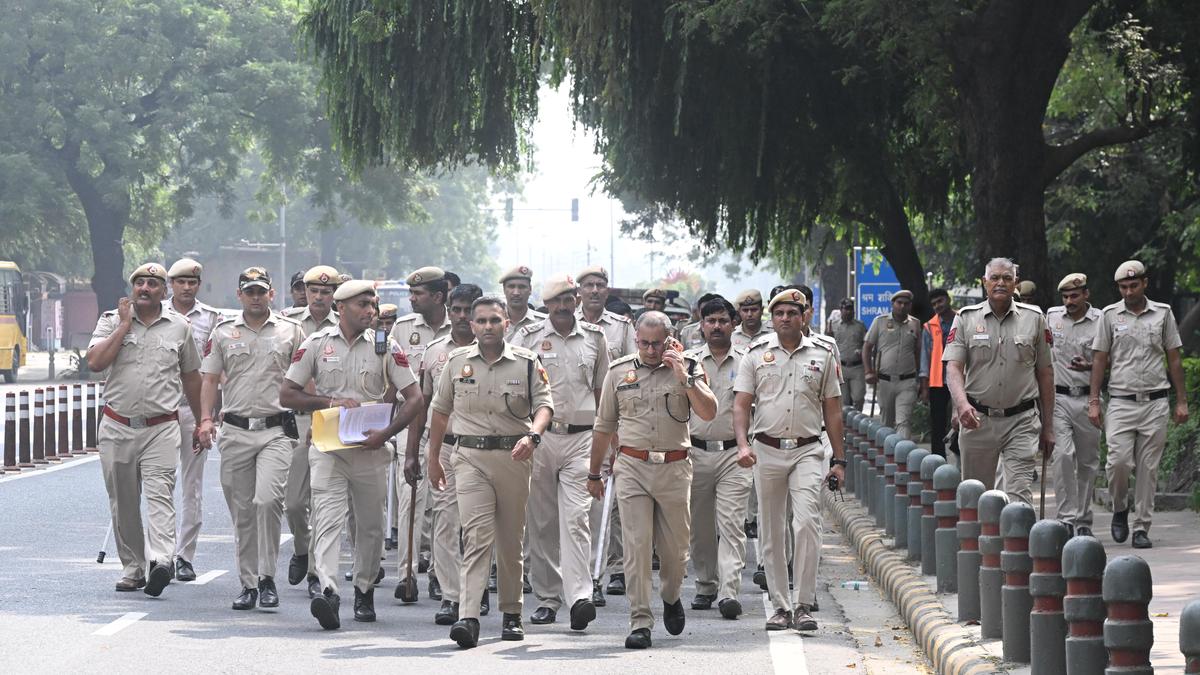
Security personnel patrolling near Jantar Mantar on October 10, 2026
| Photo Credit: Sushil Kumar Verma
The mobile internet shutdown, from 10 p.m. on Friday (October 9, 2026) through Saturday evening, compounded the disruption caused by the massive crackdown on attempts to protest in the capital. Digital payments all but ground to a halt — except in restaurants, shops and facilities equipped with WiFi — while protesters scrambled to call friends and family in other parts of the city, unable to send pictures or video.
The shutdown was ordered for a 4-kilometre radius centred on the intersection of Janpath and Kartavya Path, normally two of the busiest thoroughfares in the administrative heart of the city. It was geographically the largest curb in Delhi since the protests against the Citizenship (Amendment) Act, 2019, over half a decade ago.
The shutdown crippled gig workers’ operations in the capital, as many needed mobile data to take orders or even to resume work after finishing a delivery or a ride in the affected area. Google Maps was affected too: it had no up-to-date information on traffic restrictions or even traffic flow, as its real-time updates rely on crowdsourced data from users.
Through the afternoon, turn-by-turn navigation showed extremely long routes snaking around Lutyens’ Delhi, since removed restrictions could not be updated quickly, even in spots the police had cleared. The curbs also appeared to be enforced inconsistently, with some users of one telecom operator reporting that they had access until late in the afternoon.
The shutdown also appeared to be paired with a measure of censorship online, though its scale was difficult to establish immediately. The Congress party’s Seva Dal had its account on X, formerly Twitter, withheld. B.V. Srinivas, the Seva Dal’s chief organiser, had his Instagram handle blocked in India by Meta. Mr. Srinivas said he would move the Delhi High Court to challenge the blocking.
The Internet Freedom Foundation (IFF) condemned the shutdown, noting that the order had not been published despite a legal mandate. “The communication shared by [newswire agency] ANI invokes Rule 3 of these Rules, the same Rule that requires the order to be published. It is nevertheless marked ‘Top Secret’, the highest security classification used by the Government of India,” the IFF said.
“The government has placed no evidence before the public that a shutdown makes a protest safer,” the IFF said. “The available research is to the contrary, as a 2019 study of shutdowns and protest in India by Jan Rydzak, then at Stanford’s Global Digital Policy Incubator, found shutdowns ‘much more strongly associated with increases in violent collective action than with non-violent mobilization’.”
As of Saturday evening, curbs had been lifted at least partially, with data access restored in some parts of central Delhi.
Published – October 11, 2026 12:56 am IST