BRICS gatherings always trigger heated debates in India. The primary reason is the importance that the strategic and policymaking community, comprising both optimists and sceptics, attaches to this platform, of which India is an integral pillar. While optimists argue that BRICS could function as an institution capable of multipolarising the global order, or expediting that transition, sceptics highlight the grouping’s internal divisions and worry about its possible domination by Russia and China. A third group writes off BRICS altogether, dismissing it as little more than an annual gathering that generates strategic noise. They argue that India should be wary of close association with the grouping and instead focus on preserving and expanding its partnership with the United States, which, in their view, is the only viable path to India’s rise.
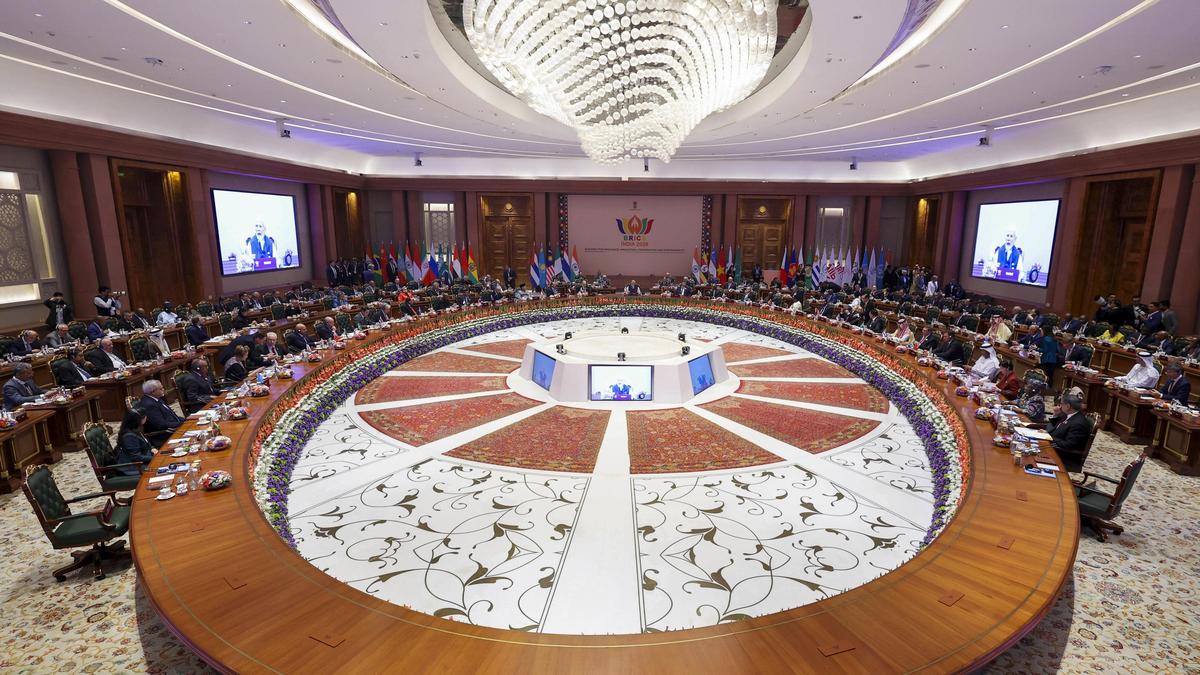
The 18th BRICS summit, held in New Delhi on September 12-13, 2026, attracted greater national and global attention because of its timing and location. It was the first BRICS annual summit since the U.S. and Israel launched their unprovoked war against Iran, in India’s extended neighbourhood, on February 28, 2026. The summit, which brought together the Presidents of Iran, Russia and China, among other leaders, was hosted by India, a close strategic partner of the U.S. and Israel.
Consensus in Delhi
Despite its internal contradictions and the broader chaos enveloping international politics, the summit can be seen as a success on multiple levels. That New Delhi could forge a consensus among the 11 member-countries, including the United Arab Emirates (UAE) and Iran, which are involved in an undeclared conflict, was itself an achievement. The Delhi Declaration shows that, despite their differences and even disputes, member-countries continue to find value in supporting a BRICS worldview rooted in the pursuit of a more representative global order.
The consensus was reached through compromises by all parties. Consider India’s position. Prime Minister Narendra Modi was in Israel just two days before Israel and the U.S. started bombing Iran. India initially refrained from condemning the attacks or the assassination of Iran’s Supreme Leader, Ayatollah Ali Khamenei. This created an impression that New Delhi was siding with the U.S. and Israel. India also watched from the sidelines as Pakistan seized on the diplomatic opening created by the war and stepped in as a mediator between the U.S. and Iran. But India quickly repositioned itself as a traditional balancer in West Asia.
Multilateral platforms such as the Shanghai Cooperation Organisation (SCO) and BRICS provided New Delhi with space to restore that balancing posture without causing strategic damage to its bilateral relationships. India strongly endorsed the Bishkek resolution of the SCO in September, condemning the strikes on Iran and expressing condolences to the country over the killing of Khamenei. It also hosted Iran’s President Masoud Pezeshkian for the Delhi BRICS summit, even as the war in West Asia grinds on. The image of Mr. Modi walking hand in hand with Mr. Pezeshkian is unlikely to fade any time soon in Washington or Tel Aviv.
Editorial | Building consensus: On the 18th BRICS Summit, the New Delhi Declaration
Second, while there is no immediate resolution to the border problems with China, which continue to simmer, there is momentum in efforts to reset ties. Multilateral forums such as BRICS provide a platform for India and China to remain engaged even when high-level bilateral visits are not taking place. Their differences are not going to disappear; they have to learn to manage their troubled relationship. History suggests that a lack of engagement between competing major powers can only deepen mistrust, while deepening mistrust, combined with the security dilemma stemming from their competition, could have dangerous consequences. So, it is important for India and China to stay engaged, bilaterally and multilaterally, creating guardrails for competitive coexistence.
Third, on all the major global issues of the present — artificial intelligence regulation, the rules governing global trade and finance, climate change, border conflicts, and the role and status of multilateral bodies — BRICS members may have different approaches and priorities, but they converge on the point that unilateralism by any bloc or power is detrimental to their interests and to the planet.
The Washington predictability
The context in which the Delhi summit was held is also crucial. The total predictability of the U.S. approach — rather than the unpredictability that some commentators labour to establish — towards the rest of the world is that it does not care much about anything other than its own dominance. Several BRICS members have had their own difficult experiences with the U.S., and they are trying to chart their own paths forward. India, a few months ago, was slapped with varying tariffs by Washington. India was also one of the countries most affected economically by the U.S.-Israel war on Iran. On September 16, the U.S. House passed the Russia sanctions Bill, seeking to impose tariffs of up to 100% on countries including India.
India’s foreign policy under Mr. Modi has been interpreted by a section of the strategic commentariat as an evident tilt towards the U.S. camp. Statements by Mr. Modi himself in the early years of his premiership that India had overcome its “hesitation of history” in ties with Washington gave further impetus to this view, though there has also been the parallel official formulation of ‘sabke sath’ foreign policy, or multi-alignment. India has always had a more complex view of history. And even if it has overcome its “hesitation of history”, it has not abandoned the hesitations of its strategic realism.
When India looks back at history and looks around the world today, it sees that countries that become frontiers in great-power rivalries often pay a huge price. If Pakistan’s story is not instructive enough, there are two live battlefronts that illustrate this every day — the UAE and Ukraine.
The UAE and Iran would have been better off dealing with each other than facing the situation in which they currently find themselves. The UAE-Iran bilateral meeting on the sidelines of BRICS in Delhi marks an acknowledgment of this lesson and a quest to use multilateral platforms to address bilateral challenges. Ukraine, which, backed by the North Atlantic Treaty Organization (NATO), has been fighting Russia for more than four years, does not have any such platform to maintain direct contact with Moscow — which leaves Kyiv’s diplomatic options totally dependent on the whims and wishes of Brussels and Washington.
India’s learning
This is not to argue that India should downgrade its relations with the U.S. The strategic partnership with Washington is extremely important for India’s progress and development, but what India must not allow itself to become, at any cost, is a frontline in the U.S.-China competition. BRICS enables India to pursue that path without having to champion an anti-U.S. agenda or undermine its cooperation with Washington. The U.S., which had come to terms with India’s firm adherence to strategic autonomy, has recently been pushing the envelope to draw New Delhi into a more subordinate relationship. For Washington, this is an ongoing theme. But India should pursue multiple pathways to its rise rather than succumb to the temptations of unequal great-power alliances.
While it is true that there are serious internal divisions among BRICS members, there is also a larger reality of external convergence of interests among them. BRICS is not an organisation like the G-7, where American primacy and the western order are accepted by all member-countries. Nor is it the case that every multilateral or plurilateral grouping is converging on all points.
The divisions within BRICS, to a certain extent, prevent any one country from dominating the grouping, while the external convergence of interests — their shared belief that the post-war international system is unfair and that a more representative order should be built — could hold the group together as it lays the foundations and builds the blocks of a new order. The dialectical relationship between internal contradictions and external convergence could ultimately produce a synthesis, which is increasingly evident in the case of BRICS. The contradictions within are therefore not a reason to question the grouping’s existence; they are, in fact, part of the reason why it should exist and flourish.
Published – September 24, 2026 12:16 am IST